The Breakfast Club (Follow Your Own Path)

Welcome to The Breakfast Club! We’re a disorganized group of rebel lefties who hang out and chat if and when we’re not too hungover  we’ve been bailed out we’re not too exhausted from last night’s (CENSORED) the caffeine kicks in. Join us every weekday morning at 9am (ET) and weekend morning at 10:30am (ET) to talk about current news and our boring lives and to make fun of LaEscapee! If we are ever running late, it’s PhilJD’s fault.

 photo 807561379_e6771a7c8e_zps7668d00e.jpg

This Day in History

First major battle in America’s Civil War fought at Bull Run in Virginia; Scopes ‘Monkey Trial’ concludes; Peace deal ends Indochina War; Author Ernest Hemingway and actor-comedian Robin Williams born.

Breakfast Tunes

Something to Think about over Coffee Prozac

No matter what people tell you, words and ideas can change the world.

Robin Williams

Breakfast News

Canada’s PM blocking climate reform, says Ontario premier Kathleen Wynne

The leader of Canada’s biggest province has escalated her feud with the country’s prime minister, accusing Stephen Harper of obstructing efforts to fight climate change and calling on Canadians to make global warming a decisive issue in the coming elections.

In an interview with the Guardian, Kathleen Wynne, the Liberal premier of Ontario, brought long-simmering tensions with Harper over energy and economic policy to a rollicking boil, repeatedly calling out the Conservative prime minister for blocking efforts to cut carbon pollution.

When it came to fighting climate change, Harper was an obstruction rather than a help, she said.

Italy violates human rights of same-sex couples, court rules

Italy violates human rights by not offering adequate legal protection and recognition to same-sex couples, a European court has ruled.

The decision by the European court of human rights increases pressure on the government of Matteo Renzi, the centre-left prime minister who has long promised to pass legislation recognising civil partnerships. Italy is the only major western European country that does not recognise either civil partnerships or gay marriage.

Efforts to move forward on the issue have made little progress since Renzi took office last year, and face significant opposition from Italian conservatives.

Which countries are still affected by US sanctions?

Trade sanctions in the US are administered by the Office for Foreign Assets Control (Ofac) and are often targeted at certain groups of individuals or companies within a country. An example is last year’s introduction of sanctions on government officials and specific energy firms within Russia.

There are also sanctions issued by world governing bodies that the US adheres to such as the UN security council restriction’s against Eritrea. However, embargoes or restrictions that apply broadly to one country and are independently taken by the US such as those for Iran and Cuba are much more rare. Including those two countries, there are only six to which comprehensive restrictions apply.

George Clooney seeks to expose those who fund and profit from wars in Africa

Hollywood actor George Clooney launched an initiative on Monday to track down and help bring to justice those funding and profiting from Africa’s deadliest conflicts, in a bid to fight corruption in war zones.

Clooney joined forces with US human rights activist John Prendergast in a project called The Sentry that aims to investigate the flow of money in and out of conflict zones and give policymakers the tools to take effective action.

Using data collection, field research and analysis technology, the initiative plans to expose how conflict is financed and profits laundered, with a website encouraging people to anonymously submit leaks and tips.

Clooney, 54, a campaigner who has led drives to highlight the plight of refugees in Sudan, and Prendergast said the aim was to “deny war profiteers the proceeds from their crimes”.

LA police discover arsenal of 1,200 guns in dead man’s home

Police investigating the death of a Los Angeles man uncovered an arsenal inside his home and garage more than 1,200 guns and about two tons of ammunition, authorities said on Monday.

Commander Andrew Smith of Los Angeles police department called the number of rifles, pistols and shotguns staggering. Many had never been fired and some were still wrapped in boxes, with price tags still attached.

“Our truck couldn’t carry it all,” Smith told the Los Angeles Times. “We had to go back and make another trip.”

There were no signs of foul play. Police have found no evidence the man, who has not been identified, was involved in criminal activity.

Police made the discovery after the man’s decomposing body was found in a car down the street from his home in the Pacific Palisades neighbourhood.

Detectives want to find out why he had so many guns and are examining the weapons to determine if they have been linked to any crime.

Less than 15% of US adults eat enough fruits and vegetables, CDC finds

A report from the Centers for Disease Control and Prevention found that most adults in the US consume fewer fruits and vegetables than recommended by the federal government.

According to the report, less than 15% of US citizens met their recommended fruit intake, and 8.9% met vegetable recommendations in 2013.

Adults who engage in less than 30 minutes of moderate physical activity each day should consume between 1.5 and two cups of fruit and two to three cups of vegetables daily, according to federal recommendations.

Fruit and vegetable intake was lowest in the south. In Tennessee, just 7.5% of citizens met the fruit intake recommendation, and in Mississippi, 5.5% of adults ate the recommended portion of vegetables. The highest percentages were in California, where 17.7% of adults consumed the recommended portion of fruit .

Tales of the Cocktail: New Orleans event proves booze industry knows how to party

The relentless humidity of July in New Orleans doesn’t make it the most seductive time to visit, yet the grand old Hotel Monteleone was last week packed to the rafters with anyone who’s anyone in the global spirits and cocktail industries.

Tales of the Cocktail is an annual gathering that began in the Crescent City 13 years ago when Ann Tuennerman led a walking tour of the boozy city’s best watering holes. Together with her husband Paul, Tuennerman now oversees the largest event on the cocktail and spirits calendar, earning them the nicknames “Mr and Mrs Cocktail”.

“It’s a week-long party, a marathon, a convention and an endurance test,” said David Wandrich, drinks correspondent for Esquire magazine.

The party culminated with a globally recognised awards ceremony on Saturday night, the end of a weeklong collection of seminars, tastings and, of course, daunting amounts of booze.

—–

Must Read Blog Posts

Your Move, US Congress: EU and UN Back Iran Nuclear Accord CTuttle, FDL

NSA Spied on German Officials to Help CIA Escape Scrutiny for Torture & Renditions Kevin Gosztola, FDL

California Drought, the “Bigger Water Crisis” & the Consumer Economy​ Gaius Publius, naked capitalism

The Cynic and Senator Obama Charles Pierce, Esquire Politics

The Proper Use Of The Troops Is To Bash Dirty Hippies, Not Fellow Right-Wingers Steve M. Crooks ans Liars

Predatory Lender Or ‘Premier’ Chain Of Career Colleges? Anonymous, Crooks and Liars

Verizon Support Wants You To Know That Twitter Is A Perfectly Secure Way To Send Them Your Social Security Number Karl Bode, Techdirt

TPP Likely To Force Canada To Repeal Local Data Protection Laws Glyn Moody, Techdirt

Charlie Hebdo Bows To Assassins’ Veto, Hecklers’ Veto; Will No Longer Mock Mohammed

—–

Your Moment of Zen

—–

On This Day In History July 21

This is your morning Open Thread. Pour your favorite beverage and review the past and comment on the future.

Find the past “On This Day in History” here.

Click on images to enlarge

July 21 is the 202nd day of the year (203rd in leap years) in the Gregorian calendar. There are 163 days remaining until the end of the year.

On this day in 1861, the first battle of Bull Run.. In the first major land battle of the Civil War, a large Union force under General Irvin McDowell is routed by a Confederate army under General Pierre G.T. Beauregard. . . .

On the morning of July 21, hearing of the proximity of the two opposing forces, hundreds of civilians–men, women, and children–turned out to watch the first major battle of the Civil War. The fighting commenced with three Union divisions crossing the Bull Run stream, and the Confederate flank was driven back to Henry House Hill. However, at this strategic location, Beauregard had fashioned a strong defensive line anchored by a brigade of Virginia infantry under General Thomas J. Jackson. Firing from a concealed slope, Jackson’s men repulsed a series of Federal charges, winning Jackson his famous nickname “Stonewall.”

Meanwhile, Confederate cavalry under J.E.B. Stuart captured the Union artillery, and Beauregard ordered a counterattack on the exposed Union right flank. The rebels came charging down the hill, yelling furiously, and McDowell’s line was broken, forcing his troops in a hasty retreat across Bull Run. The retreat soon became an unorganized flight, and supplies littered the road back to Washington. Union forces endured a loss of 3,000 men killed, wounded, or missing in action while the Confederates suffered 2,000 casualties. The scale of this bloodshed horrified not only the frightened spectators at Bull Run but also the U.S. government in Washington, which was faced with an uncertain military strategy in quelling the “Southern insurrection.”

Bull Run was the largest and bloodiest battle in American history up to that point. Union casualties were 460 killed, 1,124 wounded, and 1,312 missing or captured; Confederate casualties were 387 killed, 1,582 wounded, and 13 missing. Among the latter was Col. Francis S. Bartow, who was the first Confederate brigade commander to be killed in the Civil War. General Bee was mortally wounded and died the following day.

Union forces and civilians alike feared that Confederate forces would advance on Washington, D.C., with very little standing in their way. On July 24, Prof. Thaddeus S. C. Lowe ascended in the balloon Enterprise to observe the Confederates moving in and about Manassas Junction and Fairfax. He saw no evidence of massing Rebel forces, but was forced to land in Confederate territory. It was overnight before he was rescued and could report to headquarters. He reported that his observations “restored confidence” to the Union commanders.

The Northern public was shocked at the unexpected defeat of their army when an easy victory had been widely anticipated. Both sides quickly came to realize the war would be longer and more brutal than they had imagined. On July 22 President Lincoln signed a bill that provided for the enlistment of another 500,000 men for up to three years of service.

The reaction in the Confederacy was more muted. There was little public celebration as the Southerners realized that despite their victory, the greater battles that would inevitably come would mean greater losses for their side as well.

Beauregard was considered the hero of the battle and was promoted that day by President Davis to full general in the Confederate Army. Stonewall Jackson, arguably the most important tactical contributor to the victory, received no special recognition, but would later achieve glory for his 1862 Valley Campaign. Irvin McDowell bore the brunt of the blame for the Union defeat and was soon replaced by Maj. Gen. George B. McClellan, who was named general-in-chief of all the Union armies. McDowell was also present to bear significant blame for the defeat of Maj. Gen. John Pope’s Army of Virginia by Gen. Robert E. Lee’s Army of Northern Virginia thirteen months later, at the Second Battle of Bull Run. Patterson was also removed from command.

 356 BC – The Temple of Artemis in Ephesus, one of the Seven Wonders of the World, is destroyed by arson.

230 – Pope Pontian succeeds Urban I as the eighteenth pope.

285 – Diocletian appoints Maximian as Caesar and co-ruler.

365 – A tsunami devastates the city of Alexandria, Egypt. The tsunami was caused by the Crete earthquake estimated to be 8.0 on the Richter Scale. 5,000 people perished in Alexandria, and 45,000 more died outside the city.

1403 – Battle of Shrewsbury: King Henry IV of England defeats rebels to the north of the county town of Shropshire, England.

1545 – The first landing of French troops on the coast of the Isle of Wight during the French invasion of the Isle of Wight.

1568 – Eighty Years’ War: Battle of Jemmingen – Fernando Alvarez de Toledo, Duke of Alva defeats Louis of Nassau.

1718 – The Treaty of Passarowitz between the Ottoman Empire, Austria and the Republic of Venice is signed.

1774 – Russo-Turkish War, 1768-1774: Russia and the Ottoman Empire sign the Treaty of Kuchuk-Kainarji ending the war.

1831 – Inauguration of Leopold I of Belgium, first king of the Belgians.

1861 – American Civil War: First Battle of Bull Run – at Manassas Junction, Virginia, the first major battle of the war begins and ends in a victory for the Confederate army.

1865 – In the market square of Springfield, Missouri, Wild Bill Hickok shoots and kills Davis Tutt in what is regarded as the first western showdown.

1873 – At Adair, Iowa, Jesse James and the James-Younger Gang pull off the first successful train robbery in the American Old West.

1877 – After rioting by Baltimore and Ohio Railroad workers and the deaths of nine rail workers at the hands of the Maryland militia, workers in Pittsburgh, Pennsylvania stage a sympathy strike that is met with an assault by the state militia.

1904 – Louis Rigolly, a Frenchman, becomes the first man to break the 100 mph (161 km/h) barrier on land. He drove a 15-liter Gobron-Brille in Ostend, Belgium.

1914 – The Crown council of Romania decides the country shall remain neutral in World War I

1918 – U-156 shells Nauset Beach, in Orleans, Massachusetts.

1919 – The dirigible Wingfoot Air Express crashes into the Illinois Trust and Savings Building in Chicago, killing 12 people.

1925 – Scopes Trial: In Dayton, Tennessee, high school biology teacher John T. Scopes is found guilty of teaching evolution in class and fined $100.

1925 – Sir Malcolm Campbell becomes the first man to break the 150 mph (241 km/h) land barrier at Pendine Sands in Wales. He drove a Sunbeam at a two-way average speed of 150.33 mph (242 km/h).

1944 – World War II: Battle of Guam – American troops land on Guam starting the battle. It would end on August 10.

1944 – World War II: Claus Schenk Graf von Stauffenberg and fellow conspirators are executed in Berlin, Germany for the July 20 plot to assassinate Adolf Hitler.

1949 – The United States Senate ratifies the North Atlantic Treaty.

1954 – First Indochina War: The Geneva Conference partitions Vietnam into North Vietnam and South Vietnam.

1959 – Elijah Jerry “Pumpsie” Green becomes the first African-American to play for the Boston Red Sox, the last team to integrate. He came in as a pinch runner for Vic Wertz and stayed in as shortstop in a 2-1 loss to the Chicago White Sox.

1961 – Mercury program: Mercury-Redstone 4 Mission – Gus Grissom piloting Liberty Bell 7 becomes the second American to go into space (in a suborbital mission).

1969 – Space Race: Neil Armstrong and Edwin “Buzz” Aldrin become the first humans to walk on the Moon, during the Apollo 11 mission (July 20th in North America).

1970 – After 11 years of construction, the Aswan High Dam in Egypt is completed.

1972 – Bloody Friday bombings by the Provisional IRA around Belfast, Northern Ireland – 22 bombs are detonated, killing 9 and seriously injuring 130.

1973 – In the Lillehammer affair in Norway, Israeli Mossad agents kill a waiter whom they mistakenly thought was involved in 1972’s Munich Olympics Massacre.

1976 – Christopher Ewart-Biggs British ambassador to the Republic of Ireland is assassinated by the Provisional IRA.

1977 – The start of the four day long Libyan-Egyptian War.

1995 – Third Taiwan Strait Crisis: The People’s Liberation Army begins firing missiles into the waters north of Taiwan.

1997 – The fully restored USS Constitution (aka Old Ironsides) celebrates her 200th birthday by setting sail for the first time in 116 years.

2001 – At the conclusion of a fireworks display on Okura Beach in Akashi, Hyogo, Japan, 11 people are killed and more than 120 are injured when a pedestrian footbridge connecting the beach to JR Asagiri railway station becomes overcrowded and people leaving the event fall down in a domino effect.

2005 – Four terrorist bombings, occurring exactly two weeks after the similar July 7 bombings, target London’s public transportation system. All four bombs fail to detonate and all four suspected suicide bombers are captured and later convicted and imprisoned for long terms.

2011 – NASA’s Space Shuttle program ends with the landing of Space Shuttle Atlantis on mission STS-135.

2012 – Erden Eruç completes the first solo human-powered circumnavigation of the world.

Holidays and observances

   * Christian Feast Day:

       * Arbogast

       * Daniel (Roman Catholic Church)

       * Lawrence of Brindisi

       * Praxedes

       * Victor of Marseilles

       * July 21 (Eastern Orthodox liturgics)

   * Liberation Day in 1944 (Guam)

   * National Day, celebrates the inauguration of Léopold I, the first king of the Belgians, after its independence from the Netherlands on October 4, 1830. (Belgium)

   * Racial Harmony Day (Singapore)

   * Summer Kazanskaya (Russia)

The Daily/Nightly Show (Semi-Penultimate)

It’s a real word, it means third to last.

I suppose I ought to be writing brilliant little essays about Jon and what he’s meant to me personally and my career (such as it is) as a blogger, but that’s too hard and I’m too tired and besides- I’m already maximally depressed by the prospect and I understand the great hidden mystery of continuity.

It was just a matter of knowing the secret of all television: at the end of the episode, everything is back to normal.

And I like it.  Why do you think I’m in therapy?  You know how long February 2nd lasts?  Thirty four years.

Bree Newsome

What makes you think we’re not going to talk about Cos tonightly?  The panel is Kerry Coddett, Sunny Hostin, and Mike Yard.

Discontinuity

First they came for our team names, and I said nothing

This week’s guests-

Paul Rudd will be on to talk about Ant Man which I’m given to understand is modest and quirky for a Marvel movie, though I wouldn’t feel compelled to fork out $14 just so I could set up Captain America: Civil War.

The real news (Donald Trump) below.

The Breakfast Club (Sunrise, Sunset)

Welcome to The Breakfast Club! We’re a disorganized group of rebel lefties who hang out and chat if and when we’re not too hungover  we’ve been bailed out we’re not too exhausted from last night’s (CENSORED) the caffeine kicks in. Join us every weekday morning at 9am (ET) and weekend morning at 10:30am (ET) to talk about current news and our boring lives and to make fun of LaEscapee! If we are ever running late, it’s PhilJD’s fault.

 photo 807561379_e6771a7c8e_zps7668d00e.jpg

This Day in History

The first men to walk on the Moon; Viking One lands on Mars; Nazi Germany’s dictator Adolf Hitler wounded in an assassination attempt; Mountaineer Edmund Hillary and musician Carlos Santana born

Breakfast Tunes

Something to Think about over Coffee Prozac

There’s never one sunrise the same or one sunset the same.

Carlos Santana

Breakfast News

Greek banks reopen for first time in three weeks

Greeks were queueing outside banks on Monday morning, as the institutions opened their doors for the first time in three weeks, amid hopes that the beleaguered nation can reach a swift agreement with its international creditors on a bailout of its wrecked economy.

Limits on cash withdrawals remain in place, but have been loosened. Greeks are now able to withdraw up to €420 (£290) a week in one transaction, rather than being limited to €60 a day. But restrictions on sending money abroad and other controls have not been lifted and the Athens stock market is closed until further notice.

Greece pays off some debt as emergency loan arrives in Athens

The Greek money merry-go-round carries on in full swing as Athens received a €7.2bn (£5bn) loan from the EU and immediately spent almost all of it on repaying debts.

Greek officials confirmed on Monday they had begun paying back international lenders, not long after the emergency bridging loan arrived in the Greek government’s bank account.

The EU agreed the loan on Friday to enable Athens to meet urgent debt repayments and clear arrears, both necessary hurdles if the Greek government is to get a three-year bailout worth up to €86bn.

Cuba to raise flag in Washington as embassy reopens after half a century

Diplomatic relations between the US and Cuba have been officially restored, with Cuba’s foreign minister set to take the hugely symbolic step of raising his country’s flag at a newly designated embassy in Washington later on Monday.

Bruno Rodríguez, visiting the US capital for the first time in his life, will conduct the ceremony at the mansion which has not functioned as an embassy for more than 50 years.

He will later attend the State Department for what both sides say will be “substantive” discussions with secretary of state John Kerry. The two top diplomats will appear together at a joint press conference.

The tech industry is threatening to drink California dry

We hear a lot about what the tech giants are doing with our data, but what are they doing with our water?

Water keeps our internet-based economy afloat by ensuring equipment in data centres stays cool enough to funtion. Yet in California, the drought-ravaged epicenter of the technology industry, water is in ever-shorter supply. Nasa scientist Jay Famiglietti predicts the state has only one year of water left. This raises serious questions about the environmental impact of our burgeoning data demands.

Ed. Note: If anyone believes this fairy tale, I have a couple of bridges in Brooklyn to sell you.

US missed Chattanooga attack but foiled ‘over 60’ Isis-linked plots: security chair

Three days after four marines and a sailor were killed by a gunman with Middle Eastern roots and a father who was once on the terrorism watch list, the chairman of the House homeland security committee heralded US successes against “over 60” would-be terrorist attacks by “Isis followers” in the last year.

Of the attack in Chattanooga, Tennessee, Michael McCaul said: “What keeps us up at night are really the ones that we don’t know about and I’m afraid that this case really falls into that category.”

Jury selection begins in Charlotte trial of officer accused of killing unarmed man

Jury selection is beginning in the trial of a white Charlotte police officer accused of fatally shooting an unarmed black man who was looking for help.

Prosecutors say Randall Kerrick fatally shot 24-year-old Jonathan Ferrell, a former Florida A&M football player, on 14 September 2013. Kerrick was arrested the day of the shooting. He was later indicted for voluntary manslaughter, which carries a prison sentence of up to 11 years.

Prosecutors say the shooting was a case of excessive force, while defense attorneys say Kerrick acted in self-defense.

Mitsubishi Materials apologizes for using US prisoners of war as slave labor

The construction company Mitsubishi Materials Corp has become the first major Japanese company to apologize for using captured American soldiers as slave laborers during the second world war, offering remorse on Sunday for “the tragic events in our past”.

A company representative offered the apology on behalf of its predecessor, Mitsubishi Mining, at a ceremony at a Los Angeles museum.

“Today we apologize remorsefully for the tragic events in our past,” Mitsubishi Materials’ senior executive officer, Hikaru Kimura, said at the Simon Wiesenthal Center’s Museum of Tolerance in Los Angeles.

French public beach closure due to Saudi royal family holiday angers locals

Beach lovers on the French Riviera expressed their anger on Sunday over the imminent arrival of the Saudi royal family, who have ordered a long stretch of beach to be closed off to the public.

“Looking after their security is fine, but they should at least let us go for a swim,” said Mohamed, a disgruntled fishing enthusiast.

Nestled in the rocks between the coastal railway and the translucent waters of the Mediterranean, the grounds of the royal family’s immense villa stretch across a kilometre of Riviera coastline between Antibes and Marseille.

—–

Must Read Blog Posts

Fight Big Money in Politics & Win a Year’s Supply of Ben & Jerry’s CTuttle, FDL

The Bipartisan Push for Internment Camps emptywheel aka Marcy Wheeler, emptywheel

O’Malley’s Explanation for White Lives Matter emptywheel aka Marcy Wheeler, emptywheel

Out on the Weekend: The Blog Needs a Break from the Insanity Charles Pierce, Esquire Politics

Is it just me, or did the GOP coordinate an anti-abortion push based on a doctored video? Jon Green, AMERICAblog

It’s time to stop making fun of Donald Trump gjohnsit, caucus99percent

The irrelevance of Jim Webb DCblogger, Corrente

Walker’s Enemies List capper, Crooks and Liars

EU Proposes To Reform Corporate Sovereignty Slightly; US Think Tank Goes Into Panic Mode Glyn Moody, Techdirt

Washington Post Observes Encryption War 2.0 For Several Months, Learns Absolutely Tim Cushing, Techdirt

—–

Your Moment of Zen

—–

Desperate Measures

Sometimes the radical is the only responsible thing to do.

Lapavitsas Calls for Exit as the Only Strategy for Greek People

Interview with Costas Lapavitsas

Cartnoon

Anti-Capitalist Meetup: A Tale of Two Countries

By NY Brit Expat

“It was the best of times, it was the worst of times, it was the age of wisdom, it was the age of foolishness, it was the epoch of belief, it was the epoch of incredulity, it was the season of Light, it was the season of Darkness, it was the spring of hope, it was the winter of despair, we had everything before us, we had nothing before us, we were all going direct to Heaven, we were all going direct the other way – in short, the period was so far like the present period, that some of its noisiest authorities insisted on its being received, for good or for evil, in the superlative degree of comparison only (Charles Dickens, 1859, A Tale of Two Cities, Book I, Chapter 1).”

The British Summer Budget

While these Malthusian and Benthamite lines of thought have been clear from the Tories for a while, it has been further codified in the latest British Summer Budget where among other atrocious policies, both child tax credits and housing benefits will only be given to 2 children maximum. To add insult to injury, Harriet Harman (the acting leader of the Labour party awaiting results of its leadership contest) has argued that they will not fight against this latest pile of Malthusian crap coming from the Tories (so if you go over the magic number 2, you will not get tax credits for your kiddies nor will your housing benefit allowance rise after 2017; needless to say that this impacts horrifically upon working class women who are in paid employment).

Harriet’s pink van or bus was used during the election period (in which Labour did so spectacularly poorly and which left the county in the hands of Tory politicians whose policies would have only been in Margaret Thatcher’s whisky fuelled fantasies).  Harman initially claimed to want to use to reach out to women; well it clearly got a flat tyre (tire for my American friends) in areas where upper class women live as she clearly is not hearing the voices of working class women (so probably the van never made it to those areas) … anyway …

The Summer Budget in Britain has given us the full Tory workup with £12 billion in benefit reductions. Benefit freezes will continue until April 2021 saving £4billion by 2020-2021. £6 billion cuts to tax credits (with no more than 2 children being covered from April 2017). They abolished the family element in child tax credit.  There are cuts to work allowances which means that the amount that people in work can earn before benefits are reduced has been dropped from £6420 to £3850. The overall benefit cap has been reduced from a measly £500/week for families and £350 for single persons (inclusive of housing benefit) from April 2016 to £442.31 and £295.35 respectively in London; outside London that falls to £384.62 and £257.69 respectively.

• In London to £23000 per year or £442.31 for families and £15,410 per year or £296.25 per week for single persons

• Outside London to £20000 per year or £384.62 per week for families and £13400 per year or £257.69 per week for single persons

• The single person’s amount used to be 70% of the families amount and has also been reduced to 67% as the figures show. This is an unannounced move and will mean that a single person renting privately in London who loses their job will lose their privately rented property (https://speye.wordpress.com/2015/07/11/the-budget-and-social-housing-and-e-g-752704-children-made-homeless/).

According to Andrew Hood of the IFS, this amounts to a 4.8% real cut given projections of the changes in the consumer price index with 13 million families losing £260/year on average (with the 7.4 million in work losing £280/year on average).

According to Joe Halewood:

“These new lower caps will affect at a best estimate 229,291 households and put 752,074 children at severe risk of homelessness together with 357,694 adults (https://speye.wordpress.com/2015/07/11/the-budget-and-social-housing-and-e-g-752704-children-made-homeless/).”

There is a social rent cap (1% increase only) that applies to Council and Housing Association tenants only in England which will mean lower rental income to English social landlords which will mean that they will cut back on services in social housing; this amounts to £1.4 billion in cuts. There is also a “pay more to stay” being introduced which will further isolate those in social housing (making it for those that are unemployed mostly and thereby destroying the idea of social housing for the working class whether in paid employment or not that was the original policy). As such, those in paid employment will have to pay more rent to stay in social housing with the additional rent going to the Treasury rather than to local councils. According to Halewood, this means a total of £776 million MORE will be charged to social tenants and means 212,000 or so social tenants will be hit by this policy not the 34,000 figure of the government.

The Tories have proposed a “national minimum wage” which has been laughably touted as a “living wage” will be increased from £7.20 currently, to £7.70 in 2016 to £9/hour in 2020. But it is also quite obvious that this minimal increase in the wage is not compensating the loss of benefit income. Since much of what is being taken away impacts upon child benefit and housing benefits, there is no doubt whatsoever that women will be more strongly effected than men and this is continuing with what has been the situation up to this latest budget. Again, social housing is strongly populated by women and people with disabilities.

 photo 66e7f963-1759-459d-a0b8-a08d9c93a6de_zpsvkbigzeo.jpg

Iain Duncan Smith (Minister of Works and Pensions) at the Summer Budget Announcements positively orgasmic at the possibility of putting the screws to the unemployed, women and children.

Impacts of distributional effects of the implementation of this budget have been estimated by Andrew Hood of the IFS who shows that it is the 3 poorest income deciles that again bear the brunt of these changes, with the working poor the hardest hit yet again and with the removal of wealthier people from receipt of benefits thereby transforming the nature of the social welfare state from a universal one towards one only for the poorest (http://www.ifs.org.uk/uploads/publications/budgets/Budgets%202015/Summer/Hood_distributional_analysis.pdf, p.12).

Why A Tale of Two Cities?

The Dickensianism I am feeling is more of A Tale of Two Cities Dickens rather than A Christmas Carol Dickens … you know the one, with the comparison between Britain and France and bourgeois democratic revolutions … the one that ends with the Reign of Terror in the French revolution where Sidney Carton goes to his death so that the French aristocrat Charles Evrémonde (aka Darnay) may live to make dear Lucie happy… you know the one, Carton’s last words are some of the most famous ones to appear in English literature:

“It is a far, far better thing that I do, than I have ever done; it is a far, far better rest that I go to than I have ever known.”

Yes, that one. What could be causing this shift in my Dickensian feelings? There is still the element of A Christmas Carol or even Great Expectations (wherein Pip discovers that a working class boy will never be accepted by the ruling class no matter how hard he tries, that he is a dupe used by an eccentric wealthy woman abandoned at the altar, and discovers that the funds for his attempt to flee his working class roots comes from a convict he has helped escape out of fear). It does amaze me at times that the stories written in the 19th century are still relevant today. Clearly, economic policy has unfortunately not shifted, but one would think that stories written in a certain context would remain contextual …

 photo 9aa446c3-20f5-4e49-8110-2e37c09aa6cf_zpsfdm6yrni.jpg

3 July 2015: Demonstration for voting NO in front of the Greek parliament,

Syntagma Square, Athens

Perhaps it is the high of a Greek population voting OXI (NO) in a rare triumph of democracy of people over the needs of banks and the demands of a capitalist economic system to reject a Troika-led bailout. Then my celebrations (at least there was that one night) plummeting as despite the clear rejection of the Greek population against the conditions imposed by the Troika, there is the deal proposed by Tsipras, for a minor amount of debt relief while accepting some increased austerity (a worse deal could not have been had especially since the population overwhelmingly rejected any more suffering by a sizable 61.31%).

Then there is the Troika and the German mainstream right, represented by the German Finance Minister, Wolfgang Schaeuble saying that the Greek government is not doing enough to cause further misery and demands and that a “haircut” wasn’t sufficient and that there be even more increased austerity demanded from the Greek working class. There is then a vote in the Greek Parliament on Tsipras’s proposals for negotiations including £13 billion of austerity measures where quite honestly left-wing members of Syriza were hard pressed to vote in favour with 17 abstentions and 2 outright rejections.

Whither Bourgeois Democracy?

This is then capped off by my repulsion of the perfidy of politicians instituting austerity on a servile British population with the sole purpose of destroying all the gains for which so many fought and the destruction of the social welfare net.

In one case, the British vote their own continuing austerity into office and are facing far worse measures than what was clearly stated during the election (they talked about cuts to the social welfare state, but not how much of the cuts would come from there and what they would actually hit) and in another country, Greece, voters overwhelmingly reject further imposition of austerity and yet this continuing austerity is accepted by the Greek Parliament.

But I think that it is the pretences of bourgeois democracy by which so much is being destroyed for so many that has added to my feelings of disgust and despair. When bourgeois democracy cannot cope with the needs demands of vast majorities in its desire to protect the capitalist economic system, and its banks and finance capital, then we hopefully become aware that Lenin may actually have been on the right track in his description of bourgeois democracy as a phenomenon limited by the need of capitalism to ensure the exploitation of the non-propertied classes:

“In capitalist society, providing it develops under the most favourable conditions, we have a more or less complete democracy in the democratic republic. But this democracy is always hemmed in by the narrow limits set by capitalist exploitation, and consequently always remains, in effect, a democracy for the minority, only for the propertied classes, only for the rich. Freedom in capitalist society always remains about the same as it was in the ancient Greek republics: freedom for the slave-owners. Owing to the conditions of capitalist exploitation, the modern wage slaves are so crushed by want and poverty that “they cannot be bothered with democracy”, “cannot be bothered with politics”; in the ordinary, peaceful course of events, the majority of the population is debarred from participation in public and political life.

Democracy for an insignificant minority, democracy for the rich – that is the democracy of capitalist society. If we look more closely into the machinery of capitalist democracy, we see everywhere, in the “petty” – supposedly petty – details of the suffrage (residential qualifications, exclusion of women, etc.), in the technique of the representative institutions, in the actual obstacles to the right of assembly (public buildings are not for “paupers”!), in the purely capitalist organization of the daily press, etc., etc., – we see restriction after restriction upon democracy. These restrictions, exceptions, exclusions, obstacles for the poor seem slight, especially in the eyes of one who has never known want himself and has never been in close contact with the oppressed classes in their mass life (and nine out of 10, if not 99 out of 100, bourgeois publicists and politicians come under this category); but in their sum total these restrictions exclude and squeeze out the poor from politics, from active participation in democracy (V.I. Lenin, The State and Revolution, Ch. 5: The Economic Basis of the Withering Away of the State).

You may ask how do I see A Tale of Two Cities in all this mess in which we find ourselves in Greece and Britain? The thing was in A Tale of Two Cities, Dickens’s own “middle class” fear of the mob becomes rather apparent  … his fear of the danger of the terror of the mob is quite clear as he compares Britain to revolutionary France. It is one thing to sympathise in a benign paternalistic manner with the plight of working class people, it is quite another thing when working class people actually lead movements and take things a bit further than what the scions of the ruling class or the then rising capitalist class is comfortable and that is where I get A Tale of Two Cities moment. This is what is behind a lot of the comments by mainstream politicians that the Greeks were acting like children for refusing to continue austerity in the face of a huge humanitarian crisis caused by the Troika’s policies (of course these politicians themselves are not being childish for saying that there would be no deal if Tsipras remained Prime Minister). Again, we are childish for not facing our responsibilities as that is what children do; but the Greeks themselves have not caused this crisis, this was the actions of finance capital, the ECB, the IMF and the EU which imposed austerity and essentially destroyed the Greek economy. So why should they agree to bear the responsibility for the actions of others?

As we await the outcome of negotiations between Greece and the Troika on whether to open negotiations on a third round of rescue in 5 years and I hope desperately that the Greek government either finally pulls the plug on the Euro or that the Eurozone pulls the plug on them so that at least Tsipras can claim that he tried everything to stay in the Eurozone, but really the criterion that they ran under of “no sacrifices for the euro” has already been met.  

Interestingly, it seems that there is talk of a temporary Greek exit from the Euro if no deal is reached tonight and a “deal” appears to not be likely irrespective of Tsipras’s claims to the contrary (why does he not simply accept a Grexit is beyond me at this point as that would certainly help Greece and bring a whole set of problems for the legitimacy of the policies underlying the eurozone). Angela Merkel has now demanded that Greece surrender fiscal sovereignty to receive another bailout (and if Tsipras agrees to this he is a fool, a danger to the Greeks and will preside over one of the worst catastrophes for the left in recent times).

Quite honestly, at this point, Tsipras does have a mandate for rejecting further austerity, he may not have one to leave the Euro, but he does have the former, while the latter is implied, so maybe you are not hoping that they leave or are tossed out, but I am.

Moreover, and even weirder, I find myself agreeing with Joseph Stiglitz. While I often find myself agreeing with post-Keynesians, it is far rarer that I do so with New Keynesians. It was not only a question of voting no in the referendum, but the obvious reasons for doing so and what it implied for remaining in the Eurozone with which I found agreement. But when New Keynesians (who are mainstream economists) whose job it is to prop up the capitalist system despite its inherent contradictions are talking about democracy and how the EU just dodged a bullet

“But think of it this way: we have just witnessed Greece stand up to a truly vile campaign of bullying and intimidation, an attempt to scare the Greek public, not just into accepting creditor demands, but into getting rid of their government. It was a shameful moment in modern European history, and would have set a truly ugly precedent if it had succeeded (http://krugman.blogs.nytimes.com/2015/07/05/europe-wins/?_r=0).”

then it may perhaps be time that the true nature of bourgeois democracies are revealing a bit too much of their inner contradiction for the comfort of liberals.

Perhaps instead of the sadness of mourning while living the life of the poor in Άπονη ζωή (Aponi Zoi), we can use a little more militancy like this song from the Greek Partisans, Αρνιέμαι (Arnieme; I Refuse)

And this brings us back to the need for revolution yet again!

Άπονη ζωή (Aponi Zoi; Ruthless Life)

“Merciless life, you have us thrown to the curb you treated us unfairly Not a moment you said, you fend off our tears, you chased us …

Our shame difficult, you have given birth to us poor embittered with the heart, full of worries

Merciless life, we did not want, that you give us palaces and Stars …

A morsel of bread you have gave us, can treat orphaned pigeons,

The north wind has beaten us, the rain has us, the blood of the heart drunk, because we are poor (http://translate.google.co.uk/translate?hl=en&sl=de&u=http://www.greeklyrics.de/uebersetzungen/17-laika/653-aponi-zoi.html&prev=search).”

I am feeling a wee bit Dickensian; normally when I feel this way it has to do with attacks on the rights of the poor in the face of arguments articulating either Benthamite or Malthusian positions on how to address poverty which is unfortunately becoming the sole manner of response of the ruling class to the poverty and inequality brought about by the capitalist system. And yes, there is a part of that going on …

On This Day In History July 20

This is your morning Open Thread. Pour your favorite beverage and review the past and comment on the future.

Find the past “On This Day in History” here.

July 20 is the 201st day of the year (202nd in leap years) in the Gregorian calendar. There are 164 days remaining until the end of the year.

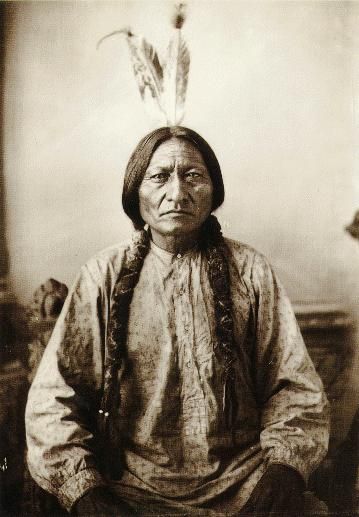
On this day in 1881, Sitting Bull surrenders.

Five years after General George A. Custer’s infamous defeat at the Battle of Little Bighorn, Hunkpapa Teton Sioux leader Sitting Bull surrenders to the U.S. Army, which promises amnesty for him and his followers. Sitting Bull had been a major leader in the 1876 Sioux uprising that resulted in the death of Custer and 264 of his men at Little Bighorn. Pursued by the U.S. Army after the Indian victory, he escaped to Canada with his followers.

Surrender

Hunger and cold eventually forced Sitting Bull, his family, and nearly 200 other Sioux in his band to return to the United States and surrender on July 19, 1881. Sitting Bull had his young son Crow Foot surrender his rifle to the commanding officer of Fort Buford. He told the soldiers that he wished to regard them and the white race as friends. Two weeks later, Sitting Bull and his band were transferred to Fort Yates, the military post located adjacent to the Standing Rock Agency.

Arriving with 185 people, Sitting Bull and his band were kept separate from the other Hunkpapa gathered at the agency. Army officials were concerned that the famed chief would stir up trouble among the recently surrendered northern bands. On August 26, 1881, he was visited by census taker William T. Selwyn who counted twelve people in the Hunkpapa leader’s immediate family. Forty-one families, totaling 195 people, were recorded in Sitting Bull’s band. The military decided to transfer him and his band to Fort Randall, to be held as prisoners of war. Loaded onto a steamboat, Sitting Bull’s band, now totaling 172 people, were sent down the Missouri River to Fort Randall. There they spent the next 20 months. They were allowed to return to the Standing Rock Agency in May 1883.

 70 – First Jewish-Roman War: Siege of Jerusalem – Titus, son of emperor Vespasian, storms the Fortress of Antonia north of the Temple Mount. The Roman army is drawn into street fights with the Zealots.

1304 – Wars of Scottish Independence: Fall of Stirling Castle – King Edward I of England takes the stronghold using the War Wolf.

1738 – Canadian explorer Pierre Gaultier de Varennes et de La Vérendrye reaches the western shore of Lake Michigan.

1807 – Nicéphore Niépce is awarded a patent by Napoleon Bonaparte for the Pyréolophore, the world’s first internal combustion engine, after it successfully powered a boat upstream on the river Saône in France.

1810 – Citizens of Bogota, New Granada declare independence from Spain.

1864 – American Civil War: Battle of Peachtree Creek – Near Atlanta, Georgia, Confederate forces led by General John Bell Hood unsuccessfully attack Union troops under General William T. Sherman.

1866 – Austro-Prussian War: Battle of Lissa – The Austrian Navy , led by Admiral Wilhelm von Tegetthoff, defeats the Italian Navy near the island of Vis in the Adriatic Sea.

1871 – British Columbia joins the confederation of Canada.

1885 – The Football Association legalizes professionalism in football under pressure from the British Football Association.

1903 – Ford Motor Company ships its first car.

1917 – World War I: The Corfu Declaration, which leads to the creation of the post-war Kingdom of Yugoslavia, is signed by the Yugoslav Committee and Kingdom of Serbia.

1922 – The League of Nations awards mandates of Togoland to France and Tanganyika to the United Kingdom.

1932 – In Washington, D.C., police fire tear gas on World War I veterans part of the Bonus Expeditionary Force who attempt to march to the White House.

1934 – Labor unrest in the U.S., as police in Minneapolis fire upon striking truck drivers, during the Minneapolis Teamsters Strike of 1934, killing two and wounding sixty-seven.

1934 – 1934 West Coast waterfront strike: In Seattle, police fire tear gas on and club 2,000 striking longshoremen. The governor of Oregon calls out the National Guard to break a strike on the Portland docks.

1935 – Switzerland: A Royal Dutch Airlines plane en route from Milan to Frankfurt crashes into a Swiss mountain, killing thirteen.

1936 – The Montreux Convention is signed in Switzerland, authorizing Turkey to fortify the Dardanelles and Bosphorus but guaranteeing free passage to ships of all nations in peacetime.

1938 – The United States Department of Justice files suit in New York City against the motion picture industry charging violations of the Sherman Antitrust Act in regards to the studio system. The case would eventually result in a break-up of the industry in 1948.

1940 – Denmark leaves the League of Nations.

1940 – California opens its first freeway, the Arroyo Seco Parkway.

1941 – Soviet leader Joseph Stalin consolidates the Commissariats of Home Affairs and National Security to form the NKVD and names Lavrenti Beria its chief.

1944 – World War II: Adolf Hitler survives an assassination attempt (known as the 20 July plot) led by German Army Colonel Claus von Stauffenberg.

1949 – Israel and Syria sign a truce to end their nineteen-month war.

1950 – Cold War: In Philadelphia, Harry Gold pleads guilty to spying for the Soviet Union by passing secrets from atomic scientist Klaus Fuchs.

1951 – King Abdullah I of Jordan is assassinated by a Palestinian while attending Friday prayers in Jerusalem.

1954 – Germany: Otto John, head of West Germany’s secret service, defects to East Germany.

1960 – Ceylon (now Sri Lanka) elects Sirimavo Bandaranaike Prime Minister, the world’s first elected female head of government.

1960 – The Polaris missile is successfully launched from a submarine, the USS George Washington, for the first time.

1961 – French military forces break the Tunisian siege of Bizerte.

1964 – Vietnam War: Viet Cong forces attack the capital of Dinh Tuong Province, Cai Be, killing 11 South Vietnamese military personnel and 40 civilians (30 of which are children).

1968 – The first Special Olympics is held.

1969 – Apollo Program: Apollo 11 successfully makes the first human-crewed landing on the Moon in the Sea of Tranquility. The first Moonwalk EVA follows almost 7 hours later.

1969 – A cease fire is announced between Honduras and El Salvador, 6 days after the beginning of the “Football War”

1974 – Turkish occupation of Cyprus: Forces from Turkey invade Cyprus after a “coup d’etat”, organised by the dictator of Greece, against president Makarios.

1976 – The American Viking 1 lander successfully lands on Mars.

1976 – Hank Aaron hits his 755th home run, the final home run of his career.

1977 – Johnstown is hit by a flash flood that kills eighty and causes $350 million in damage.

1977 – The Central Intelligence Agency releases documents under the Freedom of Information Act revealing it had engaged in mind control experiments.

1980 – The United Nations Security Council votes 14-0 that member states should not recognize Jerusalem as the capital of Israel.

1982 – Hyde Park and Regents Park bombings: The Provisional IRA detonates two bombs in Hyde Park and Regents Park in central London, killing eight soldiers, wounding forty-seven people, and leading to the deaths of seven horses.

1985 – The government of Aruba passes legislation to secede from the Netherlands Antilles.

1989 – Burma’s ruling junta puts opposition leader Daw Aung San Suu Kyi under house arrest.

1992 – Vaclav Havel resigns as president of Czechoslovakia.

1999 – Falun Gong is banned in the People’s Republic of China, and a large scale crackdown of the practice is launched.

2000 – In Zimbabwe, Parliament opens its new session and seats opposition members for the first time in a decade.

2012 – During a midnight showing of The Dark Knight Rises, a gunman opens fire at a movie theater in Aurora, Colorado, killing 12 people and injuring 58.

2013 – Seventeen government soldiers are killed in an attack by FARC revolutionaries in the Colombian department of Arauca

Holidays and observances

   * Christian Feast Day:

       * Apollinaris of Ravenna

       * Aurelius

       * Elijah

       * Margaret the Virgin

       * Thorlac (relic translation)

       * Wilgefortis (cult suppressed)

       * July 20 (Eastern Orthodox liturgics)

   * Friend’s Day (Argentina, Uruguay, Brazil)

   * Independence Day, celebrates the independence declaration of Colombia from Spain in 1810.

Jon Stewart – Slandero Gigante

Adapted from Rant of the Week at The Stars Hollow Gazette

Sladero Gigante

Six In The Morning

On Sunday

  Explosions hit cars of Hamas officials in Gaza City

  Palestinian security sources say two people injured in blasts targeting officials of Hamas and Islamic Jihad.

19 Jul 2015 08:36 GMT

Two people have been injured in multiple car explosions in northern Gaza City, Palestinian security sources said.

The sources said six explosions took place at same time on Sunday morning in the Sheikh Radwan neighbourhood.

The cars belonged to officials of Islamic Jihad, Hamas and its armed wing, the Qassam Brigades.

Interior ministry spokesman Iyad al-Buzom released a brief statement in which he accused “vandals” seeking to destabilise Gaza of carrying out the explosions.

He said security officials started an investigation and would pursue the criminals.


Sunday’s Headlines:

 A Government Divided: Schäuble’s Push for Grexit Puts Merkel on Defensive

Australia’s war on cats: Government plans to cull 2 million by 2020

Local elections in North Korea unlikely to bring change

South Korea spy kills himself amid hacking scandal

Privacy fears over hacking revelations

 A Government Divided: Schäuble’s Push for Grexit Puts Merkel on Defensive

 German Finance Minister Wolfgang Schäuble had a plan to push Greece out of the euro zone. Chancellor Merkel wasn’t sure what to do about it. The result is widespread resentment of Germany and a damaged Franco-German relationship.

By SPIEGEL Staff

There are days when Wolfgang Schäuble’s staff would prefer to be somewhere else. In Timbuktu perhaps, or up on the Acropolis. In any case, far, far away.

Last Thursday, the German finance minister rolled into an elevator in the Reichstag in Berlin. He was irritated, for he soon had to appear before the Affairs of the European Union Committee to defend a bailout plan for Greece that he didn’t even believe in. “Grottenfalsch,” as he would say — “dreadfully wrong.”

 Australia’s war on cats: Government plans to cull 2 million by 2020

  Australia’s feral cats are reportedly responsible for dwindling numbers among some endangered species

Ishaan Tharoor

The Australian government has announced plans to cull up to 2 million feral cats by 2020 in a bid to preserve dozens of native species that authorities claim face extinction because of the cats’ predatory behavior.

Speaking to a national radio station, Gregory Andrews, the country’s first threatened-species Commissioner, said Australian Environment Minister Greg Hunt “is declaring war on feral cats, and he’s asked me to take charge of that programme.”

Hunt unveiled the five-year plan at a Melbourne zoo on Thursday, vowing to protect Australia’s native mammal and bird populations.

Local elections in North Korea unlikely to bring change

 First local polls in country since Kim Jong-un came to power in 2011 seen by many as a sham.

19 Jul 2015 02:14 GMT

North Korea is set to hold its first local elections since Kim Jong-un came to power in 2011.

Sunday’s elections, which are held every four years, will select deputy positions at provincial, city and county assembly levels.

Citizens have the opportunity to vote for only one candidate for each position selected by the ruling party.

Dae Young Kim, a South Korean reporter who has extensively covered stories from North Korea, said that although democratic in name, the elections are in practice a foregone conclusion.

 South Korea spy kills himself amid hacking scandal


BBC

An employee of South Korea’s National Intelligence Service (NIS) spying agency has been found dead in his car after apparently taking his own life on a mountain road, police say.

His death comes as a scandal over phone-hacking gathers pace.

The man left a suicide note admitting that he had deleted important information about the hacking.

It has emerged that mobile phones were tracked and monitored just before the presidential election in 2012.

Government and NIS officials have denied opposition claims that the spyware – bought from an Italian company – was used to monitor South Koreans in general.


 (From Bangkok Post Sunday)

  By AT Editor on July 19, 2015 in Top News

The Thai military and police struck deals as recently as December to allow them to use hacking software to monitor mobile phones and computers, raising concerns of privacy violations.

The revelation came after WikiLeaks released more than one million searchable emails from the Italian surveillance malware vendor Hacking Team (HT) on July 8, showing the inner workings of the controversial global surveillance industry.

The Bangkok Post Sunday learned of the deals by sifting through hundreds of the company’s emails and documents, which name the Royal Thai Army and Royal Thai Police as customers of its remote control systems. Read more

Grimm’s Fairy Tales

C’mon, you know I had to.

Michael Grimm, Former Congressman, Gets 8-Month Sentence

By STEPHANIE CLIFFORD, The New York Times

JULY 17, 2015

Michael G. Grimm, a former New York congressman who resigned from office after pleading guilty to tax fraud, was given an eight-month sentence on Friday.

A federal investigation that initially focused on Mr. Grimm’s campaign fund-raising turned into a 20-count indictment related to his running of a restaurant in Manhattan, Healthalicious. Prosecutors said he underreported wages and revenue to the government and filed false tax documents as a result.

…

Prosecutors had requested a sentence of 24 to 30 months, while defense lawyers argued for no prison time. Judge Chen, who said that federal sentencing guidelines called for a term of 18 to 24 months, described the crime as “sustained fraud.”

“That this type of crime is common does not lessen its significance,” the judge said. “Your moral compass, Mr. Grimm, needs some reorientation.”

Mr. Grimm was a former Marine and Federal Bureau of Investigation agent. He was elected in 2010 to represent Staten Island and part of Brooklyn in Congress, and resigned after he pleaded guilty in December to one count of tax fraud, a felony.

…

Mr. Grimm had been punished enough, Mr. Rashbaum added, saying that he “suffered this humiliation” publicly: He left Congress and forfeited his pension; his law license has been suspended in New York and Connecticut; and he faces likely disbarment.

…

An assistant United States attorney, James D. Gatta, argued that Mr. Grimm had not taken responsibility for his crime. “He wants the court to accept that he is remorseful, but still, even today, he is trying to shift the blame for his conduct to others,” he said.

…

“He wraps himself in the oaths that he has sworn when it suits him, and turns his back on those oaths when it suits him,” Mr. Gatta said.

Mr. Grimm is scheduled to surrender Sept. 10 and begin his sentence. Once he serves his term, he must perform 200 hours of community service.

Judge Chen said that Mr. Grimm’s work for the F.B.I., as an agent investigating white-collar crime, meant that “he of all people knew better.”

Such a nice guy–

On January 28, 2014, NY1-TV political reporter Michael Scotto was interviewing Grimm in a balcony hallway of the U.S. Capitol building about the recently concluded 2014 State of the Union Address. He then tried to question Grimm about a campaign finance investigation. Grimm said he would not discuss the investigation. As Scotto started to mention the investigation again, Grimm walked off. Scotto then turned to the camera and implied that Grimm didn’t want to face the issue on camera. Grimm then appeared to threaten Scotto, saying that he would “break [Scotto] in half,” as well as threatening to throw Scotto over the balcony.

Grimm issued a statement defending his behavior, saying that he was annoyed by what he called a “disrespectful cheap shot” from Scotto.[67][68] The next day, Grimm contacted Scotto to offer an apology for his behavior, which Scotto deemed sincere.[69] Grimm also issued a written apology, saying, “I shouldn’t have allowed my emotions to get the better of me and lose my cool.”[70] An unnamed former staffer for Grimm and NY1-TV political director Bob Hardt reported that Grimm had behaved in a similar manner to other reporters on previous occasions.

Cartnoon

Load more