
Author's posts
Jun 12 2012
In Memoriam: Ray Bradbury
“I don’t try to predict the future, I try to prevent it.”
~Ray Bradbury~
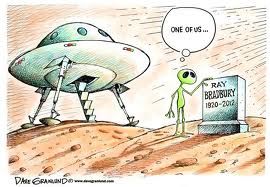
Bradbury died in Los Angeles, California, on June 5, 2012, at the age of 91, after a “lengthy illness”, coincidentally during a rare transit of Venus
My earliest memory of Ray Bradbury was my father reading to me from The Martian Chronicles. I was three. Later he would read aloud from Fahrenheit 451 and his short stories while I looked on at the words on the page. I read from those same books that were left to me by “Pop” to my daughter and gave her my first edition copy of “Something Wicked This Way Comes” which “Pop” gave me for my 15th birthday.
By many estimations Mr. Bradbury was the writer most responsible for bringing modern science fiction into the literary mainstream. His name would appear near the top of any list of major science fiction writers of the 20th century, beside those of Isaac Asimov, Arthur C. Clarke, Robert A. Heinlein and the Polish author Stanislaw Lem. His books are still being taught in schools, where many a reader has been introduced to them half a century after they first appeared. Many readers have said Mr. Bradbury’s stories fired their own imaginations.
More than eight million copies of his books have been sold in 36 languages. They include the short-story collections “The Martian Chronicles,” “The Illustrated Man” and “The Golden Apples of the Sun,” and the novels “Fahrenheit 451” and “Something Wicked This Way Comes.”
Though none of his works won a Pulitzer Prize, Mr. Bradbury received a Pulitzer citation in 2007 “for his distinguished, prolific and deeply influential career as an unmatched author of science fiction and fantasy.”
Scarecrow gave this tribute to Bradbury’s memory by reminding us of what could happen in a totalitarian society like the one in Fahrenheit 451:
In Fahrenheit 451, Bradbury describes the horrors of a totalitarian society so repressive and fearful of ideas that it banned books and burned them. But clever humans figured out they could preserve the literature if each person committed to memorizing a book, reciting and teaching it to others, and passing it on to the next generations.
So I thought we might honor Bradbury’s life and work by passing on a few ideas that are worth preserving as we ponder the meaning of Wisconsin and mourn America’s descent into union bashing and income inequality, enforced by secrecy, propaganda and protected financial looting. [..]
First, as this analysis from the Economic Policy Institute illustrates – and see the video at top – income equality tends to be much higher in America when there are strong unions, while inequality explodes when unions are weak. It seems like an obvious connection – if lower classes have clout, they can demand more of the benefits of their labor – but it’s not emphasized enough in all the media’s right wing excitement about destroying the power of unions. [..]
Second, as James Kwak has written, the Republican policy of lower taxes does not apply across the board; it applies to the top, mostly. But they don’t seem to care if taxes are directly or indirectly raised on the poor. In the Atlantic, Kwak writes about the “GOP’s bizarre, disturbing passion for raising taxes on the poor.” [..]
[One] way to look at Wisconsin is to see it as part of a long term, calculated strategy of weakening unions and destroying their bargaining power. With that power gone, there is nothing to prevent the top percentages from grabbing almost all the gains from labor productivity increases, thus increasing income and wealth inequality. The winners then use the political power from that to perpetuate the inequality in their favor. From there, it is a simple enough leap to use the protected positions of wealth to loot the rest of society and use the power of the state to protect the looting and cover for the looters.
It’s a great strategy if you’re one of the looters, but it’s profoundly criminal. Remember that.
Ray Bradbury will live forever with his words, hopefully, the future generations will listen, so far we aren’t
May the Goddess guide him on his journey to the Summerlands. May his family, friends and all those who ahve read and will read his works, find Peace.
Blessed Be. The Wheel Turns.
Jun 11 2012
Today on The Stars Hollow Gazette

Our regular featured content-
- On This Day In History June 11 by TheMomCat
- Punting the Pundits by TheMomCat
These featured articles-
- Pique the Geek 20120610: More on Fireflies by Translator
- Sunday Train: Putting Steel into the Amtrak Long Distance Backbone by BruceMcF
- Lame Ducks Cooking Up A Catfood Christmas for Country by joe shikspack
- Citizens United, June 5th, and Money, Money, Money, Money! by Geminijen by Anti-Capitalist Meetup
Follow us on Twitter @StarsHollowGzt
This is an Open Thread
Jun 11 2012
On This Day In History June 11
Cross posted from The Stars Hollow Gazette
This is your morning Open Thread. Pour your favorite beverage and review the past and comment on the future.
Find the past “On This Day in History” here.
Click on image to enlarge
June 11 is the 162nd day of the year (163rd in leap years) in the Gregorian calendar. There are 203 days remaining until the end of the year.

On this day in 1776, the Continental Congress selects Thomas Jefferson of Virginia, John Adams of Massachusetts, Benjamin Franklin of Pennsylvania, Roger Sherman of Connecticut and Robert R. Livingston of New York to draft a declaration of independence.
Knowing Jefferson’s prowess with a pen, Adams urged him to author the first draft of the document, which was then carefully revised by Adams and Franklin before being given to Congress for review on June 28.
The revolutionary treatise began with reverberating prose:
While political maneuvering was setting the stage for an official declaration of independence, a document explaining the decision was being written. On June 11, 1776, Congress appointed a “Committee of Five”, consisting of John Adams of Massachusetts, Benjamin Franklin of Pennsylvania, Thomas Jefferson of Virginia, Robert R. Livingston of New York, and Roger Sherman of Connecticut, to draft a declaration. Because the committee left no minutes, there is some uncertainty about how the drafting process proceeded-accounts written many years later by Jefferson and Adams, although frequently cited, are contradictory and not entirely reliable. What is certain is that the committee, after discussing the general outline that the document should follow, decided that Jefferson would write the first draft. Considering Congress’s busy schedule, Jefferson probably had limited time for writing over the next seventeen days, and likely wrote the draft quickly. He then consulted the others, made some changes, and then produced another copy incorporating these alterations. The committee presented this copy to the Congress on June 28, 1776. The title of the document was “A Declaration by the Representatives of the United States of America, in General Congress assembled.” Congress ordered that the draft “lie on the table”.
On Monday, July 1, having tabled the draft of the declaration, Congress resolved itself into a committee of the whole, with Benjamin Harrison of Virginia presiding, and resumed debate on Lee’s resolution of independence. John Dickinson made one last effort to delay the decision, arguing that Congress should not declare independence without first securing a foreign alliance and finalizing the Articles of Confederation.[64] John Adams gave a speech in reply to Dickinson, restating the case for an immediate declaration.
Jun 10 2012
On This Day In History June 10
Cross posted from The Stars Hollow Gazette
This is your morning Open Thread. Pour your favorite beverage and review the past and comment on the future.
Find the past “On This Day in History” here.
June 10 is the 161st day of the year (162nd in leap years) in the Gregorian calendar. There are 204 days remaining until the end of the year.
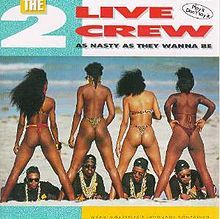
On this day in 1990, Luther Campbell and fellow 2LiveCrew members are arrested on obscenity charges
Though the First Amendment to the Constitution clearly states that the U.S. Congress “shall make no law…abridging the freedom of speech,” free speech is widely understood to have its limits. It is dangerous and potentially criminal, for instance, to yell, “Fire!” in a crowded theater. But what about yelling “$&%#@!!” in a crowded nightclub? Lenny Bruce and other comedians tested the limits of that practice in the 1960s, but it was not until the late 1980s that the issue of obscenity came front and center in the world of popular music. The group that brought it there was 2LiveCrew, a hip-hop outfit led by Luther “Luke Skyywalker” Campbell. On June 10, 1990, just days after a controversial ruling by a Florida federal judge, Campbell and two other members of 2LiveCrew were arrested on charges of public obscenity after performing material from their album As Nasty As They Wanna Be in a Hollywood, Florida, nightclub.
In 1989, the group released their album, As Nasty As They Wanna Be, which also became the group’s most successful album. A large part of its success was due to the single “Me So Horny”, which was popular despite little radio rotation. The American Family Association (AFA) did not think the presence of a “Parental Advisory” sticker was enough to adequately warn listeners of what was inside the case. Jack Thompson, a lawyer affiliated with the AFA, met with Florida Governor Bob Martinez and convinced him to look into the album to see if it met the legal classification of obscene. In 1990 action was taken at the local level and Nick Navarro, Broward County sheriff, received a ruling from County Circuit Court judge Mel Grossman that probable cause for obscenity violations existed. In response, Luther Campbell maintained that people should focus on issues relating to hunger and poverty rather than on the lyrical content of their music.
Navarro warned record store owners that selling the album may be prosecutable. The 2 Live Crew then filed a suit against Navarro. That June, U.S. district court Judge Jose Gonzalez ruled the album obscene and illegal to sell. Charles Freeman, a local retailer, was arrested two days later, after selling a copy to an undercover police officer. This was followed by the arrest of three members of The 2 Live Crew after they performed some material from the album at a nightclub. They were acquitted soon after, as professor Henry Louis Gates, Jr. testified at their trial in defense of their lyrics. Freeman’s conviction was overturned on appeal as well.
In 1992, the United States Court of Appeals for the Eleventh Circuit overturned the obscenity ruling from Judge Gonzalez, and the Supreme Court of the United States refused to hear Broward County’s appeal. As in the Freeman case, Gates testified on behalf of Navarro, arguing that the material that the county alleged was profane actually had important roots in African-American vernacular, games, and literary traditions and should be protected.
As a result of the controversy, As Nasty As They Wanna Be sold over two million copies. It peaked at #29 on The Billboard 200 and #3 on the Top R&B/Hip-Hop Albums chart. A few other retailers were later arrested for selling it as well, including Canadian Marc Emery who was convicted in Ontario in 1991, and would later gain fame as a marijuana activist. Later hard rock band Van Halen sued over an uncleared sample of their song “Ain’t Talkin’ ‘Bout Love” in The 2 Live Crew Song “The Fuck Shop”. The publicity then continued when George Lucas, owner of the Star Wars universe, successfully sued Campbell for appropriating the name “Skywalker” for his record label, Luke Skyywalker Records. Campbell changed his stage name to Luke (and changed the record label’s name to Luke Records) and the group released an extremely political follow up album, Banned in the USA after obtaining permission to use an interpolation of Bruce Springsteen‘s Born in the U.S.A. The 2 Live Crew paraphernalia with the Luke Skyywalker or Skyywalker logos are often sought-after collector’s items.
Jun 09 2012
Good Morning From NN12
Well, we warned you posting would light.
h/t John Aravosis @ AMERICAblog who is not here but Chris in Paris and Gaius Publius are.
Jun 09 2012
On This Day In History June 9
Cross posted from The Stars Hollow Gazette
This is your morning Open Thread. Pour your favorite beverage and review the past and comment on the future.
Find the past “On This Day in History” here.
June 9 is the 160th day of the year (161st in leap years) in the Gregorian calendar. There are 205 days remaining until the end of the year.
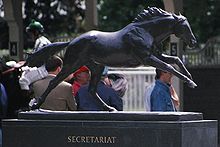
On this day in 1973, Secretariat wins Triple Crown
With a spectacular victory at the Belmont Stakes, Secretariat becomes the first horse since Citation in 1948 to win America’s coveted Triple Crown–the Kentucky Derby, the Preakness, and the Belmont Stakes. In one of the finest performances in racing history, Secretariat, ridden by Ron Turcotte, completed the 1.5-mile race in 2 minutes and 24 seconds, a dirt-track record for that distance.
With easy victories in his first two starts of 1973, Secretariat seemed on his way to the Triple Crown. Just two weeks before the Kentucky Derby, however, he stumbled at the Wood Memorial Stakes at Aqueduct, coming in third behind Angle Light and Sham. On May 5, he met Sham and Angle Light again at the Churchill Downs track in Louisville for the Kentucky Derby. Secretariat, a 3-to-2 favorite, broke from near the back of the pack to win the 2 1/4-mile race in a record 1 minute and 59 seconds. He was the first to run the Derby in less than two minutes and his record still stands. Two weeks later, at Pimlico Race Course in Baltimore, Maryland, Secretariat won the second event of the Triple Crown: the Preakness Stakes. The official clock malfunctioned, but hand-recorded timers had him running the 1 1/16-mile race in record time.
On June 9, 1973, almost 100,000 people came to Belmont Park near New York City to see if “Big Red” would become the first horse in 25 years to win the Triple Crown. Secretariat gave the finest performance of his career in the Belmont Stakes, completing the 1.5-mile race in a record 2 minutes and 24 seconds, knocking nearly three seconds off the track record set by Gallant Man in 1957. He also won by a record 31 lengths. Ron Turcotte, who jockeyed Secretariat in all but three of his races, claimed that at Belmont he lost control of Secretariat and that the horse sprinted into history on his own accord.
Jun 08 2012
On This Day In History June 8
Cross posted from The Stars Hollow Gazette
This is your morning Open Thread. Pour your favorite beverage and review the past and comment on the future.
Find the past “On This Day in History” here.
Click on image to enlarge
June 8 is the 159th day of the year (160th in leap years) in the Gregorian calendar. There are 206 days remaining until the end of the year.
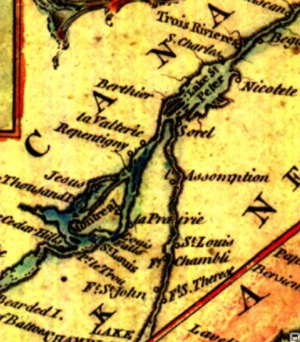
On this day in 1776, Canadian Governor Sir Guy Carleton defeats American Patriot forces under John Sullivan, who were already in retreat from Quebec toward Montreal.
After General Richard Montgomery’s early success in Montreal, he and Colonel Benedict Arnold attempted to take Quebec in the middle of the night between December 31, 1775 and January 1, 1776. Montgomery lost his life and Arnold was wounded in the action; half of their men were also lost to death, injury or capture and Quebec remained in British control. The colonists’ ill-conceived, pre-emptive attack on Canada ended in disaster. Instead of winning French Canadians to the Patriot cause, it led only to a huge loss of life among Patriot forces.
The Battle of Trois-Rivières (Three Rivers in English) was fought on June 8, 1776, during the American Revolutionary War. A British army under Quebec Governor Guy Carleton defeated an attempt by units from the Continental Army under the command of Brigadier General William Thompson to stop a British advance up the Saint Lawrence River valley. The battle occurred as a part of the American colonists’ invasion of Quebec, which had begun in September 1775 with the goal of “liberating” the province from British rule.
The crossing of the Saint Lawrence by the American troops was observed by Quebec militia, who alerted British troops at Trois-Rivières. A local farmer led the Americans into a swamp, enabling the British to land additional forces in the village, and to establish positions behind the American army. After a brief exchange between an established British line and American troops emerging from the swamp, the Americans broke into a somewhat disorganized retreat. As some avenues of retreat were cut off, the British took a sizable number of prisoners, including General Thompson and much of his staff.
This was the last major battle fought on Quebec soil. Following the defeat, the remainder of the American forces, under the command of John Sullivan, retreated, first to Fort Saint-Jean, and then to Fort Ticonderoga.
Jun 07 2012
On This Day In History June 7
Cross posted from The Stars Hollow Gazette
This is your morning Open Thread. Pour your favorite beverage and review the past and comment on the future.
Find the past “On This Day in History” here.
Click on image to enlarge
June 7 is the 158th day of the year (159th in leap years) in the Gregorian calendar. There are 207 days remaining until the end of the year.
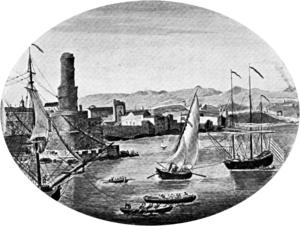
On this day in 1692, a massive earthquake devastates the infamous town of Port Royal in Jamaica, killing thousands. The strong tremors, soil liquefaction and a tsunami brought on by the earthquake combined to destroy the entire town.
Port Royal was built on a small island off the coast of Jamaica in the harbor across from present-day Kingston. Many of the buildings where the 6,500 residents lived and worked were constructed right over the water. In the 17th century, Port Royal was known throughout the New World as a headquarters for piracy, smuggling and debauchery. It was described as “most wicked and sinful city in the world” and “one of the lewdest in the Christian world.”
Earthquakes in the area were not uncommon, but were usually rather small. In 1688, a tremor had toppled three homes. But four years later, late in the morning on June 7, three powerful quakes struck Jamaica. A large tsunami hit soon after, putting half of Port Royal under 40 feet of water. The HMS Swan was carried from the harbor and deposited on top of a building on the island. It turned out to be a refuge for survivors.
Port Royal provided a safe harbour initially for privateers and subsequently for pirates plying the shipping lanes to and from Spain and Panama. Buccaneers found Port Royal appealing for several reasons. Its proximity to trade routes allowed them easy access to prey, but the most important advantage was the port’s proximity to several of the only safe passages or straits giving access to the Spanish Main from the Atlantic. The harbour was large enough to accommodate their ships and provided a place to careen and repair these vessels. It was also ideally situated for launching raids on Spanish settlements. From Port Royal, Henry Morgan attacked Panama, Portobello, and Maracaibo. Roche Brasiliano, John Davis (buccaneer), and Edward Mansveldt (Mansfield) also came to Port Royal.
Since the English lacked sufficient troops to prevent either the Spanish or French from seizing it, the Jamaican governors eventually turned to the pirates to defend the city.
By the 1660s, the city had gained a reputation as the Sodom of the New World where most residents were pirates, cutthroats, or prostitutes. When Charles Leslie wrote his history of Jamaica, he included a description of the pirates of Port Royal:
Wine and women drained their wealth to such a degree that… some of them became reduced to beggary. They have been known to spend 2 or 3,000 pieces of eight in one night; and one gave a strumpet 500 to see her naked. They used to buy a pipe of wine, place it in the street, and oblige everyone that passed to drink.
The taverns of Port Royal were known for their excessive consumption of alcohol such that records even exist of the wild animals of the area partaking in the debauchery. During a passing visit, famous Dutch explorer Jan van Riebeeck is said to have described the scenes:
The parrots of Port Royal gather to drink from the large stocks of ale with just as much alacrity as the drunks that frequent the taverns that serve it.
There is even speculation in pirate folklore that the infamous Blackbeard met a howler monkey while at leisure in a Port Royal alehouse whom he named Jefferson and formed a strong bond with during the expedition to the island of New Providence. Port Royal benefited from this lively, glamorous infamy and grew to be one of the two largest towns and the most economically important port in the English colonies. At the height of its popularity, the city had one drinking house for every ten residents. In July 1661 alone, forty new licenses were granted to taverns. During a twenty-year period that ended in 1692, nearly 6,500 people lived in Port Royal. In addition to prostitutes and buccaneers, there were four goldsmiths, forty-four tavern keepers, and a variety of artisans and merchants who lived in 2000 buildings crammed into 51 acres of real estate. 213 ships visited the seaport in 1688. The city’s wealth was so great that coins were preferred for payment rather than the more common system of bartering goods for services.
Following Henry Morgan’s appointment as lieutenant governor, Port Royal began to change. Pirates were no longer needed to defend the city. The selling of slaves took on greater importance. Upstanding citizens disliked the reputation the city had acquired. In 1687, Jamaica passed anti-piracy laws. Instead of being a safe haven for pirates, Port Royal became noted as their place of execution. Gallows Point welcomed many to their death, including Charles Vane and Calico Jack, who were hanged in 1720. Two years later, forty-one pirates met their death in one month.
Although a work of historical fiction, James Michener’s The Caribbean details the history, atmosphere and geography of Port Royal accurately.
Jun 07 2012
Against Their Own Best Interests
Cross posted from The Stars Hollow Gazette
Last week the Irish voted against their own (s)elf interest, which according to Yanis Varoufakis, professor of economics at the University of Athens, when they “voted in favour of the EU’s fiscal compact which specifies that which is both impossible to attain and catastrophic if it is attained“:
So, why did the Fine Gael-led Dublin government push so powerfully in favour of this piece of crippling idiocy? And why did the smart, decent Irish voters said Yes, despite their tradition of saying No to euro-silliness? The answer is simple: They were blackmailed. Ireland’s voters were told: Vote No and the flow of money from the troika will cease. And so they voted Yes, even though I suspect that no government minister, no rank and file Fine Gael or Labour Party member, no man or woman on the street believes that the Fiscal Compact they voted for makes sense. [..]
If on 17th June Greeks voted like the Irish did last week (that is, against their reasoning and guided by fear and blackmail), the Eurozone will become history, with terrible consequences for the global economy. This is not the case of the Philosopher Kings blackmailing the plebs to do what is right. This is the case of ‘madmen in authority’, to quote Keynes, who are not only steering the vessel toward the rocks but who are, in the process, punching holes in the life vests that may carry us to safety once the shipwreck is complete. [..]
To conclude, Europe’s peoples are being marched into a catastrophe. They know that this is their predicament. They can see their march is leading them off a mighty cliff. But they are too afraid to veer off, in case there are beaten back into line, in case they get lost in the woods, for reasons that sheep know best. However, the only way this hideous march can end is if someone summons up the courage and does it. And steps out, showing the others that this march can stop and must stop – for everyone’s benefit. Who is that someone? We, Europeans, do not have many options. As I wrote above, the Irish people had a chance but did not take it. In two weeks, the Greeks have their chance. Voting for Syriza would offer us (and by ‘us’ I mean all Europeans) a chance of this circuit-breaker. A chance to say: Enough! Time to change course in order to save the Eurozone, so as to prevent the Great Postmodern Depression which lurks once the euro-system fragments formally.
Varoufakis gives his reasons for supporting Sariza: first, that Sariza is the only party that understands that Greece needs to stay in the EuroZone and that the Eurozone won’t survive if it doesn’t give up austerity; second, the economic team that will negotiate on Greece’s behalf are good and persuasive with a clear understanding of the situation; and third, Syriza will not be the sole arbiter of the Greek government. It will be a coalition, so there is no need to fear the party’s extreme leftism.
I hope the Greeks’ come to their senses unlike the Irish and Wisconsins.
Jun 06 2012
On This Day In History June 6
Cross posted from The Stars Hollow Gazette
This is your morning Open Thread. Pour your favorite beverage and review the past and comment on the future.
Find the past “On This Day in History” here.
Click on image to enlarge
June 6 is the 157th day of the year (158th in leap years) in the Gregorian calendar. There are 208 days remaining until the end of the year.
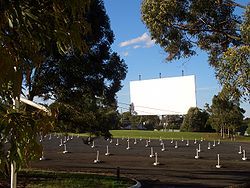
On this day in 1933, eager motorists park their automobiles on the grounds of Park-In Theaters, the first-ever drive-in movie theater, located on Crescent Boulevard in Camden, New Jersey.
The drive-in theater was the creation of Camden, New Jersey, chemical company magnate Richard M. Hollingshead, Jr., whose family owned and operated the R.M. Hollingshead Corporation chemical plant in Camden. In 1932, Hollingshead conducted outdoor theater tests in his driveway at 212 Thomas Avenue in Riverton. After nailing a screen to trees in his backyard, he set a 1928 Kodak projector on the hood of his car and put a radio behind the screen, testing different sound levels with his car windows down and up. Blocks under vehicles in the driveway enabled him to determine the size and spacing of ramps so all automobiles could have a clear view of the screen. Following these experiments, he applied August 6, 1932, for a patent of his invention, and he was given U.S. Patent 1,909,537 on May 16, 1933. That patent was declared invalid 17 years later by the Delaware District Court.
Hollingshead’s drive-in opened in New Jersey June 6, 1933, on Admiral Wilson Boulevard at the Airport Circle in Pennsauken, a short distance from Cooper River Park. It offered 500 slots and a 40 by 50 ft (12 by 15 m) screen. He advertised his drive-in theater with the slogan, “The whole family is welcome, regardless of how noisy the children are.” (The first film shown was the Adolphe Menjou film Wife Beware.) The facility only operated three years, but during that time the concept caught on in other states. The April 15, 1934, opening of Shankweiler’s Auto Park in Orefield, Pennsylvania, was followed by Galveston’s Drive-In Short Reel Theater (July 5, 1934), the Pico in Los Angeles (September 9, 1934) and the Weymouth Drive-In Theatre in Weymouth, Massachusetts (May 6, 1936). In 1937, three more opened in Ohio, Massachusetts and Rhode Island, with another 12 during 1938 and 1939 in California, Florida, Maine, Maryland, Massachusetts, Michigan, New York, Texas and Virginia. Michigan’s first drive-in was the Eastside, which opened May 26, 1938, in Harper Woods near Detroit.
Early drive-in theaters had to deal with noise pollution issues. The original Hollingshead drive-in had speakers installed on the tower itself which caused a sound delay affecting patrons at the rear of the drive-in’s field. Attempts at outdoor speakers next to the vehicle did not produce satisfactory results. In 1941, RCA introduced in-car speakers with individual volume controls which solved the noise pollution issue and provided satisfactory sound to drive-in patrons.
Jun 06 2012
What Is Wrong With Wisconsin?
Cross posted from The Stars Hollow Gazette
MSNBC and other news outlets are calling the Wisconsin recall of Republican Governor Scott Walker for Gov. Walker.
Scott Walker, the embattled Republican governor of Wisconsin, narrowly survived a recall vote on Tuesday, defeating a union-led effort to remove him from office for pushing laws to restrict the collective bargaining rights of state workers.
The state’s labor movement had marshaled widespread anger earlier this year to force a recall vote just two years into Mr. Walker’s four-year term. Democrats collected close to one million signatures in the petition drive to oust him.
That effort led to the closely-watched rematch between Mr. Walker and the Democratic opponent he beat in 2010, Tom Barrett, the mayor of Milwaukee. In the voting Tuesday, Mr. Walker once again bested Mr. Barrett for the state’s top job.
The results were a victory for the national Republican Party and conservative groups from around the country, which had rallied behind Mr. Walker with tens of millions of dollars. Mr. Walker will now complete his term.
Unless, he’s indicted.