Mobile version

Sunday Train: The Appalachian Hub, Part 1


by: BruceMcF

Sun Aug 30, 2009 at 12:33:59 PDT


Burning the Midnight Oil for Living Energy Independence , crossposted from The Hillbilly Report

It is widely remarked that the US Department of Transport map of High Speed Rail Corridors leaves a lot of obvious holes.

Often, this reflects a misunderstanding of what the DoT is mapping. This is not a "Master Plan". There is no HSRail planner division inside the Federal Rail Administration inside the Department of Transport that is working away at deciding which corridor should be added to the corridor.

Instead, what they have mapped are the corridors that are eligible for HSRail funding. The way that things are set up is that a state or group of states do some planning, petition Congress be designated as a HSRail corridor, or added to a corridor, or for less sweeping changes petition the Department of Transport to revise an existing corridor, and {*voila*}, that's a designated corridor.

BruceMcF :: Sunday Train: The Appalachian Hub, Part 1
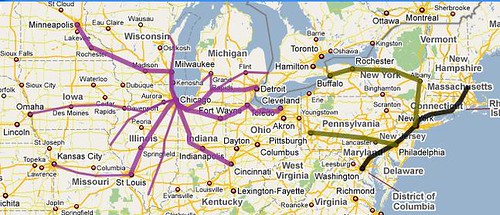
Since the corridor is a funding category, there are lots of HSRail corridors that are not on the DoT map.  For example, compare the corridor map to the full Midwest Hub which is, formally, the "Mid-West Regional Rail System", a hub and spoke system centered on Chicago.

Some of the "missing lines" are not 110mph lines, but some - like Milwaukee to Green Bay, or Kalamazoo to Port Huron - are planned for 110mph.

So why are they missing? Because they are not planned for immediate construction. Kalamazoo/Grand Rapids and Kalamazoo/Port Huron would not be started until Chicago/Detroit is running as an HSRail corridor. Milwaukee/Green Bay would not start until Chicago/Milwaukee is running as an 110mph service. There is no reason to seek designation for these branch corridors until the corridors they branch out from are under construction and nearing completion.
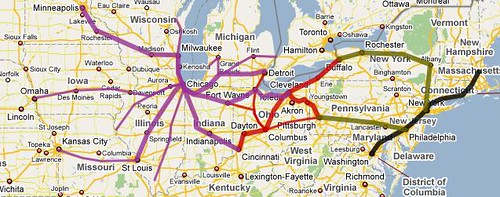
Looking at the full Midwest Hub from a Buckeye perspective, there is one real obvious gap - the Cleveland/Columbus/Cincinnati route - the "Triple-C". And, as you can see above, the Triple-C planned for by the Ohio Rail Development Commission (ORDC) in their Ohio Hub plan, was added to the Midwest HSRail corridor system.

But the Ohio Hub is much more than just the Triple-C. It reaches out to connect to the East Coast via Buffalo and the Empire Corridor and Pittsburgh and the Keystone Corridor, and direct connections for southern and central Ohio to Detroit and Chicago. However, it is a staged plan, and the Triple-C is the first stage, so that is all that shows up on the Federal map.


Some Gaps Really Are Gaps
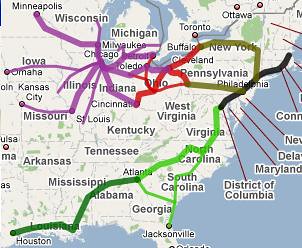
Some gaps in the corridor map, however, are exactly that: gaps. East of the Mississippi, the biggest gap is right smack dab in the middle: Kentucky, Tennessee, and West Virginia. The only plans that I am aware of that even touch these states are a maglev proposal from Atlanta to Chattanooga, and the designation of Indianapolis to Louisville in the Federal corridor map - which is not, note, part of the most recent Midwest Hub.

And in general, in what will be no news to anybody who grew up in or near Appalachia, very few routes are planned to run through Appalachia at all.

The Keystone Corridor extended by a later stage of the Ohio Hub runs east to west through the far northern end of Appalachia, while the Gulf Coast corridor swings through Birmingham, Alabama, so its got to run into the far southern end of Appalachia. The Southeast Corridor skirts the eastern edge Appalachia. But West Virginia, Eastern Kentucky, Eastern Tennessee, Western Virginia ... pretty much nothing.

You might think, "but, this is terrible terrain for High Speed Rail, its normal that there are few High Speed Rail corridors planned".

Except - the HSRail system has that problem covered.


Tilt-Trains and Appalachian Rail

The Federal designation of "High Speed Rail" actually covers three distinct tiers of High Speed Rail. The top tier, "Express HSR", are the bullet trains that most people think of when they hear HSR. And bullet trains through mountainous terrain are massive undertakings, with tunnels connecting to viaducts connecting to tunnels. For the size of most of the cities and towns of Appalachia - even when connecting them to a large metropolis - it is very hard to justify the cost per mile in terms of the available ridership.

But the second and third tiers, the 125mph "Regional HSR" and 110mph "Emerging HSR", are different. These are the speeds you can get to on existing right of way with modern "tilt-trains".

You can't just run at 110mph on an existing right of way without upgrades, of course. The track sometimes has to be upgraded to take 60mph rail traffic. All level crossings have to be upgraded to standard above the 79mph standard. The signaling has to be upgraded. Still, the new grade-separated right of way designed for trains running 220mph is the biggest cost of an Express HSR system, and that is not needed for an express tilt-train system.

That is why, after all, the Midwest Hub, Ohio Hub, Empire Corridor, Keystone Corridors, Southeast Corridor and Gulf Coast Corridor are all planned for 110mph or 125mph tilt-train systems. There are quite a lot of cities that can be connected for two to three hour trips via 110mph or 125mph trains, and connecting them with Emerging HSR and Regional HSR corridors allows five to ten times as many route-miles as an Express HSR system.

So, what is a tilt-train, and why is it important?

The top speed of a train only has a loose relationship with the travel time between two places. The problem is curves. A passenger train needs to bank to go through a curve at speed, to avoid tossing the passengers inside around like so much loose baggage.

Problem is, when you are sharing track between passenger trains and freight trains, banking the track to allow for faster passenger trains leaves a slower freight train unbalanced, causing excessive wear, for higher maintenance cost and increased risk of derailment. And a heavy freight train has to go slower, because a trestle that can handle a passenger train with 17 tons per axle at 110mph cannot necessarily take a heavy freight train with 33 tons per axle at 100mph.

So, as the Japanese, Spanish and Italians have worked out over the last thirty years, a key trick to sharing track between 110mph passenger trains and slower heavy freight trains is for the fast passenger train to do part of the banking itself. This is the "tilt-train".

And the more curves, the more benefit the tilt-train provides. Indeed, for the existing Amtrak routes through Appalachia, such as the DC/Cincinnati route through West Virginia, a tilt-train running at 79mph would be faster than a regular Amtrak running at 79mph.

Actually, a 110mph tilt-train can be more energy efficient than a 79mph train on a typical Appalachian alignment. While the the 79mph is constantly slowing down for tighter curves curves and then speeding up to go through looser curves, the 110mph is able to maintain a much steadier speed.


Network Economies and the Appalachian Hub Stage 1
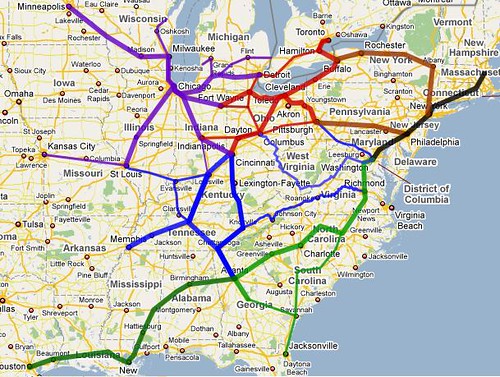
The "Appalachian Hub" sketched here - and I stress that this is just a back of the envelope concept, and there is absolutely no state rail planning agency behind this unless people in these states make it happen - fills in the big hole in the middle of the current state plans east of the Mississippi.

You may notice that one of the striking features of this Appalachian Hub is how much of it lies outside of Appalachia. The reason for that is simple. While the Great Lakes states, Southeast Coast states, and Gulf Coast states have at least got systems up on the drawing boards that Appalachian rail corridors can connect to ... it seems like the state governments of Kentucky and Tennessee have been laying down on the job.

So the first stage is to complete the hole in the ring around Appalachia, with a corridor from Atlanta to Chattanooga to Nashville to Louisville to Cincinnati. As noted on the map, the Nashville to Cincinnati leg could also be usefully extended to Memphis.

Access to an 110mph route at Chattanooga opens up the door to an Amtrak speed route from Knoxville to Chattanooga, which can be incrementally upgraded to 90mph then 110mph. When it reaches 110mph, that opens the door to a through route from Atlanta to Knoxville, which can run through to Lexington and on to Cincinnati.

The ultimate target for these corridor would be electrification and signal and level crossing upgrades to allow them to run at 125mph.


Stage 2: The Real Appalachian Hub
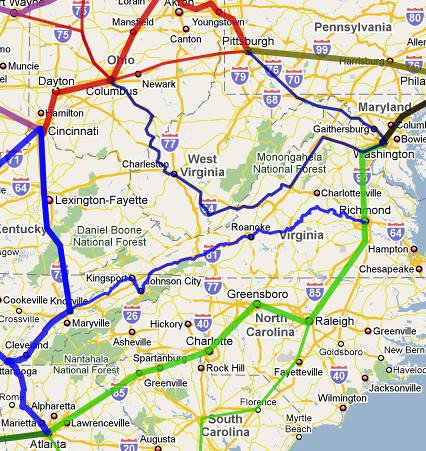
Even with these corridors in place, there are still a big hole in the map. Much of the hole represents the Appalachian mountains themselves. But of course, they have mountains in Spain, Italy and Japan - that's why they led the way in developing tilt trains.

The northernmost east-west link is the existing Amtrak route through the eastern pandhandle of West Virginia from Pittsburgh through to Washington DC. That ties into the Keystone Corridor and Ohio Hub at the western end, and the Northeast Corridor and Southeast Corridor at the eastern end.

The second east-west link in the map runs into the Appalachian foothill counties of Ohio that are excluded from the Ohio Hub, then to Charleston, West Virginia, then on to Washington DC on the existing Cincinnati/Washington Amtrak route.

The third east-west link on the map runs from Knoxville, Tennessee through the TN "tri-cities" of Kinsgport, Johnson City, and Bristol, and then through Western Virginia to Roanoke and on to Richmond.

Now, it looks like the second and third east-west links run awful close to each other, and on the state map it looks like it might be possible to crosslink those, with the existing Cincinnati/Washington route through Charleston, WV, connecting to a Columbus/Richmond line. However, while I am still on the look-out for a useful rail link to make that cross-connect - so far the miles between the two routes seem to be "mountain miles", and it might be that no real useful route exists.


Wait a minute, what about the owners?

This whole business of "sharing right of way" sometimes means laying new track in a sliver of a right of way bought off a railroad ... and sometimes means sharing track owned by a private railroad.

Won't they mind? Many railroads are awfully grumpy hosts for Amtrak, and if an Amtrak service is fifteen minutes late for a scheduled slot, some rail operators will think nothing of putting a coal train in that slot instead that will stretch the delay out to hours.

Even where these Emerging HSR corridors share track used by freight railroads, they will be upgrading track and corridor to 60mph capacity, and installing somewhere around 10 miles of passing track for every 50 miles of track. That allows the HSR services to run through without being interrupted by freight service. But it also means that there is an increase in freight capacity without cost to the freight operator.

The HSR corridors will also see a number of trains per day each way, at a rate negotiated up front, with each train paying an access fee for use of the track, which is a better source of income than one (or fewer) Amtrak service each way.

Finally, one of the things that has been driving the push to single-track rail corridors is the fact that railroads, unlike public roads and airports, pay local property taxes. The new improvements to serve the HSR corridors will typically be owned by a public authority, so the private railroads gain this new capacity without an increase in their property tax burden. At the same time, for many small towns the railroad can be their only commercial property tax income, and this approach avoids disrupting their local tax base.


Conclusions? This is just Part 1

This is a work in progress, and I am sure there are glitches, flaws, etcetera all the way through. Next time I look at the Appalachian Hub (no promises on how many weeks it will be), I will be doing back-of-the-envelope comparisons of the transport market along these corridors compared to some of the other HSR corridors already on the map.

Of course, if you find one of those glitches, I'd thank you for that. Also stories about transport in the are, criticism, praise, sharing the link around to friends of Appalachia and friends and enemies of High Speed Rail alike.

So for now, I'll open the floor for discussion.

Tags: , , , , , , , (All Tags)
Print Friendly View Send As Email

Of course, it is Bobby Kennedy that springs to mind ... (4.00 / 3)
... first when Appalachia enters the conversation, but Teddy also reminds us that a progressive majority is built from the bottom up, not from the top down.

Support Lesbian creative works, 100% Yuri from ALC Press

I happen to live... (4.00 / 1)
...smack dab in the center of the Omega-loop (Round Knob) of the 7-mile extension of Norfolk-Southern (now plus CSX) grade over the Eastern Continental Divide. All freight now, but once hosted ample passengers, with a nifty 120-foot tall geyser man-made at the bottom of my driveway that could be seen at seven different points as the train negotiated the loops.

They've been trying to get passenger service to Asheville for some years, beyond the autumn steam train excursions. From there one can travel anywhere, it's atop the Appalachian plateau. We rebuilt our station with federal grants and everything. The passenger trains still don't come here.

You can't go fast over the divide. At least, not on any existing grade on this side. But it's a beautiful ride. Wish it would happen.

Some are born to weirdness, some attain weirdness and others have weirdness thrust upon them...
- OPOL


You'd be surprised how fast these trains can go up a grade ... (4.00 / 1)
... especially since they normally have more speed starting the grade because of the ability to take corners faster ...

... but the real speed increase in hilly country comes with electrification.

Support Lesbian creative works, 100% Yuri from ALC Press


[ Parent ]
Asheville, North Carolina? (4.00 / 1)
There does look like a rail line that runs from Knoxville east, branching from the line above through Newport TN and then through the Pisgah National Forest to Asheville. I guess it would connect to the Southeastern HSR corridor at Spartanburg

Support Lesbian creative works, 100% Yuri from ALC Press

[ Parent ]
Only two grades from A-ville... (4.00 / 1)
...down. One is the steepest in the nation (from the south, and this one from the east. 7% the whole way, because that was all steam trains could handle. I know they can go faster (I've seen 'em do it, usually starting forest fires in their wake, especially in the spring). That tends to throw loose passengers into the centrifugal wall...

They can of course bypass north or south, and with passenger service do. We're slow, but beautiful. Once you're on the plateau it's not hard to get on to points westerly. There's a reason tourism is our #1 industry. Having rail service wouldn't hurt that a bit.

Some are born to weirdness, some attain weirdness and others have weirdness thrust upon them...
- OPOL


[ Parent ]
Electrify that grade, ... (4.00 / 1)
... and the speed limit is determined by the curves ... tight curves can be taken at 110mph, but going 125mph requires a wider curve radius than I've been seeing in googling the normal river-following rail corridors in Appalachia.

Support Lesbian creative works, 100% Yuri from ALC Press

[ Parent ]
Imagine a ~13 acre field... (4.00 / 1)
...that's actually a side-runup to Heartbreak Ridge (leading to the highest point east of the Mississippi). Draw a literal omega around it, then add 6 further 'loops' over 7 miles using shield-walls and tunnels to gain the 2000 feet necessary to top the divide that's right there in front of you. There's no physics on earth that can let you do 110 mph on these. You'd literally fly, and the landing would be extremely rough.

Some are born to weirdness, some attain weirdness and others have weirdness thrust upon them...
- OPOL


[ Parent ]
Fifty miles of that? (4.00 / 1)
The physics is simple - a tilt-train can go faster around a curve than a conventional Amtrak can. How fast is "faster" depends on the curve radius. There are some curves that are so tight that a tilt-train has to slow down to 80mph ... but while steel wheels on steel rails do not have the same traction as rubber on road for climing (that's why the Swiss electric trains that climb the steep grades are often two regular four axle electric locomotives rather than a single "super powerful" locomotive, because once you get to the power/weight ratio of an electric locomotive, having the sixteen wheels driving is more important than the raw power) ... they really do have far more lateral stability than we often expect. For one thing, unlike a car squeeling around a hairpin curve, its never all of the train that is subject to peak lateral stress.

There could be a problem with low speed of heavy freight traffic. If the track cannot be banked for 60mph heavy freight, then the tilt-train cannot go through at 110mph unless it runs on a dedicated high speed track.

However, more important is the question of how much of a bottleneck it is. A train at 60mph passes ten miles of track in 10 minutes, while a train at 100mph passes ten miles of track in 6 minutes. So if the train can go full speed most of the way but has to slow down to 60mph for ten track miles, and that is the only bottleneck like that on the line, the benefit of the extra 4 minutes might not be worth the cost of the dedicated track.

Given that, it may be less of a bottleneck on a longer distance route where the four minutes can be made up elsewhere on the route than on a shorter route.

Thanks for this, this is just the kind of local knowledge that would be required for going from back of the envelope to a push for an actual Appalachian Hub.

I'll also note that the prospects for a local line goes up substantially when it can connect to an Emerging HSR SECorridor.

Support Lesbian creative works, 100% Yuri from ALC Press


[ Parent ]
We're never going to be a hub... (0.00 / 0)
...for high speed rail. Even if they did put in a bobsled-like run, which they won't. Just a passenger spur using the freight tracks on a schedule from Charlotte to A-ville. At either of those ends HSR going elsewhere is feasible.

To illustrate, people have been known to hop a freight on one side of the cove and ride it around to the other side in order to best opponents in some positively legendary Capture the Flag games the guy we bought it from used to host. 10-15 miles per hour 'normally', 20mph is pushing things. Had one derail when the brakes went out a few years ago this side of the Swannanoa tunnel. Didn't make it past the first curve coming downhill.

You simply can't get atop the plateau at more than bicycle speed from any direction through the Smokies or the Blacks' shield-wall. Though I admit it would be fun if they built a whole new system of giant railroad luge! It would no doubt be a very popular route in cars with plexiglass roofs and click-down roller coaster bars... §;o)

Some are born to weirdness, some attain weirdness and others have weirdness thrust upon them...
- OPOL


[ Parent ]
Hence the miles questions .... (4.00 / 1)
... if heavy freight can go through at 20mph, tilt trains can go through running at 30mph-40mph. With dedicated tracks for the worst turns to improve the superelevation, they can go faster.

The speed around a curve is, as you say, simple physics. A curve that is dead flat for balanced wear by very low speed heavy freight leads to unbalanced load at higher speed. Change the superelevation, and the load is balanced for that curve at that speed and the training is being pulled onto the track rather than off the tracks.

Anyway, I've sketched in the natural passenger rail alignment for regional transport along that line, given routes already in planning, from Savannah to Columbia SC to Asheville to Knoxville. Since Knoxville is the proposed southern end of the Steel Interstate proposal, that's a natural place to stop it. Whenever part 2 goes up, it'll be on the map.

I am not sure what the reference to Asheville being a hub refers to. The Appalachian Hub as a name of the system by analogy to the Ohio Hub and Midwest Hub does not mean that every town on every secondary line is a hub.

Support Lesbian creative works, 100% Yuri from ALC Press


[ Parent ]
Ah, so. (0.00 / 0)
They could no doubt engineer something fancy, but not in my lifetime or for any amount of money this country's got to spend.

Being able to get HSR from any accessible city (Charlotte, Knoxville, Spartanburg, Bristol all within 1.5 hours) to points east, west, north and south would be useful. Columbia, Raleigh and Atlanta are 5 hours away. I've some serious doubts how useful HSR would ever be to the Appalachian region itself, purely because so much of it is inaccessible to the technology without super-engineering that would never pay for itself. Economically we're better off developing the jobs and dollars associated with tourism and value-added ag. If we wanted those 'good jobs' I hear people can get in the city, we'd live in the city.

I think HSR would be great in most parts of the country, and many states have had fine hub-and-wheel plans for decades on their future wish-list. Trains are ever so much more fun than driving or flying, I really think people could become as fond of them here as elsewhere in the world. I just don't see it as cost-effective in the Appalachian interior.

Some are born to weirdness, some attain weirdness and others have weirdness thrust upon them...
- OPOL


[ Parent ]
In similar terrain, in any other high income country ... (4.00 / 1)
... tilt-trains would already be running. But putting in tracks with the superelevation to handle higher speeds around the curve is not very fancy engineering, they have automatic machines that trundle along doing that kind of work.

I am contacting the RAIL people who are proposing a freight+passenger "steel interstate" from Knoxville to Harrisburg PA along the Shenandoah Valley alignment. For that, there's no doubt about 110mph Electric HSR being cost-effective, since it would just be paying access fees for infrastructure that they argue ought to be constructed in any event. Its far cheaper than expanding I-81 to eight lanes, that's for certain.

For being cost-effective, a look at ridership potential of various lines is part of the series.

It goes without saying that any area that hangs its hat on tourism via car is taking a big gamble on the future price of gasoline, since long drive tourism is one of the first things to get cut back on in an oil price shock.


Support Lesbian creative works, 100% Yuri from ALC Press


[ Parent ]
Well, that was supposed to... (0.00 / 0)
...have been the purpose of the Charlotte-to-Asheville line that never got funded beyond painting the stations. A tourist train from points east, and passenger service from points west and south as well, just not high speed.

The spectacular engineering of this loop system was once the "8th Wonder of the World." Passenger trains came through regularly back when my grandfather was a telegrapher for the railroad and could hop a train to visit us anywhere in the country. My parents honeymooned at the lodge next to the geyser just after WW-II, they both remembered this exact place fondly when I told them about it. They'd never be allowed to build such a thing nowdays - it was an unprecedented environmental disaster that tried very hard to sterilize these abundant mountains with wildfires that burned the soil to several feet in depth. Destroyed watersheds, wiped out species... But that was well over a century ago. Damage done and things managed to adjust.

Out here we've still got a few factories and businesses, they do okay enough (though nobody's getting filthy rich). Plus we've the wealthy bankers from Charlotte who own 2nd and 3rd homes in gated log McMansion communities on lakes or ridge lines.

Tourism is billions of dollars a year, 2 out of 3 jobs, and the rest is value-added ag products (including world class wines). Life is slow here, I don't know anyone who would commute by rail or by car 6 hours a day to a city they could just move to if they were into that. It often seems like nobody gives us credit for living here on purpose. That there are people who don't care enough about being rich to trade the natural beauty and close communities we've got for what someone else thinks is "best for us." Don't worry. The kids will all move to LA or Atlanta or Phoenix or Chicago or New York if they want to make a fortune before coming back here when they're done. For the peace and the beautiful view.

And yes, we may someday soon be reduced to burning moonshine in our tractors and trucks, or go back to mules. Luckily we still have fine mules, and a thriving moonshine industry! §;o)

Some are born to weirdness, some attain weirdness and others have weirdness thrust upon them...
- OPOL


[ Parent ]
What does commuting have to do with this? (4.00 / 1)
This is not a commuter system, its a regional transport system. Its far more important to a tourism-oriented economy to have effective regional transport than to have commuter systems.

Experience overseas is that when the lines are built, some do use them for commuting at a further than normal radius around big cities - but that's never their normal use.

Here is the updated map. I've got the Asheville line in a lighter color:


Support Lesbian creative works, 100% Yuri from ALC Press


[ Parent ]
As I said... (0.00 / 0)
...a tourist line would be very welcome and useful. We've already got that on the plate, just waiting for the rest of the funding. And semi-high speed north-south to actual high speed hubs would be great. Expand the benefit. The Charlotte-Asheville line was designed to work both airports, the only extensions necessary. No trains yet, the plan's a decade old.

High Speed Rail is ideal for certain corridors, where tens of millions of people live and travel regularly between cities and on long hauls across states. On long hauls I'd use HSR from Knoxville exclusively to get to Oklahoma or from Charlotte to Florida rather than drive - if I could load my car on the train to use once I get to the nearest hub to my relatives. The Amtrak eastern line to and from Florida does that. The retirees love it.

The idea that it can contribute significantly in the Appalachian region (or, at least my southern end of it) is questionably cost-effective. Some nice regular passenger trains on regular schedules would do as much, without the infrastructure burden and environmental impact. But if the rest of America wants to buy us some super-trains and nifty roller-coaster luge lines, we'll take 'em. They'd no doubt be a lot of fun!

Some are born to weirdness, some attain weirdness and others have weirdness thrust upon them...
- OPOL


[ Parent ]
I feel like I am talking in circles. (4.00 / 1)
I am not talking about Express HSR here. I am talking about the kind of trains that every high income country in the world has been adopting for existing rail lines in mountainous terrain because they offer from 15% to 50% faster service than non-tilt Amtrak type trains.

Cost effectiveness is the point of it. It runs in existing right of way, can use 80% of the same track, invests in signaling and level crossing upgrades. Take a corridor that can provide two conventional Amtrak services per day each way, and replace the obsolete non-tilt trains with modern tilt-trains and run three services per day each way with the same number of trains and the same labor cost.

After all, what do they say about a sportscar with great handling around mountain switchback turns? "It went like it was on rails".

As far as how big the benefit is - that fact that its the cheapest way to provide that amount of interurban transport capacity and that corridors hundreds of miles long can be built for a fraction of the money going into that useless outerbelt in Birmingham - a big example of the kind of pork that has been larded on top of the Appalachian Development Highway system because its exempt from cost-benefit analysis - then, provided we aim to provide interurban transport when gas hits $5/gallon and $8/gallon, it makes sense to look for ways to provide the interurban transport without burying local areas in maintenance and other ongoing costs down the road.

The point of the Appalachian Hub is to avoid throwing away the progress that has been made in transport in Appalachia over the past 30 years by locking Appalachia out of the interurban transport option that will be available to the majority of Americans.

And indeed, anybody that says any particular transport technology is a silver bullet is either misleading or has been misled. There is no one-size-fits-all solution to transport problems once we can no longer just throw more energy at the problem to compensate for bad fit. There are a range of transport challenges we will have to face in the two decades ahead as we start the slide down from the Peak Oil plateau - energy efficiency interurban transport is just one of them.

The only part of the alignment that I saw that looks like a major bottleneck would be this one (can't remember what part of the corridor I was at when I took that screen print):

Other than that, we already have high-tech roller coaster luge lines - they are called rails. Whatever speed a 33 ton axle load heavy freight train can do, its simple physics that an under 17 ton axle load passenger train can go faster. Except for the problem of throwing the passengers around inside, which is what the tilt of the tilt train prevents.

Support Lesbian creative works, 100% Yuri from ALC Press


[ Parent ]
See that appendix-looking (0.00 / 0)
bulb on the right? That "road" that ends in the middle of it is my driveway. It is not flat land. There is nearly 500' elevation difference between those two incoming ends (that are actually on the same ridge, you can see the long trains pass themselves in winter), about 2,500' in the loop system pictured.

Again, if Amtrak or some other passenger service wants to put cushy new engines and cars through here, great! Don't know if we could sustain more than 3 trains a week (Friday, Saturday, Sunday), we've done a lot of work at our end for what was promised to us by Amtrak ten years ago and was never forthcoming. But you know what they say - "build it and they will come!" All very nice. But for our purposes (primarily tourism), who needs to be going fast? The WHOLE POINT is to enjoy the view!

Some are born to weirdness, some attain weirdness and others have weirdness thrust upon them...
- OPOL


[ Parent ]
The way it sustains more than 3 trains a week ... (4.00 / 1)
... is by connecting Knoxville and points west and northeast and Spartanburg with connections to Charlotte and the Research Triangle and Columbia SC. Asheville is a source of supplementary patronage along the route.

Of course, some of those are direct connections, and some are network connections, and that network does not yet exist. So this is a later stage line.

Support Lesbian creative works, 100% Yuri from ALC Press


[ Parent ]
I SO look forward to that! (4.00 / 1)
About 15 years ago there was a tourist train every week through here (on Saturdays and on Sundays) from Charlotte to A-ville during the months of September and October, a super-cool old steam train from the early '50s, extremely popular and full-up every transit. We could photograph it on the way up from the driveway crossing (you can't believe that view!) and again on the way down through the cut on the back end of the property. Heck, we'd even charge admission for train buff photogs to set up!

This spot is so gorgeous - especially in the fall - that whenever there's a reason to stop and wait for a side-tracker up or down, they inevitably stop so they get the shield-wall that closed off this cove a century ago after the monster trestle washed away, and take lunch where the view is best. Here's the geyser - the one created to be seen from 7 points in the loops (left at the driveway crossing and through the cut:

AndrewsGeyser

Some are born to weirdness, some attain weirdness and others have weirdness thrust upon them...
- OPOL


[ Parent ]
Appalachian HSR economic potential (4.00 / 2)
If HSR is built in the Appalachians, then the people living there and "trapped" by few economic opportunities may have a means to travel to where jobs are.

Would it be possible to live in WV and work in DC?


At the same time, ... (4.00 / 2)
... a number of costs of doing business go down. If you can catch an HSR service in Charleston, WV to a regional headquarters or to an airport connection in a larger city, instead of having to catch a regional flight at a small local airport, that cuts down the cost of locating a plant or office in Charleston.

"HSR commuters" do not tend to be a very large number, but they do tend to be relatively high income. While HSR services are cheaper than flying, they are not subsidized tickets to help cut road congestion like most local commuter rail services - for people on median incomes, it would be awfully high, through for someone into the six figures, especially given that they can get work done on the commute, the ticket cost drops down in importance.


Support Lesbian creative works, 100% Yuri from ALC Press


[ Parent ]
What did you do to MI UP? (4.00 / 1)
They have a train to Wawa.  The indians still use it and tourists.   It is anything but high speed rail.  

I didn't do anything to the MI UP ... (4.00 / 1)
If the UP was on the Midwest Hub, I would have drawn it in, and then when I took the screenshot and turned it into a picture, I would have included it in the picture, because it had a Midwest Hub line.

Do I need to disclaimer that I do not work for the MRRS or the ORDC? I get the routes off their public maps, same as anyone else.

The only purely fictitious routes in this post are the Appalachian Hub routes in Blue.

Support Lesbian creative works, 100% Yuri from ALC Press


[ Parent ]
Just joking... (0.00 / 0)
The train to Wawa has a cattle catcher on the front.   :)

[ Parent ]
Yeah, the Emerging HSR corridors will have ... (4.00 / 1)
... cattle catchers too, but they call them "fences".

Support Lesbian creative works, 100% Yuri from ALC Press

[ Parent ]
 

Menu

- Create New Account
- Lost password
- Contact Us

Username:

Password:


- Mission Statement
- FAQ
- YouTube Posting
- HTML Help

Seek


Advanced Search


Contribute to Docudharma


Action

WikiLeaks Mirror Sites
 

Powered by: SoapBlox