
Burning the Midnight Oil for Living Energy Independence
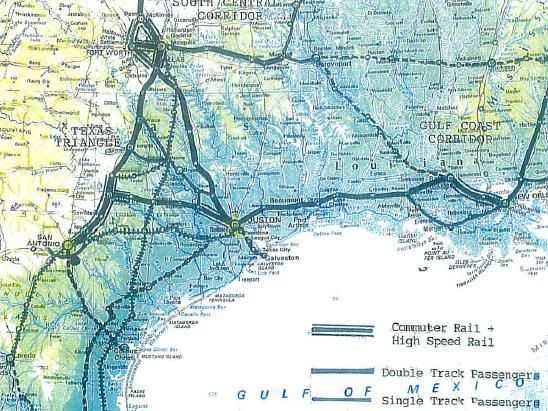 Back in the 90’s, Texas tried to get an Express HSR system off the ground (that is, a bullet train system somewhere in the 125mph to 220mph range) with the “Texas Triangle” project. It was to be an entirely privately funded project. Not surprisingly, competing against the heavily publicly subsidized interstate highway and air travel systems, it did not get off the ground.
More recently, the Texas T-Bone was proposed, based on the Dallas to San Antonio leg of the Triangle and a route from Houston to Temple, then running north to Dallas with connections south to Austin and San Antonio.
While the Texas T-Bone seems to be the current plan of the Texas High Speed Rail and Transportation Corporation, this is more of an advocacy group than an official HSR Commission or Rail Development Commission.
Given that we are in between periods of substantial federal funding for High Speed Rail, I thought this might be a good time to take a look at the prospects for Regional HSR, in some of the existing rail corridors within the “Texas Triangle” region … and so arrived at the Texas Wishbone.
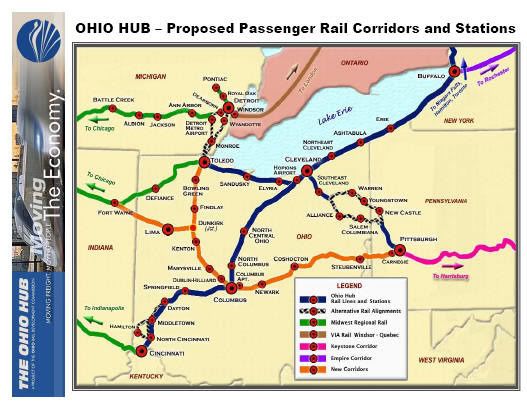 OK, now, thanks to John Kasich, we are not going to get started on that Rapid Rail HSR network before 2015. Indeed, Democrats would probably have to take back one of the two Chambers of the State Legislature to be able to hit the ground running on getting that Rapid Rail HSR network going in 2015.
 Two stories over the last week underlined the determination of the radical right wing that dominates the Republican Party to sabotage America’s future and betray our national security and the interests of our children and grandchildren:
  The headline spin on House Chairman of the Transport Committee is that he is proposing to privatize the NEC to allow HSR to be built in this decade.
 There was shocking news early this June about May economic performance: GDP growth in May was about the same as the average for the first quarter of 2011, and so employment growth was virtually stagnant, and indeed fell behind growth of the labor force.
 On Agent Orange,
  “Why We Fight” is a common feature of propaganda in support of a war. Here, tonight, it is a double entendre. On tonight’s Sunday Train, in honor of Memorial Day tomorrow, with two wars launched in the past decade and still ongoing (though in one, “combat operations” by US forces have finished, so any fighting and dying is of the support and training type of fighting and dying), and another recently started up, what it means when we notice that “why we fight” has a simple answer: oil.
 Last week, I looked at the California Legislative Analyst Office promoting a policy of raiding the California High Speed Rail funds to build commuter rail systems in LA and San Francisco by issuing what at first blush seemed to be simply a grossly incompetent analysis of the risks of building the HSR project.
 The big news on the High Speed Rail front this week is the effort by the California Legislative Analyst to prevent the High Speed Rail project in California from breaking ground. This is in two of their recommendations: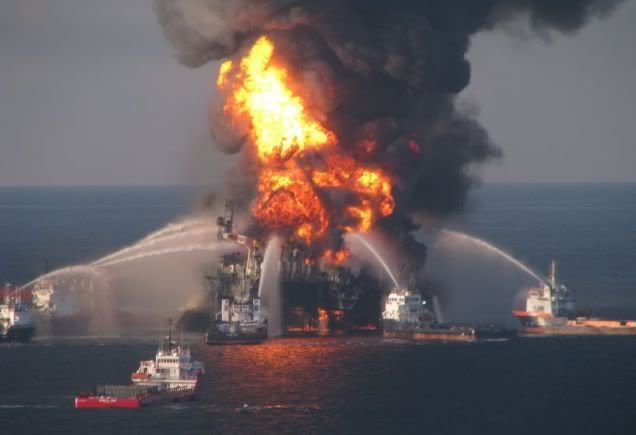
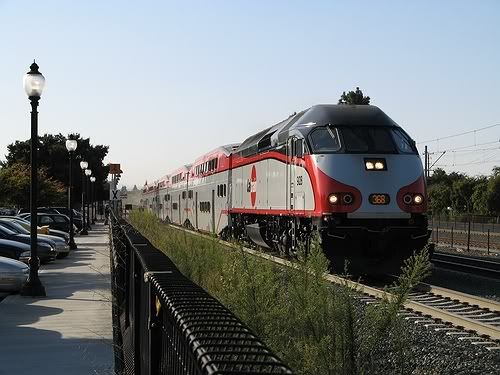 After the outcry when the Caltrain system between San Francisco and San Jose (and once in a while beyond) faced a scare that it would drop from 86 trains per day down to a peak-commute-only 48 trains per day …