
Author's posts
Jan 21 2012
On this Day In History January 21
Cross posted from The Stars Hollow Gazette
This is your morning Open Thread. Pour your favorite beverage and review the past and comment on the future.
Find the past “On This Day in History” here.
January 21 is the 21st day of the year in the Gregorian calendar. There are 344 days remaining until the end of the year (345 in leap years).
On this day in 1911, the first Monte Carlo Rally takes place.
The Monte Carlo Rally (officially Rallye Automobile Monte-Carlo) is a rallying event organised each year by the Automobile Club de Monaco who also organises the Formula One Monaco Grand Prix and the Rallye Monte-Carlo Historique . The rally takes place along the French Riviera in the Principality of Monaco and southeast France.
From its inception in 1911 by Prince Albert I, this rally, under difficult and demanding conditions, was an important means of testing the latest improvements and innovations to automobiles. Winning the rally gave the car a great deal of credibility and publicity. The 1966 event was the most controversial in the history of the Rally. The first four finishers driving three Mini-Coopers, Timo Makinen, Rauno Aaltonen and Paddy Hopkirk, and Roger Clark‘s 4th-placed Ford Cortina “were excluded for having iodine vapour, single filament bulbs in their standard headlamps instead of double-filament dipping bulbs.” This elevated Pauli Toivonen (Citroen ID) into first place overall. The controversy that followed damaged the credibility of the event. The headline in Motor Sport: “The Monte Carlo Fiasco.”
From 1973 to 2008 the rally was held in January as the first event of the FIA World Rally Championship, but since 2009 it has been the opening round of the Intercontinental Rally Challenge (IRC) programme. As recently as 1991, competitors were able to choose their starting points from approximately five venues roughly equidistant from Monte Carlo (one of Monaco’s administrative areas) itself. With often varying conditions at each starting point, typically comprising dry tarmac, wet tarmac, snow, and ice, sometimes all in a single stage of the rally. This places a big emphasis on tyre choices, as a driver has to balance the need for grip on ice and snow with the need for grip on dry tarmac. For the driver, this is often a difficult choice as the tyres that work well on snow and ice normally perform badly on dry tarmac.
The Automobile Club de Monaco confirmed on 19 July 2010 that the 79th Monte-Carlo Rally would form the opening round of the new Intercontinental Rally Challenge season. To mark the centenary event, the Automobile Club de Monaco have also confirmed that Glasgow, Barcelona, Warsaw and Marrakesh has been selected as start points for the rally.
Jan 20 2012
Anonymous Strikes Back Against FBI & Music Industry
Cross posted from The Stars Hollow Gazette
 This afternoon in raids that extended as far as New Zealand, the FBI took down on of the most popular websites in the world, Magaupload.com charging them with internet piracy seizing $50 million in assets and arresting seven people, four in New Zealand. Who needed SOPA?
Megaupload left this comment before the website went dark:
“The fact is that the vast majority of Mega’s Internet traffic is legitimate, and we are here to stay. If the content industry would like to take advantage of our popularity, we are happy to enter into a dialogue. We have some good ideas. Please get in touch.”
Not long after Meguploads was shut down and the news hit the web, this happened
Hacktivists with the collective Anonymous are waging an attack on the website for the White House after successfully breaking the sites for the FBI, Department of Justice, Universal Music Group, RIAA and Motion Picture Association of America. [..]
“It was in retaliation for Megaupload, as was the concurrent attack on Justice.org,” Anonymous operative Barrett Brown tells RT on Thursday afternoon. [..]
Brown adds that “more is coming” and Anonymous-aligned hacktivists are pursuing a joint effort with others to “damage campaign raising abilities of remaining Democrats who support SOPA.”
Although many members of Congress have just this week changed their stance on the controversial Stop Online Piracy Act, or SOPA, the raid on Megaupload Thursday proved that the feds don’t need SOPA or its sister legislation, PIPA, in order to pose a blow to the Web.
Brown adds that operatives involved in the project will use an “experimental campaign” and search engine optimization techniques “whereby to forever saddle some of these congressmen with their record on this issue.”
Despite the loss of support for SOPA and PIPA Wednesday night, the Democrats remain the chief sponsors of the bills. MPAA CEO Chris Dodd, the former Democratic senator from Connecticut that blocked all financial reform, and his cohort, former Senate Democrat, now Independent, Sen. Joseph Lieberman have admitted that they want to copy Chinese style censorship. In an guest post article at naked capitalism, Washington’s Blog George Washington follows the money from Hollywood’s music and film industry to the Democrats in the Senate who are the “pillars of support for PIPA”:
Far and away, the top beneficiary in the Senate from interest groups that support PIPA is Sen. Barbara Boxer (D-CA), who’s taken in just short of a million dollars from those groups, according to data from OpenSecrets.org. She’s also the most recent Senator to co-sponsor PIPA, adding her name to the list on Dec. 12. The runner-up is Sen. Al Franken (D-MN), who’s taken $777,383 from PIPA-supporting interest groups, and has co-sponsored the bill since May 2011.
In fact, a list of the top 20 beneficiaries of special interest money in favor of PIPA reads like a list of the Senate’s most influential Democrats: Sen. Kristen Gillibrand (D-NY) in third; Sen. Harry Reid (D-NV) in fourth; Sen. Chuck Schumer (D-NY) in fifth; Sen. Patrick Leahy (D-VT), the bill’s primary sponsor, in sixth; Sen. Dianne Feinstein (D-CA) in seventh; Sen. Claire McCaskill (D-MO) in eighth; Sen. Sheldon Whitehouse (D-RI) in ninth; and Sen. Michael Bennet (D-CO) in tenth.
The list goes on like that until Sen. Mitch McConnell (R-KY), who places 15th with $274,600 in special interest money promoting PIPA. He has not yet announced an official position on the bill. The only other Republican on the list of the top 20 PIPA beneficiaries in the Senate is Sen. Bob Corker (R-TN), in 19th place with $212,312. Corker is one of the bill’s co-sponsors.
I have to give at least one Democrat credit although she is not in the Senate, House Minority Leader Nancy Pelosi (D-CA) opposed SOPA.
This is far from over.
Jan 20 2012
On this Day In History January 20
Cross posted from The Stars Hollow Gazette
This is your morning Open Thread. Pour your favorite beverage and review the past and comment on the future.
Find the past “On This Day in History” here.
January 20 is the 20th day of the year in the Gregorian calendar. There are 345 days remaining until the end of the year (346 in leap years).
On this day in 1801, John Marshall is appointed the fourth Chief Justice of the United States. Marshall (September 24, 1755 – July 6, 1835) was an American jurist and statesman whose court opinions helped lay the basis for American constitutional law while enhancing the role of the Supreme Court as a center of power. Marshall was the fourth Chief Justice of the United States, serving from 1801 until his death in 1835. He had served in the United States House of Representatives from 1799 to 1800, and was Secretary of State under President John Adams from 1800 to 1801. Marshall was from the Commonwealth of Virginia and was a leader of the Federalist Party.
The longest-serving Chief Justice of the United States, Marshall dominated the Court for over three decades (a term outliving his own Federalist Party) and played a significant role in the development of the American legal system. Most notably, he reinforced the principle that federal courts are obligated to exercise judicial review, by disregarding purported laws if they violate the Constitution. Thus, Marshall cemented the position of the American judiciary as an independent and influential branch of government. Furthermore, the Marshall Court made several important decisions relating to federalism, affecting the balance of power between the federal government and the states during the early years of the republic. In particular, he repeatedly confirmed the supremacy of federal law over state law, and supported an expansive reading of the enumerated powers.
Marshall was thrust into the office of Chief Justice in the wake of the presidential election of 1800. With the Federalists soundly defeated and about to lose both the executive and legislative branches to Thomas Jefferson and the Democratic-Republicans, President Adams and the lame duck Congress passed what came to be known as the Midnight Judges Act, which made sweeping changes to the federal judiciary, including a reduction in the number of Justices from six to five so as to deny Jefferson an appointment until two vacancies occurred. As the incumbent Chief Justice Oliver Ellsworth was in poor health, Adams first offered the seat to ex-Chief Justice John Jay, who declined on the grounds that the Court lacked “energy, weight, and dignity.” Jay’s letter arrived on January 20, 1801, and as there was precious little time left, Adams nominated Marshall, who was with him at the time and able to accept immediately. The Senate at first delayed, hoping that Adams would make a different choice, such as promoting Justice William Paterson of New Jersey. According to New Jersey Senator Jonathan Dayton, the Senate finally relented “lest another not so qualified, and more disgusting to the Bench, should be substituted, and because it appeared that this gentleman (Marshall) was not privy to his own nomination”. Marshall was confirmed by the Senate on January 27, 1801, and received his commission on January 31, 1801. While Marshall officially took office on February 4, at the request of the President he continued to serve as Secretary of State until Adams’ term expired on March 4. President John Adams offered this appraisal of Marshall’s impact: “My gift of John Marshall to the people of the United States was the proudest act of my life.”
Jan 19 2012
Today on The Stars Hollow Gazette

Our regular featured content-
- On This Day In History January 19 by TheMomCat
- Punting the Pundits by TheMomCat
These featured articles-
- Both SOPA And PIPA Stopped For Now by TheMomCat
- Not Abel? by ek hornbeck
- What about NO do you not understand? by ek hornbeck
This is an Open Thread
Jan 19 2012
On this Day In History January 19
Cross posted from The Stars Hollow Gazette
This is your morning Open Thread. Pour your favorite beverage and review the past and comment on the future.
Find the past “On This Day in History” here.
January 19 is the 19th day of the year in the Gregorian calendar. There are 346 days remaining until the end of the year (347 in leap years).
On this day in 1853, Giuseppe Verdi‘s opera Il Trovatore receives its premiere performance in Rome.
Il trovatore (The Troubadour) is an opera in four acts by Giuseppe Verdi to an Italian libretto by Salvadore Cammarano, based on the play El Trovador (1836) by Antonio Garcia Gutierrez. Cammarano died in mid-1852 before completing the libretto. This gave the composer the opportunity to propose significant revisions, which were accomplished under his direction by the young librettist, Leone Emanuele Bardare, and they are seen largely in the expansion of the role of Leonora.
The opera was first performed at the Teatro Apollo, Rome, on 19 January 1853 where it “began a victorious march throughout the operatic world”. Today it is given very frequently and is a staple of the standard operatic repertoire. It appears at number 17 on Opera America‘s list of the 20 most-performed operas in North America.
Enrico Caruso once said that all it takes for successful performance of Il trovatore is the four greatest singers in the world. On many different occasions, this opera and its music have been featured in various forms of popular culture and entertainment. Scenes of comic chaos play out over a performance of Il trovatore in the Marx Brothers‘s film, A Night at the Opera. Luchino Visconti used a performance of Il trovatore at La Fenice opera house for the opening sequence of his 1954 film Senso. As Manrico sings his battle cry in “Di quella pira”, the performance is interrupted by the answering cries of Italian nationalists in the audience. In Italian Film in the Light of Neorealism, Millicent Marcus proposes that Visconti used this operatic paradigm throughout Senso, with parallels between the opera’s protagonists, Manrico and Leonora, and the film’s protagonists, Ussoni and Livia.
Jan 19 2012
Both SOPA And PIPA Stopped For Now
Cross posted from The Stars Hollow Gazette
 It certainly been an eventful day. The two bills, Stop Online Piracy Act (SOPA) and Protect Intellectual Property Act (PIPA), were defeated Wednesday by an internet blackout of key web sites and the avalanche of petitions, street protests, e-mails and phone calls to congressional members.
When the powerful world of old media mobilized to win passage of an online antipiracy bill, it marshaled the reliable giants of K Street – the United States Chamber of Commerce, the Recording Industry Association of America and, of course, the motion picture lobby, with its new chairman, former Senator Christopher J. Dodd, the Connecticut Democrat and an insider’s insider.
Yet on Wednesday this formidable old guard was forced to make way for the new as Web powerhouses backed by Internet activists rallied opposition to the legislation through Internet blackouts and cascading criticism, sending an unmistakable message to lawmakers grappling with new media issues: Don’t mess with the Internet. [..]
Congress now follows Bank of America, Verizon and Netflix as the latest institution to forced to change course by an internet led revolt.
It was especially dismaying that First Amendment stalwarts, like Senator Patrick Leahy and Representative John Conyers Jr. of Michigan, were sponsoring this bill. It took Republicans in the House, assisted by Paul Ryan (R-WI) and, initially, six Republican senators to get both bill pulled from consideration. To his credit, Sen. Ron Wyden (D-OR) was a one man road block to PIPA until the Republicans, pressured by their House compatriots, pulled their support.
So, besides Sen. Wyden, why weren’t there more Democrats opposed? Why were they even supporting a bill that would infringe on free speech and hurt job growth in the technology field? Follow the money. Hollywood, the music and movie industry, are a big supporters of anti-piracy and IP protection laws and Democrats.
Former Senator, Chris Dodd (D-CT), who forswore a lobbying career but is now CEO of Motion Picture Assn. of America, railed against technology companies such as Google, Mozilla and Wikipedia calling the blackout a “stunt”:
“It is an irresponsible response and a disservice to people who rely on them for information and who use their services,” Dodd said in a statement. “It is also an abuse of power given the freedoms these companies enjoy in the marketplace today.”
It wasn’t until Saturday that President Obama spoke out about the most controversial portions of the House bill that would require Internet service providers to block infringing websites but said nothing about PIPA, the Senate version, and fell short of saying he would veto the bill.
Up until the last few days the media, especially television and cable have been pretty silent. Chris Hayes of MSNBC’s “Up with Chris” hosted a debate with NBC Universal’s General Counsel, Richard Cotton, Alexis Ohanian, co-founder of Reddit.com, former Rep. Joe Sestak (D-PA) and former lobbyist Jack Abramoff. Since it became apparent that the traditional media was missing the boat on one of the biggest news stories of the year, they all started jumping back on the ship.
Wednesday night, Mr. Hayes was a guest on “The Rachel Maddow Show” where he and Rachel talked about the power and effectiveness of the online protest in influencing Congress who by and large didn’t understand the bills or the internet.
Will this stop these two bills? No, it won’t. As Wikipedia points out in its thank you to its visitors, “we’re not done yet”
SOPA sponsor Lamar Smith stated that the House of Representatives will push the bill forward in February. Senate sponsor Patrick Leahy still plans for a PIPA vote on January 24.
Moreover, SOPA and PIPA are symptoms of a larger issue. They are misguided solutions to a misunderstood problem. In the U.S. and abroad, legislators and big media are embracing censorship and sacrificing civil liberties in their attacks on free knowledge and an open Internet.
Although support has slipped in both the Senate and the House, there is a Senate vote on PIPA scheduled for January 24, and the House will be moving forward as well. It is important to keep the pressure up on both houses. We expect changes that appear to tone down the damaging effects of the laws, without addressing their fundamental flaws.
Keep calling your representatives! Tell them you believe in a free and open Internet!
It looks like this is just start of the war to save the internet.
Jan 18 2012
On this Day In History January 18
Cross posted from The Stars Hollow Gazette
This is your morning Open Thread. Pour your favorite beverage and review the past and comment on the future.
Find the past “On This Day in History” here.
January 18 is the 18th day of the year in the Gregorian calendar. There are 347 days remaining until the end of the year (348 in leap years).
On this day in 1865, the United States House of Representatives passes the 13th Amendment to the Constitution, abolishing slavery in the United States. It read, “Neither slavery nor involuntary servitude…shall exist within the United States, or any place subject to their jurisdiction.”
The Thirteenth Amendment to the United States Constitution officially abolished and continues to prohibit slavery and involuntary servitude, except as punishment for a crime. It was passed by the Senate on April 8, 1864, passed by the House on January 31, 1865, and adopted on December 6, 1865. On December 18, Secretary of State William H. Seward, in a proclamation, declared it to have been adopted. It was the first of the Reconstruction Amendments.
President Lincoln was concerned that the Emancipation Proclamation, which outlawed slavery in the ten Confederate states still in rebellion in 1863, would be seen as a temporary war measure, since it was based on his war powers and did not abolish slavery in the border states.
The first twelve amendments were adopted within fifteen years of the Constitution’s adoption. The first ten (the Bill of Rights) were adopted in 1791, the Eleventh Amendment in 1795 and the Twelfth Amendment in 1804. When the Thirteenth Amendment was proposed there had been no new amendments adopted in more than sixty years.
During the secession crisis, but prior to the outbreak of the Civil War, the majority of slavery-related bills had protected slavery. The United States had ceased slave importation and intervened militarily against the Atlantic slave trade, but had made few proposals to abolish domestic slavery, and only a small number to abolish the domestic slave trade. Representative John Quincy Adams had made a proposal in 1839, but there were no new proposals until December 14, 1863, when a bill to support an amendment to abolish slavery throughout the entire United States was introduced by Representative James Mitchell Ashley (Republican, Ohio). This was soon followed by a similar proposal made by Representative James F. Wilson(Republican, Iowa).
Eventually the Congress and the public began to take notice and a number of additional legislative proposals were brought forward. On January 11, 1864, Senator John B. Henderson of Missouri submitted a joint resolution for a constitutional amendment abolishing slavery. The abolition of slavery had historically been associated with Republicans, but Henderson was one of the War Democrats. The Senate Judiciary Committee, chaired by Lyman Trumbull (Republican, Illinois), became involved in merging different proposals for an amendment. On February 8 of that year, another Republican, Senator Charles Sumner (Radical Republican, Massachusetts), submitted a constitutional amendment to abolish slavery as well as guarantee equality. As the number of proposals and the extent of their scope began to grow, the Senate Judiciary Committee presented the Senate with an amendment proposal combining the drafts of Ashley, Wilson and Henderson.
Originally the amendment was co-authored and sponsored by Representatives James Mitchell Ashley (Republican, Ohio) and James F. Wilson (Republican, Iowa) and Senator John B. Henderson (Democrat, Missouri).
While the Senate did pass the amendment on April 8, 1864, by a vote of 38 to 6, the House declined to do so. After it was reintroduced by Representative James Mitchell Ashley, President Lincoln took an active role in working for its passage through the House by ensuring the amendment was added to the Republican Party platform for the upcoming Presidential elections. His efforts came to fruition when the House passed the bill on January 31, 1865, by a vote of 119 to 56. The Thirteenth Amendment’s archival copy bears an apparent Presidential signature, under the usual ones of the Speaker of the House and the President of the Senate, after the words “Approved February 1, 1865”.
The Thirteenth Amendment completed the abolition of slavery, which had begun with the Emancipation Proclamation issued by President Abraham Lincoln in 1863.
Shortly after the amendment’s adoption, selective enforcement of certain laws, such as laws against vagrancy, allowed blacks to continue to be subjected to involuntary servitude in some cases.
The Thirteenth Amendment was followed by the Fourteenth Amendment (civil rights in the states), in 1868, and the Fifteenth Amendment (which bans racial voting restrictions), in 1870.
Jan 17 2012
Protesting SOPA, Web Sites Go Dark
Cross posted from The Stars Hollow Gazette
 Over the weekend the discussion about bills pending in Congress that would change the Internet has started to get some attention. Opposition to Stop Internet Piracy Act, House version and the Senate’s version, Protect the Internet Privacy Act came from the White House in a statement expressing concerns that the bills would stifle innovation and infringe on free speech and lead to “online censorship of lawful activity.” While the White House statement did not say Pres. Obama would veto it, it was a clear condemnation of the flaws critics have pointed to in the bill.
One of the most controversial portions of the House bill that would require Internet service providers to block infringing websites was removed completely by House Judiciary Chairman Lamar Smith (R-TX). Rep. Darrel Issa (R-CA) secured a promise from Majority Leader Eric Cantor (R-VA) that the House will not vote unless there is consensus on the bill. A Reddit campaign managed to persuade Rep. Paul Ryan (R-WI) to oppose the bill, for instance.
On the Senate side, PIPA had up unit now blocked by a lone senator, Ron Wyden (D-OR. He has now been joined by Sen. Ben Cardin (D-MD)and Mark Udall (D-CO). Similarly, six Republican Senators, including two co-sponsors — Senators Orrin Hatch (R-UT), Chuck Grassley (R-IA) (the two co-sponsors) along with John Cornyn (R-TX), Jeff Sessions (R-AL), Mike Lee (R-UT) and Tom Coburn (R-OK) — have asked Aenate Majority Leader Harry Reid (D_NV)not to bring the cloture vote he’s promised to bring on the 24th. Sen. Pat Leahy, a key sponsor of the Protect IP Act, has conceded that more study is needed for the provisions that would allow rogue sites to be delisted from the Domain Name Service (basically the Internet’s phone directory). Critics have warned that mucking with DNS could splinter the architecture of the Internet.
On Wednesday beginning at midnight, several major web sites will go dark for 24 hours. Websites Wikpedia, Reddit, Craig’s List and ICanHasCheezburger.com are among the larger sites that will participate. The document-sharing site Scribd, for instance, made a billion pages vanish to protest the bill. Wikipedia users can view proposed designs for “blackout pages,” which may appear in place of normal Wikipedia entries during the protest on January 18.
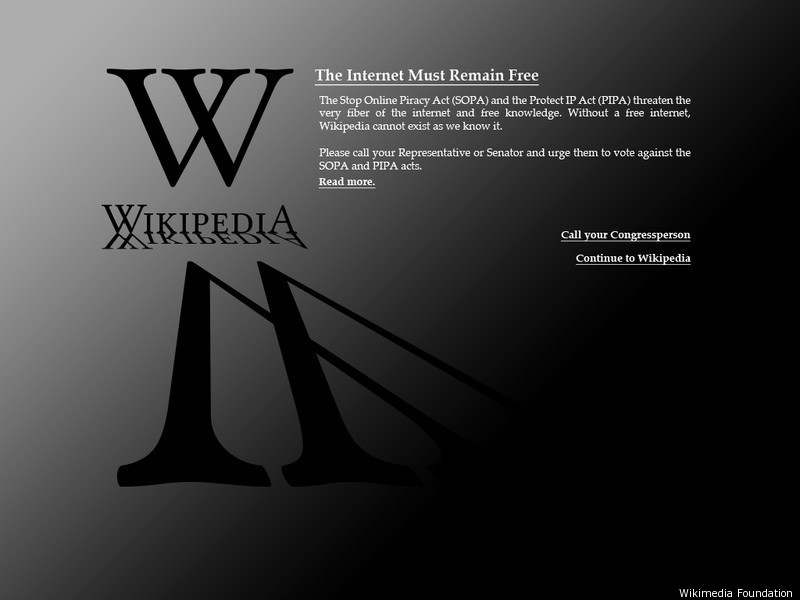
click on image to enlarge.
In New York City, New York Tech Meetup, a 20,000 member community of people working in the New York Tech Industry are protesting the pending legislation in from of the offices of Senators Charles Schumer and Kirsten Gillibrand who are still supporting the bill and urging Sen. Reid to bring the bill to the floor for cloture. One of the largest areas of job growth in NYC has been in the tech industries. New York Tech believes that SOPA, besides threatening freedom of speech, will kill those jobs.
You can physically join the NYC Protest at this site:
When: Wednesday January 18, 2012
Time 12:30-2:00PM
Where: 780 Third Ave (at 49th street) – outside the offices of New York Senators Charles Schumer and Kirsten Gillibrand
Jan 17 2012
Today on The Stars Hollow Gazette
Our regular featured content-
- On This Day In History January 17 by TheMomCat
- Punting the Pundits by TheMomCat
These featured articles-
- Go Vikings! by ek hornbeck
- Protesting SOPA, Web Sites Go Dark by TheMomCat
- But, if not… by ek hornbeck
This is an Open Thread
Jan 17 2012
Austerity Insanity
Cross posted from The Stars Hollow Gazette
Doing the same thing repeatedly and expecting different results is the definition of insanity. It then must follow that Germany’s Chancellor, Andrea Merkel has got to be insane.
Eurozone in new crisis as ratings agency downgrades nine countries
Standard & Poor’s strips France of its AAA credit rating, rekindling fears in the markets over future of single currency
S&P said austerity was driving Europe even deeper into financial crisis as it also cut Austria’s triple-A rating, and relegated Portugal and Cyprus to junk status.
The humiliating loss of France’s top-rated status leaves Germany as the only other major economy inside the eurozone with a AAA rating, and rekindled financial market anxiety about a possible break-up of the single currency.
S&P brought an abrupt end to the uneasy calm that has existed in the eurozone since the turn of the year by downgrading the ratings of Cyprus, Italy, Portugal and Spain by two notches. Austria, France, Malta, Slovakia and Slovenia were all cut by one notch.
The agency said that its actions on eurozone ratings were “primarily driven by insufficient policy measures by EU leaders to fully address systemic stresses”. It added that fiscal austerity alone “risks becoming self-defeating“.
Germany,too may be facing a downgrade as it slips into recession as its economy is contracting in the face of the deflationary economic policy of the euro zone. So what does Frau Merkel do? You got it, more austerity.
Merkel: Europe Faces ‘Long Road’ to Win Back Trust
German Chancellor Angela Merkel said Standard and Poor’s downgrades of nine countries underline the fact that the eurozone faces a “long road” to win back investors’ confidence, pushing Saturday for it to move quickly on a new budget discipline pact and a permanent rescue fund.
I agree with Chris in Paris at AMERICAblog that the ratings agencies should be rendered useless considering their part in the current economic crisis but they are right about austerity. The Europeans led by Merkel are ignoring reality.
Jan 17 2012
On this Day In History January 17
Cross posted from The Stars Hollow Gazette
This is your morning Open Thread. Pour your favorite beverage and review the past and comment on the future.
Find the past “On This Day in History” here.
January 17 is the 17th day of the year in the Gregorian calendar. There are 348 days remaining until the end of the year (349 in leap years).
On this day in 1961, President Dwight D. Eisenhower delivers his farewell address to the nation warning the American people to keep a careful eye on what he calls the “military-industrial complex” that has developed in the post-World War II years.
A fiscal conservative, Eisenhower had been concerned about the growing size and cost of the American defense establishment since he became president in 1953. In his last presidential address to the American people, he expressed those concerns in terms that frankly shocked some of his listeners.
Eisenhower began by describing the changing nature of the American defense establishment since World War II. No longer could the U.S. afford the “emergency improvisation” that characterized its preparations for war against Germany and Japan. Instead, the United States was “compelled to create a permanent armaments industry” and a huge military force. He admitted that the Cold War made clear the “imperative need for this development,” but he was gravely concerned about “the acquisition of unwarranted influence…by the military-industrial complex.” In particular, he asked the American people to guard against the “danger that public policy could itself become the captive of a scientific-technological elite.”
Military-industrial complex (MIC) is a concept commonly used to refer to policy relationships between governments, national armed forces, and the industrial sector that supports them. These relationships include political approval for research, development, production, use, and support for military training, weapons, equipment, and facilities within the national defense and security policy. It is a type of iron triangle.
The term is most often played in reference to the military of the United States, where it gained popularity after its use in the farewell address speech of President Dwight D. Eisenhower, though the term is applicable to any country with a similarly developed infrastructure.
It is sometimes used more broadly to include the entire network of contracts and flows of money and resources among individuals as well as institutions of the defense contractors, The Pentagon, and the Congress and executive branch. This sector is intrinsically prone to principal-agent problem, moral hazard, and rent seeking. Cases of political corruption have also surfaced with regularity.
A similar thesis was originally expressed by Daniel Guerin, in his 1936 book Fascism and Big Business, about the fascist government support to heavy industry. It can be defined as, “an informal and changing coalition of groups with vested psychological, moral, and material interests in the continuous development and maintenance of high levels of weaponry, in preservation of colonial markets and in military-strategic conceptions of internal affairs”.