
Author's posts
Feb 22 2012
Today on The Stars Hollow Gazette

Our regular featured content-
- On This Day In History February 22 by TheMomCat
- Punting the Pundits by TheMomCat
These featured articles-
- Supreme Court To Revisit Affirmative Action by: TheMomCat
- The Joke Is On Schneiderman by: TheMomCat
- Crooks on the Loose! by: ek hornbeck
This is an Open Thread
Feb 22 2012
On This Day In History February 22
Cross posted from The Stars Hollow Gazette
This is your morning Open Thread. Pour your favorite beverage and review the past and comment on the future.
Find the past “On This Day in History” here.
February 22 is the 53rd day of the year in the Gregorian calendar. There are 312 days remaining until the end of the year (313 in leap years).
On this day in 1980, the U.S. Olympic hockey team makes “miracle on ice”.
In one of the most dramatic upsets in Olympic history, the underdog U.S. hockey team, made up of college players, defeats the four-time defending gold-medal winning Soviet team at the XIII Olympic Winter Games in Lake Placid, New York. The Soviet squad, previously regarded as the finest in the world, fell to the youthful American team 4-3 before a frenzied crowd of 10,000 spectators.
The United States did not win the gold medal upon defeating the USSR. In 1980 the medal round was a round-robin, not a single elimination format as it is today. Under Olympic rules at the time, the group game with Sweden was counted along with the medal round games versus the Soviet Union and Finland so it was mathematically possible for the United States to finish anywhere from first to fourth.
Needing to win to secure the gold medal, Team USA came back from a 2-1 third period deficit to defeat Finland 4-2. According to Mike Eruzione, coming into the dressing room in the second intermission, Brooks turned to his players, looked at them and said, “If you lose this game, you’ll take it to your graves.” He then paused, took a few steps, turned again, said, “Your fucking graves,” and walked out.
At the time, the players ascended a podium to receive their medals and then lined up on the ice for the playing of the national anthem, as the podium was only meant to accommodate one person. Only the team captains remained on the podium for the duration. After the completion of the anthem, Eruzione motioned for his teammates to join him on the podium. Today, the podiums are large enough to accommodate all of the players.
The victory bolstered many American citizens’ feelings of national pride, which had been severely strained during the turbulent 1970s. The match against the Soviets popularized the “U-S-A! U-S-A!” chant, which has been used by American supporters at many international sports competitions since 1980.
Feb 22 2012
On This Day In History February 23
Cross posted from The Stars Hollow Gazette
This is your morning Open Thread. Pour your favorite beverage and review the past and comment on the future.
Find the past “On This Day in History” here.
February 23 is the 54th day of the year in the Gregorian calendar. There are 311 days remaining until the end of the year (312 in leap years).
On this day in 1954, a group of children from Arsenal Elementary School in Pittsburgh, Pennsylvania, receive the first injections of the new polio vaccine developed by Dr. Jonas Salk.
Though not as devastating as the plague or influenza, poliomyelitis was a highly contagious disease that emerged in terrifying outbreaks and seemed impossible to stop. Attacking the nerve cells and sometimes the central nervous system, polio caused muscle deterioration, paralysis and even death. Even as medicine vastly improved in the first half of the 20th century in the Western world, polio still struck, affecting mostly children but sometimes adults as well. The most famous victim of a 1921 outbreak in America was future President Franklin Delano Roosevelt, then a young politician. The disease spread quickly, leaving his legs permanently paralyzed.
Poliomyelitis, often called polio or infantile paralysis, is an acute viral infectious disease spread from person to person, primarily via the fecal-oral route The term derives from the Greek polios, meaning “grey”, myelos, referring to the “spinal cord”, and the suffix -itis, which denotes inflammation.
Although around 90% of polio infections cause no symptoms at all, affected individuals can exhibit a range of symptoms if the virus enters the blood stream. In about 1% of cases the virus enters the central nervous system, preferentially infecting and destroying motor neurons, leading to muscle weakness and acute flaccid paralysis. Different types of paralysis may occur, depending on the nerves involved. Spinal polio is the most common form, characterized by asymmetric paralysis that most often involves the legs. Bulbar polio leads to weakness of muscles innervated by cranial nerves. Bulbospinal polio is a combination of bulbar and spinal paralysis.
Poliomyelitis was first recognized as a distinct condition by Jakob Heine in 1840. Its causative agent, poliovirus, was identified in 1908 by Karl Landsteiner. Although major polio epidemics were unknown before the late 19th century, polio was one of the most dreaded childhood diseases of the 20th century. Polio epidemics have crippled thousands of people, mostly young children; the disease has caused paralysis and death for much of human history. Polio had existed for thousands of years quietly as an endemic pathogen until the 1880s, when major epidemics began to occur in Europe; soon after, widespread epidemics appeared in the United States.
By 1910, much of the world experienced a dramatic increase in polio cases and frequent epidemics became regular events, primarily in cities during the summer months. These epidemics-which left thousands of children and adults paralyzed-provided the impetus for a “Great Race” towards the development of a vaccine. Developed in the 1950s, polio vaccines are credited with reducing the global number of polio cases per year from many hundreds of thousands to around a thousand. Enhanced vaccination efforts led by the World Health Organization, UNICEF, and Rotary International could result in global eradication of the disease.
While now rare in the Western world, polio is still endemic to South Asia and Nigeria. Following the widespread use of poliovirus vaccine in the mid-1950s, the incidence of poliomyelitis declined dramatically in many industrialized countries. A global effort to eradicate polio began in 1988, led by the World Health Organization, UNICEF, and The Rotary Foundation. These efforts have reduced the number of annual diagnosed cases by 99%; from an estimated 350,000 cases in 1988 to a low of 483 cases in 2001, after which it has remained at a level of about 1,000 cases per year (1,606 in 2009). Polio is one of only two diseases currently the subject of a global eradication program, the other being Guinea worm disease. If the global Polio Eradication initiative is successful before that for Guinea worm or any other disease, it would be only the third time humankind has ever completely eradicated a disease, after smallpox in 1979 and rinderpest in 2010. A number of eradication milestones have already been reached, and several regions of the world have been certified polio-free. The Americas were declared polio-free in 1994. In 2000 polio was officially eliminated in 36 Western Pacific countries, including China and Australia. Europe was declared polio-free in 2002. As of 2006, polio remains endemic in only four countries: Nigeria, India (specifically Uttar Pradesh and Bihar), Pakistan, and Afghanistan, although it continues to cause epidemics in other nearby countries born of hidden or reestablished transmission.
Feb 21 2012
Mardi Gras
Cross posted from The Stars Hollow Gazette
 Mardi Gras en français or Fat Tuesday in English, it is time to party. It’s the last day for some Christians to eat all the food they like and party before the season of fasting before Lent. In many traditions it isn’t just one day. Mardi Gras, or Carnival season, starts in January after 12th Night or the Epiphany, culminating at midnight on the day before Ash Wednesday. English traditions call the day Shrove Tuesday and for many religious Christians a time for confession. Celebrations vary from city to city and by country but many of the traditions are the same masks, beads, parades and parties. In Mobile, Alabama,the former capital of New France, the Mardi Gras social events start in November with “mystic society” balls on Thanksgiving and New Year’s Eve with more parades and balls in January and February ending on the traditional Tuesday before Lent. And you thought New Orleans and Rio de Janeiro were the party cities, heh. Many if these balls raise large amounts of money for charity, justifying in a way the “decadence”. In other places with a French heritage, like Louisiana, where the revelry also starts weeks before with parades and parties celebrating the arrival of the “Krewes” or organizations that sponsor various parades, the day is an official holiday. Like anyone in New Orleans is going to the office that day. There’s many traditional foods, too, like pancakes, fruit laden sweet breads and sugary pastries. Any food with lots of fat and eggs. Look out arteries here it comes.
Mardi Gras was introduced to America in colonial days as a sedate religious tradition by Pierre Le Moyne d’Iberville and Jean-Baptiste Le Moyne de Bienville, in the late 17th century, when King Louis XIV sent the pair to defend France’s claim on the territory of Louisiane.
The expedition, led by Iberville, entered the mouth of the Mississippi River on the evening of March 2, 1699, Lundi Gras, not yet knowing it was the river explored and claimed for France by René-Robert Cavelier, Sieur de La Salle in 1683. The party proceeded upstream to a place on the west bank about 60 miles downriver from where New Orleans is today, where a small tributary emptied into the great river, and made camp. This was on March 3, 1699, Mardi Gras day, so in honor of this holiday, Iberville named the spot Point du Mardi Gras (French: “Mardi Gras Point”) and called the small tributary Bayou Mardi Gras. Bienville went on to found Mobile, Alabama in 1702 as the first capital of French Louisiana. In 1703 French settlers in that city began to celebrate the Mardi Gras tradition. By 1720, Biloxi was made capital of Louisiana. While it had French settlers, Mardi Gras and other customs were celebrated with more fanfare given its new status. In 1723, the capital of French Louisiana was moved to New Orleans, founded in 1718. With the growth of New Orleans as a city and the creolization of different cultures, the varied celebration of Mardi Gras became the event most strongly associated with the city. In more recent times, several U.S. cities without a French Catholic heritage have instituted the celebration of Mardi Gras, which sometimes emerged as grassroots movements.
In other countries Mardi Gras has different names. In Belgium’s city of Binche it is the most important day if the year:
The carnival is the most known of several others that take place in Belgium at the same time and has been proclaimed as a Masterpiece of the Oral and Intangible Heritage of Humanity listed by UNESCO. Its history dates back to approximately the 14th century.
Events related to the carnival begin up to seven weeks prior to the primary celebrations. Street performances and public displays traditionally occur on the Sundays approaching Ash Wednesday, consisting of prescribed musical acts, dancing, and marching. Large numbers of Binche’s inhabitants spend the Sunday directly prior to Ash Wednesday in costume.
The centrepiece of the carnival’s proceedings are clown-like performers known as Gilles. Appearing, for the most part, on “Shrove” Tuesday, the Gilles are characterised by their vibrant dress, wax masks and wooden footwear. They number up to 1,000 at any given time, range in age from 3 to 60, and are customarily male. The honour of being a Gille at the carnival is something that is to be aspired to by local men. From dawn on the morning of the carnival’s final day, Gilles appear in the centre of Binche, to dance to the sound of drums and ward evil spirits away with sticks. Later, during the day, they don large hats adorned with ostrich plumes, which can cost upwards of $300 US dollars to rent, and march through the town with baskets of oranges. These oranges are thrown to, and sometimes at, members of the crowd gathered to view the procession. The vigour and longevity of the orange throwing event has in past caused damage to property – some residents choose to seal windows to prevent this.
In Germany, Switzerland and Austria, Mardi Gras is called Karneval, Fastnacht, or Fasching. Fastnacht means “Eve of the Beginning of the Fast”. One of the largest festivals is in Cologne, Germany:
Traditionally, the “fifth season” (carnival season) is declared open at 11 minutes past 11 on the 11th of November. The Carnival spirit is then temporarily suspended during the Advent and Christmas period, and picks up again in earnest in the New Year. The time of merrymaking in the streets is officially declared open at downtown square Alter Markt on the Thursday before the beginning of Lent. Street carnival, a week-long street festival, also called “the crazy days”, takes place between the Fat Thursday (Weiberfastnacht) and ends on Ash Wednesday (Aschermittwoch). The highlight of the carnival is Rose Monday (Rosenmontag), two days before Ash Wednesday. All through these days, Cologne folks go out masqueraded. The typical greeting during the festival is Kölle Alaaf!, a Kölsch phrase which can be translated as “Cologne above all!”
In Europe, some of the earliest Carnivales were in Italy. One of the most elegant and sumptuous is in the canal city if Venice:
It is said that the Carnival of Venice was originated from a victory of the “Repubblica della Serenissima”, Venice previous name, against the Patriarch of Aquileia, Ulrico in the year 1162. In the honor of this victory, the people started to dance and make reunions in San Marco Square. Apparently this festival started on that period and become official in the renaissance. After a long absence, the carnival return to operate in 1979. the Italian government decided to bring back the history and culture of Venice, and sought to use the traditional Carnival as the centerpiece of their efforts. Today, approximately 3,000,000 visitors come to Venice each day for Carnivals. One of the most important events is the contest for the best mask, placed at the last weekend of the Carnival. A jury of international costume and fashion designers votes for “La Maschera piu bella”. [..]
Masks have always been a central feature of the Venetian carnival; traditionally people were allowed to wear them between the festival of Santo Stefano (St. Stephen’s Day, December 26) and the start of the carnival season and midnight of Shrove Tuesday. They have always been around Venice. As masks were also allowed on Ascension and from October 5 to Christmas, people could spend a large proportion of the year in disguise. Maskmakers (mascherari) enjoyed a special position in society, with their own laws and their own guild.
Venetian masks can be made in leather or with the original glass technique. The original masks were rather simple in design,decoration, often had a symbolic, and practical function.[5] Nowadays, most of them are made with the application of gesso and gold leaf and are all hand-painted using natural feathers and gems to decorate.
I would be remiss if I didn’t include the Carnivals of Brazil:
Carnaval is the most famous holiday in Brazil and has become an event of huge proportions. Excepted the industries, malls and the carnival related workers, the country stops completely for almost a week and festivities are intense, day and night, mainly in coastal cities. The consumption of beer accounts for 80% of annual consumption[citation needed] and tourism receives 70% of annual visitors. The government distributes condoms and launches awareness campaigns at this time to prevent the spread of AIDS.
Each Brazilian has its own unique celebration, the most famous, of course, is the one in Rio de Janeiro:
Modern Brazilian Carnival originated in Rio de Janeiro in 1641 when the city’s bourgeoisie, largely Portuguese, imported the practice of holding balls and masquerade parties from Paris. It originally mimicked the European form of the festival, later absorbing and creolizing elements derived from Native American and African cultures.
In the late 19th century, the cordões (literally “cords”, laces or strings in Portuguese) were introduced in Rio de Janeiro. These were pageant groups that paraded through city avenues performing on instruments and dancing. Today they are known as Blocos (blocks), consisting of a group of people who dress in costumes or special t-shirts with themes and/or logos. Blocos are generally associated with particular neighborhoods; they include both a percussion or music group and an entourage of revellers.
Block parades have become an expressive feature of Rio’s Carnival. Today, they number more than 100 and the groups increase each year. Blocos can be formed by small or large groups of revelers with a distinct title with an often funny pun. (Os blocos RJ, para os solteiros, são um lugar para conhecer e até beijar pessoas, or “The blocos in Rio de Janeiro, for the singles, are places to meet and even kiss people.”) They may also note their neighborhood or social status. Before the show, they gather in a square, then parade in sections of the city, often near the beach. Some blocos never leave one street and have a particular place, such as a bar, to attract viewers. Block parades start in January, and may last until the Sunday after Carnival.
There occur Blocos parades in nearly every neighborhood throughout the city and metropolitan areas, but the most famous are the ones in Copacabana, Ipanema, Leblon, Lagoa, Jardim Botânico, and in downtown Rio. Organizers often compose their own music themes that are added to the performance and singing of classic “marchinhas” and samba popular songs. “Cordão do bola preta” (“Polka Dot Bloco”), that goes through the heart of Rio’s historical center, and “Suvaco do Cristo” (Christ’s statue armpit, referring to the angle of the statue seen from the neighborhood), near the Botanical Garden, are some of the most famous groups. Monobloco has become so famous that it plays all year round at parties and small concerts.
Samba schools are very large groups of performers, financed by respected organizations (as well as illegal gambling groups), who work year round in preparation for Carnival. Samba Schools perform in the Sambadrome, which runs four entire nights. They are part of an official competition, divided into seven divisions, in which a single school is declared the winner, according to costume, flow, theme, and band music quality and performance. Some samba schools also hold street parties in their neighborhoods, through which they parade along with their followers.
Feb 21 2012
On This Day In History February 21
Cross posted from The Stars Hollow Gazette
This is your morning Open Thread. Pour your favorite beverage and review the past and comment on the future.
Find the past “On This Day in History” here.
February 21 is the 52nd day of the year in the Gregorian calendar. There are 313 days remaining until the end of the year (314 in leap years).
On this day in 1965, Malcolm X, an African American nationalist and religious leader, is assassinated by rival Black Muslims while addressing his Organization of Afro-American Unity at the Audubon Ballroom in Washington Heights in New York City.
Malcolm X began to speak to a meeting of the Organization of Afro-American Unity when a disturbance broke out in the crowd of 400. A man yelled, “Nigger! Get your hand outta my pocket!” As Malcolm X and his bodyguards moved to quiet the disturbance, a man rushed forward and shot him in the chest with a sawed-off shotgun. Two other men charged the stage and fired handguns, hitting him 16 times. Furious onlookers caught and beat one of the assassins as the others fled the ballroom. Malcolm X was pronounced dead at 3:30 p.m., shortly after he arrived at Columbia Presbyterian Hospital.
Talmadge Hayer, a Nation of Islam member also known as Thomas Hagan, was arrested on the scene. Eyewitnesses identified two more suspects, Norman 3X Butler and Thomas 15X Johnson, also members of the Nation. All three were charged in the case. At first Hayer denied involvement, but during the trial he confessed to having fired shots at Malcolm X. He testified that Butler and Johnson were not present and were not involved in the assassination, but he declined to name the men who had joined him in the shooting. All three men were convicted.
Butler, now known as Muhammad Abdul Aziz, was paroled in 1985. He became the head of the Nation of Islam’s Harlem mosque in New York in 1998. He continues to maintain his innocence. Johnson, now known as Khalil Islam, was released from prison in 1987. During his time in prison, he rejected the teachings of the Nation of Islam and converted to Sunni Islam. He, too, maintains his innocence. Hayer, now known as Mujahid Halim, was paroled in 2010.
The number of mourners who came to the public viewing in Harlem’s Unity Funeral Home from February 23 through February 26 was estimated to be between 14,000 and 30,000. The funeral of Malcolm X was held on February 27 at the Faith Temple Church of God in Christ in Harlem. The Church was filled to capacity with more than 1,000 people. Loudspeakers were set up outside the Temple so the overflowing crowd could listen and a local television station broadcast the funeral live.
Among the civil rights leaders in attendance were John Lewis, Bayard Rustin, James Forman, James Farmer, Jesse Gray, and Andrew Young. Actor and activist Ossie Davis delivered the eulogy, describing Malcolm X as “our shining black prince”.
There are those who will consider it their duty, as friends of the Negro people, to tell us to revile him, to flee, even from the presence of his memory, to save ourselves by writing him out of the history of our turbulent times. Many will ask what Harlem finds to honor in this stormy, controversial and bold young captain-and we will smile. Many will say turn away-away from this man, for he is not a man but a demon, a monster, a subverter and an enemy of the black man-and we will smile. They will say that he is of hate-a fanatic, a racist-who can only bring evil to the cause for which you struggle! And we will answer and say to them: Did you ever talk to Brother Malcolm? Did you ever touch him, or have him smile at you? Did you ever really listen to him? Did he ever do a mean thing? Was he ever himself associated with violence or any public disturbance? For if you did you would know him. And if you knew him you would know why we must honor him.
Malcolm X was buried at Ferncliff Cemetery in Hartsdale, New York. At the gravesite after the ceremony, friends took the shovels away from the waiting gravediggers and completed the burial themselves. Actor and activist Ruby Dee (wife of Ossie Davis) and Juanita Poitier (wife of Sidney Poitier) established the Committee of Concerned Mothers to raise funds to buy a house and pay educational expenses for Malcolm X’s family.
Feb 21 2012
Today on The Stars Hollow Gazette
Our regular featured content-
- On This Day In History February 21 by TheMomCat
- Punting the Pundits by TheMomCat
These featured articles-
- Mardi Gras by: TheMomCat
- Cockeyed Optimists by: ek hornbeck
- Tinkerbell Is Dead! by: ek hornbeck
This is an Open Thread
Feb 20 2012
Today on The Stars Hollow Gazette
Our regular featured content-
- On This Day In History February 20 by TheMomCat
- Punting the Pundits by TheMomCat
These featured articles-
- Pique the Geek 20120218. The Things That we Eat. Cheese by Translator
- Mortgage Backed Securities Are Back by: TheMomCat
- That’s why they call it… acting. by: ek hornbeck
- What would it take? by: ek hornbeck
This is an Open Thread
Feb 20 2012
On This Day In History February 20
Cross posted from The Stars Hollow Gazette
This is your morning Open Thread. Pour your favorite beverage and review the past and comment on the future.
Find the past “On This Day in History” here.
February 20 is the 51st day of the year in the Gregorian calendar. There are 314 days remaining until the end of the year (315 in leap years).
On this day in 1792, President George Washington signs legislation renewing the United States Post Office as a cabinet department led by the postmaster general, guaranteeing inexpensive delivery of all newspapers, stipulating the right to privacy and granting Congress the ability to expand postal service to new areas of the nation.
William Goddard, a Patriot printer frustrated that the royal postal service was unable to reliably deliver his Pennsylvania Chronicle to its readers or deliver critical news for the paper to Goddard, laid out a plan for the “Constitutional Post” before the Continental Congress on October 5, 1774. Congress waited to act on the plan until after the Battle of Lexington and Concord on April 19, 1775. Benjamin Franklin promoted Goddard’s plan and served as the first postmaster general under the Continental Congress beginning on July 26, 1775, nearly one year before the Congress declared independence from the British Crown. Franklin’s son-in-law, Richard Bache, took over the position on November 7, 1776, when Franklin became an American emissary to France.
Franklin had already made a significant contribution to the postal service in the colonies while serving as the postmaster of Philadelphia from 1737 and as joint postmaster general of the colonies from 1753 to 1774, when he was fired for opening and publishing Massachusetts Royal Governor Thomas Hutchinson‘s correspondence. While postmaster, Franklin streamlined postal delivery with properly surveyed and marked routes from Maine to Florida (the origins of Route 1), instituted overnight postal travel between the critical cities of New York and Philadelphia and created a standardized rate chart based upon weight and distance. [3]
Samuel Osgood held the postmaster general’s position in New York City from 1789, when the U.S. Constitution came into effect, until the government moved to Philadelphia in 1791. Timothy Pickering took over and, about a year later, the Postal Service Act gave his post greater legislative legitimacy and more effective organization. Pickering continued in the position until 1795, when he briefly served as secretary of war, before becoming the third U.S. secretary of state. The postmaster general’s position was considered a plum patronage post for political allies of the president until the Postal Service was transformed into a corporation run by a board of governors in 1971 following passage of the Postal Reorganization Act.
Feb 20 2012
What’s Cooking: Mardi Gras a Carnivale of Food
Cross posted from The Stars Hollow Gazette
 Mardi Gras, Carnivale, Shove Tuesday, Fat Tuesday, what ever you call the day before the Christian Lent, it’s all about food, fatty food. Eat, drink and be merry for at midnight you must fast and give up your favorite vice, except on Sunday, for the next forty days, that is if you’re a Christian. We Pagans just raise an eye brow and enjoy the party and the FOOD!
Traditional foods are all rich, fatty and sweet. Gumbo, jambalaya, red beans and rice, catfish, po’ boys to pancakes and beignets are all calorie laden delights that will need 40 days of fasting and exercise to shed the pounds. So to start the party off, here are a few recipes for a hearty gumbo, desert, something to drink and, of course, King Cake. Tradition is the person who discovers the tiny plastic or porcelain baby in his or her slice is branded as the provider of the next cake. In pre-Christian societies whoever found a coin or bean in a special cake was crowned King for the year; afterwards, he was sacrificed to ensure a good harvest – which makes having to pony up for the next cake seem like a mighty good deal.

This recipe serves 10 but can be cut in half
Ingredients:
12 ounces applewood-smoked bacon, diced
1 1/2 pounds smoked fully cooked sausage (such as linguiça), halved lengthwise, cut crosswise into 1/2-inch-thick semi-circles
1 pound andouille sausages, quartered lengthwise, cut crosswise into 1/2-inch cubes
1/2 pound tasso or smoked ham (such as Black Forest), cut into 1/2-inch cubes
1 1/2 pounds onions, chopped (4 to 5 cups)
2 large celery stalks, chopped
1 8-to 10-ounce red bell pepper, coarsely chopped
1 8-to 10-ounce green bell pepper, coarsely chopped
6 large skinless boneless chicken thighs, cut into 1- to 11/2-inch pieces
2 tablespoons paprika
1 tablespoon chopped fresh thyme
1 tablespoon chili powder
1/4 teaspoon (or more) cayenne pepper
3 10-ounce cans diced tomatoes and green chiles
2 1/2 cups beef broth
3 cups (19 to 20 ounces) long-grain white rice
8 green onions, chopped (about 2 cups)
Chopped fresh Italian parsleyPreparation:
Position rack in bottom third of oven and preheat to 350°F. Cook bacon in very large pot over medium-high heat until brown but not yet crisp, stirring often, 8 to 10 minutes. Add smoked sausage, andouille, and tasso. Sauté until meats start to brown in spots, about 10 minutes. Add onions, celery, and bell peppers. Cook until vegetables begin to soften, stirring occasionally, 10 to 12 minutes. Mix in chicken. Cook until outside of chicken turns white, stirring often, 5 to 6 minutes. Mix in paprika, thyme, chili powder, and 1/4 teaspoon cayenne. Cook 1 minute. Add diced tomatoes with chiles and broth; stir to blend well. Add more cayenne, if desired. Mix in rice.
Bring jambalaya to boil. Cover pot. Place in oven and bake until rice is tender and liquids are absorbed, 45 to 48 minutes. Uncover pot. Mix chopped green onions into jambalaya; sprinkle jambalaya with chopped parsley and serve.

This will make 48 beignets
Ingredients:
3/4 cup whole milk
1 1/2 cups buttermilk
4 teaspoons active dry yeast
2 1/2 tablespoons sugar
3 1/2 cups bread flour plus extra for flouring work surface
1/2 teaspoon baking soda
1/4 teaspoon salt
Peanut oil for frying
Confectioners’ sugar for serving, as much as you think you’ll need-then double that!Preparation:
Heat the milk in a small saucepan over medium-high heat until small bubbles form at the surface. Remove from the heat, add the buttermilk, and then pour into a stand mixer bowl. Whisk in the yeast and the sugar and set aside for 5 minutes. Add the flour, baking soda, and salt, and mix on low speed, using a dough hook, until the dry ingredients are moistened, 3 to 4 minutes. Increase the mixer speed to medium and continue mixing until the dough forms a loose ball and is still quite wet and tacky, 1 to 2 minutes longer. Cover the bowl with plastic wrap and set the dough aside in a draft-free spot for 1 hour.
Pour enough peanut oil into a large pot to fill it to a depth of 3 inches and bring to a temperature of 375°F over medium heat (this will take about 20 minutes). Line a plate with paper towels and set aside.
Lightly flour your work surface and turn the dough out on it. Sprinkle the top of the dough with flour, gently press to flatten, fold it in half, and gently tuck the ends under to create a rough-shaped round. Dust again and roll the dough out into a ½-inch- to ¹/³
inchthick circle. Let the dough rest for 1 minute before using a chef’s knife, a bench knife, or a pizza wheel to cut the dough into 1 1/2-inch squares (you should get about 48).Gently stretch a beignet lengthwise and carefully drop it into the oil. Add a few beignets (don’t overcrowd them, otherwise the oil will cool down and the beignets will soak up oil and be greasy) and fry until puffed and golden brown, turning them often with a slotted spoon, for 2 to 3 minutes. Transfer to the prepared plate to drain while you cook the rest. Serve while still warm, buried under a mound of confectioners’ sugar, with hot coffee on the side.
Make ahead:
The beignet dough can be made up to 8 hours in advance of frying. Line a baking sheet with parchment paper and spray it with nonstick cooking spray. After cutting the dough, place the beignets on the paper and place another greased sheet of parchment paper, sprayed-side down, on top. Wrap the entire baking sheet with plastic wrap and refrigerate. The beignets can be fried straight from the refrigerator.

Ingredients:
For the Cake:
1/3 cup milk
1 package active dry yeast
2 1/2 cups bread flour, plus more for dusting
2 large egg yolks, plus 2 eggs
3 tablespoons granulated sugar
Finely grated zest of 1 lemon
1 teaspoon salt
1/2 teaspoon freshly grated nutmeg
1 1/2 sticks unsalted butter, melted and cooled, plus more for greasing the bowlFor the Filling and Glaze:
1/2 cup golden raisins
1/4 cup bourbon
3/4 cup packed dark brown sugar
2/3 cup toasted pecans, chopped
1 teaspoon vanilla extract
1 teaspoon ground cinnamon
2 teaspoons grated orange zest
1/4 teaspoon salt
1 dry bean or plastic King Cake baby (available at party-supply stores or mardigrasday.com)
1/2 cup confectioners’ sugar
Purple, green and gold sanding sugar, for decoratingDirections:
Make the cake: Heat the milk in a saucepan until scalding; transfer to a food processor, add the yeast and pulse to combine. Add 1/2 cup flour and the egg yolks; process to combine. Pour the remaining 2 cups flour evenly over the yeast mixture; do not process. Put the lid on; set aside for 90 minutes.
Add the 2 whole eggs, granulated sugar, lemon zest, salt and nutmeg to the food processor; process to make a slightly textured dough, about 1 minute. With the machine running, slowly add the butter to make a smooth, sticky dough. Transfer the dough to a lightly buttered bowl and cover tightly with plastic wrap; let rise in a warm place for 3 hours. Turn the dough out onto a clean surface and knead briefly; form into a ball and return to the bowl. Cover tightly with plastic wrap and refrigerate for 8 hours or overnight.
Make the filling:
Plump the raisins in the bourbon in a small saucepan over medium heat. Remove from the heat and add the brown sugar, pecans, vanilla, cinnamon, orange zest, salt and the bean or plastic baby; mix until combined and set aside.
On a floured surface, roll the dough into a 20-by-7-inch rectangle, with the long edge facing you. Spoon the filling in an even layer over the dough, leaving a 1-inch border along the top and bottom. Fold the bottom and then the top edge over the filling to make a tight roll; pinch to seal. Transfer the roll seam-side down to a parchment-lined baking sheet; tuck one end into the other to form a ring. Cover loosely with plastic wrap and set aside in a warm place until the roll doubles in size, about 2 hours.
Preheat the oven to 350 degrees. Bake the cake until firm and golden brown, about 40 minutes. Cool on a rack.
Make the glaze:
Mix 3 tablespoons water with the confectioners’ sugar; brush 3 tablespoons glaze over the cake. Sprinkle with bands of colored sugar; drizzle with more glaze.

In the years since Katrina, the only welcome storms in New Orleans are the ones in a glass. Watch out for this fruity, gale-force rum concoction-more than one, and you’ll need to declare yourself a natural disaster.
Because the syrup is hard to come by (and artificially flavored) here is a substitute for it that was well received: a tablespoon of passion fruit sorbet (Häagen Dazs makes one) and a teaspoon of grenadine, per serving.
Ingredients:
1 ounce light rum
1 ounce dark rum
1 tablespoon passion fruit syrup
Juice of 1/2 lime
1 teaspoon superfine sugar, or to taste
Ice cubesPreparation:
Mix all ingredients except ice in shaker. Stir to dissolve sugar. Add ice cubes, shake well, and strain mixture into a cocktail glass.
Feb 19 2012
Today on The Stars Hollow Gazette
Our regular featured content-
- On This Day In History February 19 by TheMomCat
These featured articles-
- My Little Town 20120215. Connie Boyd by Translator
- Networking by ek hornbeck
- What’s Cooking: Mardi Gras a Carnivale of Food by TheMomCat
our weekly features-
- Six In The Morning On Sunday by mishima
- Punting the Pundits: Sunday Preview Edition by TheMomCat
- Rant of the Week: Bill Maher Subway Elitists by TheMomCat
Feb 19 2012
Health and Fitness News
 Welcome to the Health and Fitness weekly diary which is cross-posted from The Stars Hollow Gazette. It is open for discussion about health related issues including diet, exercise, health and health care issues, as well as, tips on what you can do when there is a medical emergency. Also an opportunity to share and exchange your favorite healthy recipes.
Questions are encouraged and I will answer to the best of my ability. If I can’t, I will try to steer you in the right direction. Naturally, I cannot give individual medical advice for personal health issues. I can give you information about medical conditions and the current treatments available.
You can now find past Health and Fitness News diaries here and on the right hand side of the Front Page.
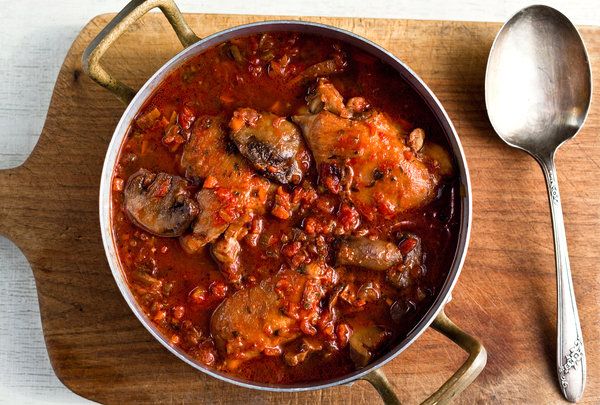
I wanted each of these stews to feature a nutritious vegetable along with the chicken and aromatics. In this way they are truly one-dish, nutrient-dense meals. Though I suggest serving them with rice, other grains or pasta, if carbs are an issue, know that these stews are very satisfying on their own.
Martha Rose Shulman
This version of the classic Italian dish includes lots of mushrooms, both dried and fresh; you can add kale if you want to work in some leafy greens.
Cinnamon adds a subtle sweetness to this stew. If salt is an issue, omit the olives; the stew will still be delicious.
Loosely based on an Algerian recipe from “Real Stew” by Clifford A. Wright, this sweetly spiced dish, with beta-carotene-rich apricots and sweet potatoes, is also evocative of recipes from the Middle East and Iran.
This is an adaptation of a classic French bistro dish, poulet Basquaise.
This dish is loosely based on a chicken stew from the Mexican state of Veracruz, where Spanish influences still remain strong.