
Author's posts
Nov 08 2012
Today on The Stars Hollow Gazette

Our regular featured content-
- On This Day In History November 8 by TheMomCat
- Punting the Pundits by TheMomCat
And these featured articles-
- Exploding Heads by: ek hornbeck
- Drone Wars & War Crimes Will Continue by TheMomCat
- Election Day Ballot Measures: The Winners & Losers by TheMomCat
Write more and often. This is an Open Thread.
Nov 08 2012
“Truthiness”
Even though Barack Obama lost in spacious red states, he is reelected due to a technicality called the Constitution.
Open Thread
Nov 08 2012
Obama Reelected: Now What?
Cross posted from The Stars Hollow Gazette
Now that Barack Obama has been given a second chance by the electorate, the question becomes what happens next. The “fiscal cliff” still looms, although it isn’t really a “cliff,” more like a slope. The government remains divided with the House still in the hands of fiscal conservatives and the Senate will remain crippled by a recalcitrant minority determined to block any reasonable effort at “compromise” by the Democratic majority and the White House to end the Bush/Obama tax cuts for the wealthiest.
The US markets reacted to the election this afternoon by plummeting to below 13,000 for the first time since August.
Stocks were sharply lower in afternoon trading in New York, with both the Standard & Poor’s 500-stock index and the Dow Jones industrial average down 2.3 percent, as European shares sank and Asian stocks were mixed. While many executives on Wall Street and in other industries favored Mitt Romney, many had already factored in the likelihood of Mr. Obama winning a second term.
Still, continued divided government in Washington and little prospect for compromise unnerved traders. [..]
Companies in some sectors, like hospitals and technology, could see a short-term pop, said Tobias Levkovich, chief United States equity strategist with Citi. Other areas, like financial services as well as coal and mining, could be hurt as investors contemplate a tougher regulatory environment.
Fears of the fiscal impasse and the continued euro crisis were just some of the reasons but more than anything it was the failure of the GOP to take back the White House and Senate to secure the fraudsters fiefdom. It was fairly obvious from some headlines that Elizabeth Warren’s election to the Senate has Wall St. very upset: Wall Street Scourge Warren Entering U.S. Senate.
Democrat Elizabeth Warren, whose attacks on Wall Street propelled her ascent, will become the first female U.S. senator from Massachusetts, entering a divided chamber that had spurned her appointment as the nation’s consumer-protection chief.
I doubt they will be able to get rid of her as easily as they got rid of the “Sheriff of Wall St.,” former New York governor Elliot Spitzer.
I highly doubt that House Speaker John Boehner (R-OH), Senate Minority Leader Mitch McConnell (R-KY) and extremist Tea Party members are going to be any more cooperative with the White House and the Democratic majority in the Senate. In fact, it was already looking like they were digging immediately after the President’s victory speech with Mr. Boehner stating that the GOP’s retaining of the House majority meant that there was no mandate to raise taxes. Sen. McConnell echoed those sentiments telling the President that he shouldn’t consider the Democratic Senate wins as too much of a mandate.
To break at least the Senate deadlock, it is well past time to do something about the filibuster, which the Republicans have used in record numbers, over the last four years to block any progress for economic recovery the Democratic wins as too much of a mandate. During the campaign, Gov. Mitt Romney tried to revise history saying that Pres. Obama got everything he wanted and still failed
The argument obscures the important policy-making role Republicans had in the first two years of Obama’s presidency, when they used a record number of filibusters in the Senate to weaken – and in some cases thwart – large pieces of his agenda.
The $787 billion stimulus package in 2009, which was ultimately too small to fully reverse the economic downturn, had to be scaled down because a GOP filibuster required Democrats to win over 60 Senate votes for final passage. Repeated filibusters on health care reform ate up nearly a year of the Democrats’ legislative time, and Obama’s subsequent efforts to boost the economy were met with the same wall of Republican opposition – one that became insurmountable after the GOP’s congressional victories in 2010.
Progressives argue that the economy continues to struggle in part because Republicans have blocked Obama’s efforts, and advanced an agenda in 2011 and 2012 that effectively – if not intentionally – sabotaged the recovery.
Sen. Harry Reid (D-NV), who will likely remain majority leader, has vowed once again to address the problem of the filibuster
Senate Majority Leader Harry Reid (D-Nev.) pledged on Wednesday to change the rules of the Senate so that the minority party has fewer tools to obstruct legislative business.
In his first post-election press conference, the Nevada Democrat said he wouldn’t go so far as to eliminate the filibuster, which requires 60 votes for the chamber to enter and exit the amendment and debate process. But in remarks meant to preview a more combative approach during the next session, he warned Republicans that obstructionism as a tactic won’t be tolerated — or as technically feasible.
The problem is what Sen. Reid, who has stated that he supports filibuster, proposes does not go far enough:
“The first thing is the most important thing,” Reid said the interview. “Do away with motion to proceed. Just do away with it. I favor the filibuster. There’s a reason for the filibuster. I understand it. It’s to protect the rights of the minority. The Senate was set up to protect the rights of the minority … so that’s the no. 1 issue, and the rest of the stuff we can deal with if there’s a filibuster conducted. Those are the kind of things — if we get the motion to proceed out of the way, we can debate it, one, to cloture. That’s good. So that’s the no. 1 biggie.”
Even with Democrats set to control the Senate — indeed, even set to expand their current majority — the avenues for Reid to pursue rules reform aren’t entirely clear.
There has historically been some debate over whether the majority can change the Senate rules at the beginning of each term, or whether two-thirds support is needed, per the Senate rules. The question hinges on whether the Senate is a “continuing legislative body” or whether each new term marks a new Senate. Those who want to change the rules using a majority vote argue that past Senates cannot bind the hands of future legislative bodies.
Whatever the historical record, the basic fight comes down to numbers. No matter what the Senate chair rules, a majority can overrule the chair. However, that will likely be unnecessary, as Vice President Joe Biden is known to be a supporter of filibuster reform, and a believer that the constitution allows the majority to write new rules at the start of a term.
While some of the Republicans say they will reflect on their inability to achieve their goal, perhaps it’s time for the Democrats to do the same in the Senate and replace Harry Reid with someone who will stand up to Mitch McConnell, John Boehner and the Tea Party bullies.
Nov 08 2012
Insult to Injury: Nor’easter hits NY, NJ & CT
Cross posted from The stars Hollow Gazette
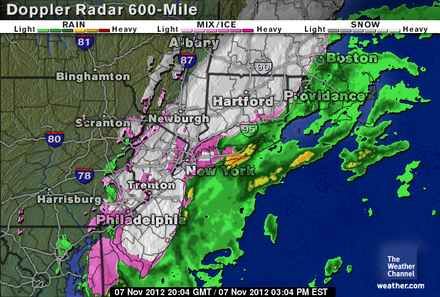 With thousands still without electricity or even homes, the east coast from is being hammered with a northeaster that is bring rain, sleet, snow, plummeting temperatures, high winds and warnings of coastal flooding.
This was a storm with no name but another huge, impossible-to-miss footprint on the weather maps. Its white swirl was smaller than the hurricane’s but still looked ferocious, and it promised to be tenacious, with a chilly brew of rain and wet snow. Road crews feared it would bring annoying slush and, later on, treacherous ice to hard-luck places where debris from the hurricane was still being cleared away. [..]
Gov. Chris Christie warned that the northeaster could set back the recovery effort. He said that many people could lose electricity again.
“I can see us actually moving backwards,” Mr. Christie said at a news conference at a firehouse on Long Beach Island, the barrier island that suffered some of the heaviest damage in last week’s storm. Long Beach Island had been reopened to residents, but the governor said he was cutting off access again.
Mr. Christie said that 369,000 homes in the state were still without power, down from a peak of 2.76 million. Consolidated Edison said early Wednesday that about 79,000 customers were still in the dark, including 15,000 in Brooklyn, 13,000 in Queens and 41,000 in Westchester County.
Staten Island still has 3,205 “customers” without power and high winds are expected to take down more overhead lines. As with Sandy, coastal flooding is expected:
As happened with the Halloween hurricane, this nor’easter will begin doing its work here just as today’s afternoon tide comes in on Staten Island. High tide in The Narrows, measured at Fort Wadsworth, is at 1:24 p.m. That could mean wind-driven tidal surges 3 to 4 feet above normal high-tide levels in some areas – plenty to further damage already compromised low-lying coastal areas.
On Staten Island, those storm surges are expected to be around 2 feet above normal. [..]
According to (Brian) Edwards, (a meteorologist with AccuWeather), “A north to northeasterly wind means that the most significant coastal flooding will occur along the coast of Delaware, central to northern New Jersey, the western end of the north shore of Long Island, N.Y. and eastern Massachusetts.”
He said the worst of the coastal flooding and strongest winds are expected during two phases on Wednesday. The two times that are of utmost concern across the region are during high tide Wednesday afternoon and a second high tide late Wednesday night/early Thursday morning.
Evacuations have been ordered in New York and New Jersey:
After Sandy killed 40 people in New York City, Bloomberg ordered evacuations of low-lying, hard-hit areas such as the Rockaways section of Queens and the south shore of Staten Island. Residents of at least two coastal New Jersey towns were also told to leave.
While FEMA said it was working with state and local authorities and was “ready to deploy additional resources if needed to respond to the Nor’easter,” the [FEMA centers were closed today “due to the weather”]:
They fly into disaster areas, but flee from raindrops.
FEMA disaster recovery centers in Hurricane Sandy-ravaged sections of the city that were supposed to provide assistance to hurricane victims went MIA Wednesday morning, posting signs saying that they were closed due to the approaching Nor’easter.
The temporary shuttering of the facilities, which help victims register for disaster relief, as well as city food distribution centers come even as many of those still reeling from the monster storm were not told that they had to leave the battered areas.
Nov 08 2012
On This Day In History November 8
Cross posted from The Stars Hollow Gazette
This is your morning Open Thread. Pour your favorite beverage and review the past and comment on the future.
Find the past “On This Day in History” here.
November 8 is the 312th day of the year (313th in leap years) in the Gregorian calendar. There are 53 days remaining until the end of the year.
On this day in 1793 the Louvre opens as a public museum. After more than two centuries as a royal palace, the Louvre is opened as a public museum in Paris by the French revolutionary government. Today, the Louvre’s collection is one of the richest in the world, with artwork and artifacts representative of 11,000 years of human civilization and culture.
The Musée du Louvre or officially Grand Louvre – in English the Louvre Museum or simply the Louvre – is one of the world’s largest museums, the most visited art museum in the world and a historic monument. It is a central landmark of Paris and located on the Right Bank of the Seine in the 1st arrondissement (district). Nearly 35,000 objects from prehistory to the 19th century are exhibited over an area of 60,600 square metres (652,300 square feet).
The museum is housed in the Louvre Palace (Palais du Louvre) which began as a fortress built in the late 12th century under Philip II. Remnants of the fortress are still visible. The building was extended many times to form the present Louvre Palace. In 1682, Louis XIV chose the Palace of Versailles for his household, leaving the Louvre primarily as a place to display the royal collection, including, from 1692, a collection of antique sculpture. In 1692, the building was occupied by the Académie des Inscriptions et Belles Lettres and the Académie Royale de Peinture et de Sculpture, which in 1699 held the first of a series of salons. The Académie
remained at the Louvre for 100 years. During the French Revolution, the National Assembly decreed that the Louvre should be used as a museum, to display the nation’s masterpieces.The museum opened on 10 August 1793 with an exhibition of 537 paintings, the majority of the works being confiscated church and royal property. Because of structural problems with the building, the museum was closed in 1796 until 1801. The size of the collection increased under Napoleon when the museum was renamed the Musée Napoleon. After his defeat at Waterloo, many works seized by Napoleon’s armies were returned to their original owners. The collection was further increased during the reigns of Louis XVIII and Charles X, and during the Second French Empire the museum gained 20,000 pieces. Holdings have grown steadily through donations and gifts since the Third Republic, except during the two World Wars. As of 2008, the collection is divided among eight curatorial departments: Egyptian Antiquities; Near Eastern Antiquities; Greek, Etruscan, and Roman Antiquities; Islamic Art; Sculpture; Decorative Arts; Paintings; Prints and Drawings.
Nov 07 2012
On This Day In History November 7
Cross posted from The Stars Hollow Gazette
This is your morning Open Thread. Pour your favorite beverage and review the past and comment on the future.
Find the past “On This Day in History” here.
November 7 is the 311th day of the year (312th in leap years) in the Gregorian calendar. There are 54 days remaining until the end of the year.
On this dayin 1940, Only four months after its completion, the Tacoma Narrows Bridge in Washington State suffers a spectacular collapse.
When it opened in 1940, the Tacoma Narrows Bridge was the third-longest suspension bridge in the world. Built to replace the ferry system that took commuters from Tacoma across the Tacoma Narrows to the Gig Harbor Peninsula, the bridge spanned 2,800 feet and took three years to build. To save cost, the principle engineer, Leon Moisseiff, designed the bridge with an unusually slender frame that measured 39 feet and accommodated just two vehicular lanes.
The Tacoma Narrows Bridge opened with great fanfare on July 1, 1940. Human traffic across the waters of the Tacoma Narrows increased dramatically, but many drivers were drawn to the toll bridge not by convenience but by an unusual characteristic of the structure. When moderate to high winds blew, as they invariably do in the Tacoma Narrows, the bridge roadway would sway from side to side and sometimes suffer excessive vertical undulations. Some drivers reported that vehicles ahead of them would disappear and reappear several times as they crossed the bridge. On a windy day, tourists treated the bridge toll as the fee paid to ride a roller-coaster ride, and the Tacoma Narrows Bridge earned the nickname “Galloping Gertie.
Nov 07 2012
Live Steam: Election 2012
If you can’t stand the pitiful coverage by networks and cable, there is always the alternative to shut off the TV. On the other hand if you’re addicted to finding out who won, there are alternatives. There is Al Jezeera English and Current that are carried by some cable providers. Then there is the Internet. Again Al Jazeera English and Russia Today are both live streaming. RT is embeddable.
Nov 06 2012
The Last Debate
And you thought we were all done with debates. This is the last until about 2014. This debate was supposed to take place October 30 in Washington, DC but Super hurricane Sandy had other plans. It is the second of two debates that was sponsored by the Free and Equal Elections Foundation and it is between Green Party candidate Jill Stein and Libertarian Party candidate Gary Johnson. They were the winners of an on line poll that was taken after the first debate on October 23 which included Justice Party candidate Rocky Anderson and Constitution Party candidate Virgil Goode.
The final debate was moderated by Tom Hartman, host of RT News‘ “Big Picture,” and Christina Tobin from the Free and Equal Elections Foundation.
You can read the summery of topics that the candidates debated here
Nov 06 2012
On This Day In History November 6
Cross posted from The Stars Hollow Gazette
This is your morning Open Thread. Pour your favorite beverage and review the past and comment on the future.
Find the past “On This Day in History” here.
November 6 is the 310th day of the year (311th in leap years) in the Gregorian calendar. There are 55 days remaining until the end of the year.
On this day in 1860, Abraham Lincoln is elected the 16th President of the United States over a deeply divided Democratic Party, becoming the first Republican to win the presidency. Lincoln received only 40 percent of the popular vote but handily defeated the three other candidates: Southern Democrat John C. Breckinridge, Constitutional Union candidate John Bell, and Northern Democrat Stephen Douglas, a U.S. senator for Illinois.
Lincoln received 1,866,452 votes, Douglas 1,376,957 votes, Breckinridge 849,781 votes, and Bell 588,789 votes. The electoral vote was decisive: Lincoln had 180 and his opponents added together had only 123. Turnout was 82.2%, with Lincoln winning the free Northern states. Douglas won Missouri, and split New Jersey with Lincoln. Bell won Virginia, Tennessee, and Kentucky, and Breckinridge won the rest of the South. There were fusion tickets in which all of Lincoln’s opponents combined to form one ticket in New York, New Jersey, and Rhode Island, but even if the anti-Lincoln vote had been combined in every state, Lincoln still would have won a majority in the electoral college.
As Lincoln’s election became evident, secessionists made clear their intent to leave the Union. On December 20, 1860, South Carolina took the lead; by February 1, 1861, Florida, Mississippi, Alabama, Georgia, Louisiana, and Texas followed. The seven states soon declared themselves to be a sovereign nation, the Confederate States of America. The upper South (Delaware, Maryland, Virginia, North Carolina, Tennessee, Kentucky, Missouri, and Arkansas) listened to, but initially rejected, the secessionist appeal. President Buchanan and President-elect Lincoln refused to recognize the Confederacy. There were attempts at compromise, such as the Crittenden Compromise, which would have extended the Missouri Compromise line of 1820, and which some Republicans even supported. Lincoln rejected the idea, saying, “I will suffer death before I consent…to any concession or compromise which looks like buying the privilege to take possession of this government to which we have a constitutional right.”
Lincoln, however, did support the Corwin Amendment to the Constitution, which had passed in Congress and protected slavery in those states where it already existed. A few weeks before the war, he went so far as to pen a letter to every governor asking for their support in ratifying the Corwin Amendment as a means to avoid secession.
Nov 05 2012
The Disenchanted Election
Cross posted from The Stars Hollow Gazette
by Chris Hedges
I learned at the age of 10, when I was shipped off to a New England boarding school where the hazing of younger boys was the principal form of recreation, that those who hunger for power are psychopathic bastards. The bullies in the forms above me, the sadistic masters on our dormitory floors, the deans and the headmaster would morph in later life into bishops, newspaper editors, college presidents, politicians, heads of state, business titans and generals. Those who revel in the ability to manipulate and destroy are demented and deformed individuals. These severely diminished and stunted human beings-think Bill and Hillary Clinton-shower themselves, courtesy of elaborate public relations campaigns and an obsequious press, with encomiums of piety, patriotism, devoted public service, honor, courage and vision, not to mention a lot of money. They are at best mediocrities and usually venal. I have met enough of them to know.
So it is with some morbid fascination that I watch Barack Obama, who has become the prime “dominatrix” of the liberal class, force us in this election to plead for more humiliation and abuse. Obama has carried out a far more egregious assault on our civil liberties, including signing into law Section 1021(b)(2) of the National Defense Authorization Act (NDAA), than George W. Bush. Section 1021(b)(2), which I challenged in federal court, permits the U.S. military to detain U.S. citizens, strip them of due process and hold them indefinitely in military facilities. U.S. District Judge Katherine B. Forrest struck down the law in September. The Obama administration immediately appealed the decision. The NDAA has been accompanied by use of the Espionage Act, which Obama has turned to six times in silencing whistle-blowers. Obama supported the FISA Amendment Act so government could spy on tens of millions of us without warrants. He has drawn up kill lists to exterminate those, even U.S. citizens, deemed by the ruling elite to be terrorists. [..]
The only recognizable basis for moral and political authority, in the eyes of the elite, is the attainment of material success and power. It does not matter how it is gotten. The role of education, the elites believe, is to train us vocationally for our allotted positions and assure proper deference to the wealthy. Disciplines that prod us to think are-and the sneering elites are not wrong about this-“political,” “leftist,” “liberal” or “subversive.” And schools and universities across the country are effectively stomping out these disciplines. The elites know, as Canetti wrote, that once we stop thinking we become a herd. We react to every new stimulus as if we were rats crammed into a cage. When the elites push the button we jump. It is collective sadomasochism. And we will get a good look at it on Election Day.
by Glenn Greenwald
Where do the abuses of the last decade from Bush and Obama rank when compared to prior assaults in the name of war?
The following interesting question arose yesterday from what at first appeared to be some petty Twitter bickering: who was the worst president for civil liberties in US history? That question is a difficult one to answer because it is so reliant upon which of many valid standards of measurement one chooses; it depends at least as much on the specific rights which one understands the phrase “civil liberties” to encompass. That makes the question irresolvable in any definitive way, but its examination is nonetheless valuable for the light it sheds on current political disputes.
It’s worthwhile first to set forth the context in which the question arose. At their Lawfare blog, Ritika Singh and Benjamin Wittes posted an excerpt of an essay they wrote for a new book on the War of 1812; their essay pertains to the impact of that war on civil liberties and executive power. The two Brookings writers note that despite intense domestic opposition to the war, President Madison “eschewed the authority to detain American citizens in military custody or try them in military tribunals, and more generally, declined to undertake the sorts of executive overreaches we have come to expect – and even encourage – from our presidents in war.” [..]
But in terms of the role played by war in enabling civil liberties assaults, at least the exploited wars are usually real. In the case of the “War on Terror”, it is far more illusory and frivolous than real. That – along with their permanence – is a major factor in determining where the civil liberties erosions of the last decade, and the presidents responsible for them, rank in history.
Nov 05 2012
On This Day In History November 5
Cross posted from The Stars Hollow Gazette
This is your morning Open Thread. Pour your favorite beverage and review the past and comment on the future.
Find the past “On This Day in History” here.
November 5 is the 309th day of the year (310th in leap years) in the Gregorian calendar. There are 56 days remaining until the end of the year.
On this day in 1938, Samuel Barber’s Adagio For Strings receives its world premiere on NBC radio
Adagio for Strings is a work for string orchestra, arranged by the American composer Samuel Barber from the second movement of his String Quartet. Barber finished the piece in 1936, and in 1938, it was conducted by Arturo Toscanini. Toscanini’s conducting was recorded at 8H Studio for radio broadcasting. Toscanini took the piece on tour to Europe and South America. It is disputed whether the first performance of Adagio in Europe was conducted by Toscanini or Henry J. Wood. Barber has rejected many arrangements published by G. Schirmer, such as the organ arrangement by William Strictland.
The piece begins with a B flat played by the violins. Lower strings enter two beats after the violins. At practical tempo, the piece length is about eight minutes. The piece’s reception was generally positive, with Alexander J. Morin writing that Adagio for Strings contains “full of pathos and cathartic passion, rarely leaves a dry eye.” The piece can be heard in many TV shows and movies.
The recording of the 1938 world premiere, with Arturo Toscanini conducting the NBC Symphony Orchestra, was selected in 2005 for permanent preservation in the National Recording Registry at the United States Library of Congress.[18] Since the 1938 recording, it has frequently been heard throughout the world, and was one of the only American pieces to be played in the Soviet Union during the Cold War.
The Adagio was broadcast over the radio at the announcement of Franklin D. Roosevelt‘s death. It was also played at the funeral of Albert Einstein and at the funeral of Princess Grace of Monaco. It was performed in 2001 at Last Night of the Proms in the Royal Albert Hall to commemorate the victims of the September 11 attacks, replacing the traditional upbeat patriotic songs. It was also played during the opening ceremonies of the Vancouver 2010 Winter Olympics. In 2004, listeners of the BBC’s Today program voted Adagio for Strings the “saddest classical” work ever, ahead of “Dido’s Lament” from Dido and Aeneas by Henry Purcell, the “Adagietto” from Gustav Mahler’s 5th symphony, Metamorphosen by Richard Strauss and Gloomy Sunday as sung by Billie Holiday.
Adagio for Strings can be heard on many film, TV, and video game soundtracks, including Oliver Stone’s Oscar-winning film Platoon, David Lynch’s 1980 Oscar-nominated film The Elephant Man, Michael Moore’s documentary Sicko, Lorenzo’s Oil, A Very Natural Thing, Reconstruction, and Jean-Pierre Jeunet’s Oscar-nominated 2001 film Amélie. It has been heard in episodes of The Simpsons, Big Brother 2010 (UK), That Mitchell and Webb Look, The Boondocks, South Park, Seinfeld, ER (TV series), Big Love. A recorded performance by the London Symphony Orchestra was, for a time, the highest selling classical piece on iTunes. The work is extremely popular in the electronic dance music genre, notably in trance. Artists who have covered it include Armin van Buuren, William Orbit, Ferry Corsten, and Tiesto. eRa included this song in their new album Classics.
Nov 05 2012
Correcting America’s Democracy
Cross posted from The Stars Hollow Gazette
We have other choices this Election Day. This is Chris Hedges’ choice and his rational explanation why he is not voting for either Obama or Romney.
by Chris Hedges
The November election is not a battle between Republicans and Democrats. It is not a battle between Barack Obama and Mitt Romney. It is a battle between the corporate state and us. And if we do not immediately engage in this battle we are finished, as climate scientists have made clear. I will defy corporate power in small and large ways. I will invest my energy now solely in acts of resistance, in civil disobedience and in defiance. Those who rebel are our only hope. And for this reason I will vote next month for Jill Stein, the Green Party candidate, although I could as easily vote for Rocky Anderson of the Justice Party. I will step outside the system. Voting for the “lesser evil”-or failing to vote at all-is part of the corporate agenda to crush what is left of our anemic democracy. And those who continue to participate in the vaudeville of a two-party process, who refuse to confront in every way possible the structures of corporate power, assure our mutual destruction.
All the major correctives to American democracy have come through movements and third parties that have operated outside the mainstream. Few achieved formal positions of power. These movements built enough momentum and popular support, always in the face of fierce opposition, to force the power elite to respond to their concerns. Such developments, along with the courage to defy the political charade in the voting booth, offer the only hope of saving us from Wall Street predators, the assault on the ecosystem by the fossil fuel industry, the rise of the security and surveillance state and the dramatic erosion of our civil liberties. [..]
The flimsy excuses used by liberals and progressives to support Obama, including the argument that we can’t let Romney appoint the next Supreme Court justices, ignore the imperative of building a movement as fast and as radical as possible as a counterweight to corporate power. The Supreme Court, no matter what its composition, will not save us from financial implosion and climate collapse. And Obama, whatever his proclivity on social issues, has provided ample evidence that he will not alter his servitude to the corporate state. For example, he has refused to provide assurance that he will not make cuts in basic social infrastructures. He has proposed raising the eligibility age for Medicare, a move that would leave millions without adequate health care in retirement. He has said he will reduce the cost-of-living adjustment for Social Security, thrusting vast numbers of seniors into poverty. Progressives’ call to vote for independents in “safe” states where it is certain the Democrats will win will do nothing to mitigate fossil fuel’s ravaging of the ecosystem, regulate and prosecute Wall Street or return to us our civil liberties.
“There is no state out there where either Obama or Romney offers a way out of here alive,” Stein said. “It’s up to us to create truly safe states, a safe nation, and a safe planet. Neither Obama nor Romney has a single exit strategy from the deadly crises we face.”