
Author's posts
Nov 15 2012
On This Day In History November 15
Cross posted from The Stars Hollow Gazette
This is your morning Open Thread. Pour your favorite beverage and review the past and comment on the future.
November 15 is the 319th day of the year (320th in leap years) in the Gregorian calendar. There are 46 days remaining until the end of the year.
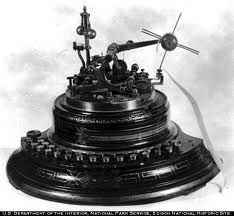
On this day in 1867, On this day in 1867, the first stock ticker is unveiled in New York City. The advent of the ticker ultimately revolutionized the stock market by making up-to-the-minute prices available to investors around the country. Prior to this development, information from the New York Stock Exchange, which has been around since 1792, traveled by mail or messenger.
The ticker was the brainchild of Edward Calahan, who configured a telegraph machine to print stock quotes on streams of paper tape (the same paper tape later used in ticker-tape parades). The ticker, which caught on quickly with investors, got its name from the sound its type wheel made.
Calahan worked for the Gold & Stock Telegraph Company, which rented its tickers to brokerage houses and regional exchanges for a fee and then transmitted the latest gold and stock prices to all its machines at the same time. In 1869, Thomas Edison, a former telegraph operator, patented an improved, easier-to-use version of Calahan’s ticker. Edison’s ticker was his first lucrative invention and, through the manufacture and sale of stock tickers and other telegraphic devices, he made enough money to open his own lab in Menlo Park, New Jersey, where he developed the light bulb and phonograph, among other transformative inventions.
Stock tickers in various buildings were connected using technology based on the then-recently invented telegraph machines, with the advantage that the output was readable text, instead of the dots and dashes of Morse code. The machines printed a series of ticker symbols (usually shortened forms of a company’s name), followed by brief information about the price of that company’s stock; the thin strip of paper they were printed on was called ticker tape. As with all these terms, the word ticker comes from the distinct tapping (or ticking) noise the machines made while printing. Pulses on the telegraph line made a letter wheel turn step by step until the right letter or symbol was reached and then printed. A typical 32 symbol letter wheel had to turn on average 15 steps until the next letter could be printed resulting in a very slow printing speed of 1 letter per second. In 1883, ticker transmitter keyboards resembled the keyboard of a piano with black keys indicating letters and the white keys indicating numbers and fractions, corresponding to two rotating type wheels in the connected ticker tape printers.
Newer and more efficient tickers became available in the 1930s and 1960s but the physical ticker tape phase was quickly coming to a close being followed by the electronic phase. These newer and better tickers still had an approximate 15 to 20 minute delay. Stock ticker machines became obsolete in the 1960s, replaced by computer networks; none have been manufactured for use for decades. However, working reproductions of at least one model are now being manufactured for museums and collectors. It was not until 1996 that a ticker type electronic device was produced that could operate in true real time.
Simulated ticker displays, named after the original machines, still exist as part of the display of television news channels and on some World Wide Web pages-see news ticker. One of the most famous displays is the simulated ticker located at One Times Square in New York City.
Ticker tapes then and now contain generally the same information. The ticker symbol is a unique set of characters used to identify the company. The shares traded is the volume for the trade being quoted. Price traded refers to the price per share of a particular trade. Change direction is a visual cue showing whether the stock is trading higher or lower than the previous trade, hence the terms downtick and uptick. Change amount refers to the difference in price from the previous day’s closing. These are reflected in the modern style tickers that we see every day. Many today include color to indicate whether a stock is trading higher than the previous day’s (green), lower than previous (red), or has remained unchanged (blue or white).
Nov 15 2012
On This Day In History November 16
Cross posted from The Stars Hollow Gazette
This is your morning Open Thread. Pour your favorite beverage and review the past and comment on the future.
Find the past “On This Day in History” here.
November 16 is the 320th day of the year (321st in leap years) in the Gregorian calendar. There are 45 days remaining until the end of the year.
On this day in 1959, the musical, “The Sound of Music” opened on Broadway.
Did the young Austrian nun named Maria really take to the hills surrounding Salzburg to sing spontaneously of her love of music? Did she comfort herself with thoughts of copper kettles, and did she swoon to her future husband’s song about an alpine flower while the creeping menace of Nazism spread across central Europe? No, the real-life Maria von Trapp did none of those things. She was indeed a former nun, and she did indeed marry Count Georg von Trapp and become stepmother to his large brood of children, but nearly all of the particulars she related in her 1949 book, The Story of the Trapp Family Singers, were ignored by the creators of the Broadway musical her memoir inspired. And while the liberties taken by the show’s writers, Howard Lindsay and Russel Crouse, and by its composer and lyricist, Richard Rodgers and Oscar Hammerstein II, caused some consternation to the real Maria von Trapp and to her stepchildren, according to many later reports, those liberties made The Sound of Music a smash success from the very night of its Broadway opening on this day in 1959.
The Sound of Music opened on Broadway at the Lunt-Fontanne Theatre on November 16, 1959, moved to the Mark Hellinger Theatre on November 6, 1962 and closed on June 15, 1963 after 1,443 performances. The director was Vincent J. Donehue, and the choreographer was Joe Layton. The original cast included Mary Martin (at age 46) as Maria, Theodore Bikel as Captain Georg von Trapp, Patricia Neway as Mother Abbess, Kurt Kasznar as Max Detweiler, Marion Marlowe as Elsa Schraeder, Brian Davies as Rolf and Lauri Peters as Liesl. Soprano June Card was one of the ensemble members in the original production. The show tied for the Tony Award for Best Musical with Fiorello!. Other awards included Martin for Best Actress in a Musical, Neway for Best Featured Actress, Best Scenic Design (Oliver Smith) and Best Musical Direction (Frederick Dvonch). Bikel and Kaznar were nominated for acting awards, and Donehue was nominated for his direction. The entire children’s cast was nominated for Best Featured Actress category as a single nominee, even though two children were boys.
The Sound of Music was the final musical written by Rodgers and Hammerstein; Hammerstein died of cancer nine months after the Broadway premiere.
Rebecca Luker leads the 1998 Broadway revival cast in a performance of ‘Climb Every Mountain,’ ‘Do Re Mi’ and ‘The Sound of Music’ at the Tony Awards.
Nov 15 2012
The Myth of the “Fiscal Cliff”
Cross posted from The Stars Hollow Gazette
Chris Hayes, host of [Up with Chris Hayes ], discusses the stand-off between President Obama and House Republicans over the “fiscal cliff,” the name given to the combination of the expiration of the Bush tax cuts and the sequestration cuts mandated by last year’s debt ceiling agreement. Chris’ “filibuster” in the first segment is a “Cliff Note” summation of the debate about the so-called “fiscal cliff.”
Chris is joined for a comprehensive, and somewhat wonky, discussion with Hakeem Jeffries, newly elected Congressman representing the 8th Congressional District in Brooklyn, New York State Assemblyman; Teresa Ghilarducci (@tghilarducci), labor economist and director of the Schwartz Center for Economic Policy Analysis at The New Schoo; Edward Conard, former partner at Bain Capital from 1993-2007 and author of “Unintended Consequences: Why Everything You’ve Been Told About The Economy Is Wrong;” Ohio Democratic Senator Sherrod Brown; and Molly Ball (@mollyesque), national political reporter for The Atlantic.
I found this article about the debt/deficit/”fiscal cliff” from letdgetitdone quite interesting. It presents a very compelling argument, point by point, why this entire discussion about a “fiscal cliff” is a myth. He concludes his argument:
So, current claims that we have a fiscal crisis, must debate the debt, must fix the debt, and must immediately embark on a long-term deficit reduction program to bring the debt-to-GDP ratio under control, all misconceive the fiscal situation because they are based on the idea that fiscal responsibility is about developing a plan to bring the debt-to-GDP ratio “under control,” when it is really about using Government spending to achieve outputs that fulfill “public purpose.” There is no fiscal crisis that will require “a Grand Bargain” and cuts to popular discretionary spending and entitlement programs. It is a phoney issue.
The only real crisis is a crisis of a failing economy and growing economic inequality in which only the needs of the few are served. MMT policies can help to bring an end to that crisis; but not if progressives, and others continue to believe in false ideas about fiscal sustainability and responsibility, and the similarity of their Government to a household. To begin to solve our problems, we need to reject the neoliberal narrative and embrace the MMT narrative about the meaning of fiscal responsibility. That will lead us to fiscal policies that achieve public purpose and away from policies that prolong economic stagnation and the ravages of austerity.
Nov 15 2012
When Will the Recovery Reach the Poor?
Cross posted from The Stars Hollow Gazette
On his show AC 360°, host Anderson Cooper interviewed Sophie Delaunay, the executive Director of Doctors Without Borders, on the organizations efforts to aid victims of Hurricane Sandy, especially in the Rockaways.
“We learned our lessons from Katrina when we thought the medical needs would be covered, and when we realized there were gaps it was too late for us to react,” says Sophie Delaunay.
She tells Anderson the most challenging place right now is the Rockaways in Queens where people who need help are homebound in high-rise apartment buildings and have had little contact with the outside world since they lost their electricity. The group is helping with a variety of needs, but 60% of the consultations are to assist with prescription refills.
by Greg B. Smith at New York Daily News
Calls it a ‘nice little Christmas present’ but has no answers for residents still struggling two weeks after Hurricane Sandy
Public tenants without heat, hot water and power for weeks will still have cough up their full rent before getting a credit in January – a refund that NYCHA Chairman John Rhea called “a nice little Christmas present.”
Rhea made the Scrooge-esque comment Monday when he showed up at the Red Hook Houses in Brooklyn, where tenants have lived in deplorable conditions since Hurricane Sandy hit Oct. 29.He told one tenant, “Hang in there.” [..]
When Rhea showed up in Red Hook Monday, 4,015 residents there were still without heat and hot water and 2,125 were without power. Twenty-two of the project’s 32 buildings were either without heat and hot water or power. [..]
As of Monday, 4,400 NYCHA tenants in Red Hook, Coney Island and Far Rockaway, Queens, were still without power, while 18,000 residents in 14 developments in Brooklyn, Queens and Manhattan still had no hot water or heat.
NYCHA turned off elevators, hot water and heat two days before the storm hit in 26 low-lying developments near waterfronts and ordered tenants to evacuate.
by Daniel Marans at Huffington Post
The situation in public housing projects in Coney Island, Brooklyn remains a “humanitarian crisis” in which the government and the Red Cross have been nearly completely absent, according to Eric Moed, a volunteer aid worker with Occupy Sandy. [..]
The projects in Coney Island remain without power, and often without water and necessities in the wake of Hurricane Sandy. Accounts of these conditions have been corroborated in the New York Daily News.
Moed says all of the supermarkets on Coney Island have been flooded or looted.
The result is what Moed describes as a “humanitarian crisis.” Sick or older people may be vulnerable to death without heat, or food and water.
Moed routinely meets elderly residents who have been trapped alone in their dark, cold apartments since the storm hit. The elevators often do not work, and residents willing to brave the stairwells face darkness, human waste, and even crime. [..]
Whatever response there has been from the government — city, state, or federal — or the Red Cross, Moed says their presence in and around the Coney Island projects is non-existent, inadequate, or counterproductive. FEMA has set up a solitary aid trailer on what Moed calls the “sexy area” of Coney Island — near the famous amusement park and Nathan’s — which was not hit very hard. It awaits people seeking help, when those who most need it are stranded in high-rise buildings a few blocks away.
Moed insists that he does not assume anything about the government and Red Cross’s lack of a response, but says their absence is indisputable. “They’re literally not there. It’s not a criticism, it’s literally a fact,” he said. “I’ve been on the ground here for four days. I’ve seen zero FEMA people. Occasionally a Red Cross truck will come through with hot meals. But there’ll be one truck for 15-20 buildings.” [..]
The absence of government or Red Cross presence has left a vacuum of authority and accountability at a time when stranded residents are seeking it most. “The projects have had nobody to talk to,” Moed says. “People literally have no power, no food, no water, no bathrooms–they’re defecating in buckets. And there is no one to answer to for it.” For lack of a higher-level city government presence, presidents of public housing blocks with few resources have been left to address residents’ grievances. [..]
Nov 14 2012
Today on The Stars Hollow Gazette

Our regular featured content-
- On This Day In History November 14 by TheMomCat
- Punting the Pundits by TheMomCat
And these featured articles-
- The Myth of the “Fiscal Cliff” by TheMomCat
- West and Smiley: Obama is Not a Progressive by TheMomCat
- A Terrorist on Every Food Cart by TheMomCat
Write more and often. This is an Open Thread.
Nov 14 2012
On This Day In History November 14
Cross posted from The Stars Hollow Gazette
This is your morning Open Thread. Pour your favorite beverage and review the past and comment on the future.
Find the past “On This Day in History” here.
November 14 is the 318th day of the year (319th in leap years) in the Gregorian calendar. There are 47 days remaining until the end of the year.
On this day in 1851, the novel Moby Dick is published. Moby Dick, a novel by Herman Melville about the voyage of the whaling ship Pequod, is published by Harper & Brothers in New York. Moby Dick is now considered a great classic of American literature and contains one of the most famous opening lines in fiction: “Call me Ishmael.” Initially, though, the book about Captain Ahab and his quest for a giant white whale was a flop.
Moby-Dick is widely considered to be a Great American Novel and a treasure of world literature. The story tells the adventures of the wandering sailor Ishmael, and his voyage on the whaleship Pequod, commanded by Captain Ahab. Ishmael soon learns that Ahab seeks one specific whale, Moby Dick, a ferocious, enigmatic white sperm whale. In a previous encounter, the whale destroyed Ahab’s boat and bit off his leg. Ahab intends to take revenge.
In Moby-Dick, Melville employs stylized language, symbolism, and metaphor to explore numerous complex themes. Through the main character’s journey, the concepts of class and social status, good and evil, and the existence of gods are all examined as Ishmael speculates upon his personal beliefs and his place in the universe. The narrator’s reflections, along with his descriptions of a sailor’s life aboard a whaling ship, are woven into the narrative along with Shakespearean literary devices such as stage directions, extended soliloquies and asides. The book portrays insecurity that is still seen today when it comes to non-human beings along with the belief that these beings understand and act like humans. The story is based on the actual events around the whaleship Essex, which was attacked by a sperm whale while at sea and sank.
Moby Dick has been classified as American Romanticism. It was first published by Richard Bentley in London on October 18, 1851, in an expurgated three-volume edition titled The Whale, and weeks later as a single volume, by New York City publisher Harper and Brothers as Moby Dick; or, The Whale on November 14, 1851. Although the book initially received mixed reviews, Moby Dick is now considered part of the Western canon.
Nov 14 2012
Bloomberg Holds Public Housing Residents Hostage
Cross posted from The Stars Hollow Gazette
Yo @mikebloomberg we’re gonna keep calling you @ 212-639-9675 till you stop holding NYCHA residents hostage!! ow.ly/fg576 #Sandy
— Occupy Wall Street (@OccupyWallStNYC) November 13, 2012
Twelve days and counting after Sandy hit on October 29, children, parents, families, the elderly and disabled remain without lights, heat, hot water or power in New York City Housing Authority (NYCHA).
This is true for houses in Gowanus, Red Hook, the Rockaways, Coney Island and elsewhere.
John Rhea, the chairman of NYCHA, told The Huffington Post that he and the organization have been doing the best they could. Unfortunately, he said, these buildings happened to be located in the areas hardest hit by the hurricane. Yet, power in those hard hit areas has been restored – just not in NYCHA housing.
Mayor Bloomberg has not addressed or remedied the failure of his city’s response. Nor has the U.S. Department of Housing and Urban Development (HUD), which funds NYCHA in part, sent federal contractors or generators to help coordinate this unacceptable human emergency.
Instead, thousands of individual volunteers, and community-organizing and health organizations like Occupy Sandy, Children’s Health Fund, Masbia Soup Kitchen, Red Hook Initiative, Make the Road NY, CAAAV, Doctor’s Without Borders (launching it’s first effort ever within the United States), and numerous religious institutions have tried to fill in where Mayor Bloomberg and NYCHA have failed NYC residents in desperate need.
CALL MAYOR BLOOMBERG TODAY: 212-NEW-YORK (212-639-9675). Tell him the response has been unacceptable.
CALL HUD’s NATIONAL HEADQUARTERS TODAY: (202) 708-1112. Tell Secretary Shaun Donovan that their response has been unacceptable.
Nov 13 2012
Today on The Stars Hollow Gazette
Our regular featured content-
- On This Day In History November 13 by TheMomCat
- Punting the Pundits by TheMomCat
And these featured articles-
- When Will the Recovery Reach the Poor? by: TheMomCat
- Desperate Housewives of the Defense Department: Up Date by TheMomCat
- Bloomberg Holds Public Housing Residents Hostage by TheMomCat
Write more and often. This is an Open Thread.
Nov 13 2012
On This Day In History November 13
Cross posted from The Stars Hollow Gazette
This is your morning Open Thread. Pour your favorite beverage and review the past and comment on the future.
Find the past “On This Day in History” here.
November 13 is the 317th day of the year (318th in leap years) in the Gregorian calendar. There are 48 days remaining until the end of the year.
On this day in 1982, The Vietnam Veterans Memorial is dedicated in Washington, D.C. after a week long national salute to Americans who served in the Vietnam War.
The Memorial Wall, designed by Maya Lin, is made up of two gabbro walls 246 feet 9 inches (75 m) long. The walls are sunk into the ground, with the earth behind them. At the highest tip (the apex where they meet), they are 10.1 feet (3 m) high, and they taper to a height of eight inches (20 cm) at their extremities. Stone for the wall came from Bangalore, Karnataka, India, and was deliberately chosen because of its reflective quality. Stone cutting and fabrication was done in Barre, Vermont. Stones were then shipped to Memphis, Tennessee where the names were etched. The etching was completed using a photoemulsion and sandblasting process. The negatives used in the process are in storage at the Smithsonian Institution. When a visitor looks upon the wall, his or her reflection can be seen simultaneously with the engraved names, which is meant to symbolically bring the past and present together. One wall points toward the Washington Monument, the other in the direction of the Lincoln Memorial, meeting at an angle. Each wall has 72 panels, 70 listing names (numbered 1E through 70E and 70W through 1W) and 2 very small blank panels at the extremities. There is a pathway along the base of the Wall, where visitors may walk, read the names, make a pencil rubbing of a particular name, or pray.
Inscribed on the walls with the Optima typeface are the names of servicemen who were either confirmed to be KIA (Killed in Action) or remained classified as MIA (Missing in Action) when the walls were constructed in 1982. They are listed in chronological order, starting at the apex on panel 1E in 1959 (although it was later discovered that the first casualties were military advisers who were killed by artillery fire in 1957), moving day by day to the end of the eastern wall at panel 70E, which ends on May 25, 1968, starting again at panel 70W at the end of the western wall which completes the list for May 25, 1968, and returning to the apex at panel 1W in 1975. Symbolically, this is described as a “wound that is closed and healing.” Information about rank, unit, and decorations are not given. The wall listed 58,159 names when it was completed in 1993; as of June 2010, there are 58,267 names, including 8 women. Approximately 1,200 of these are listed as missing (MIAs, POWs, and others), denoted with a cross; the confirmed dead are marked with a diamond. If the missing return alive, the cross is circumscribed by a circle (although this has never occurred as of March 2009); if their death is confirmed, a diamond is superimposed over the cross. According to the Vietnam Veterans Memorial Fund, “there is no definitive answer to exactly how many, but there could be as many as 38 names of personnel who survived, but through clerical errors, were added to the list of fatalities provided by the Department of Defense.” Directories are located on nearby podiums so that visitors may locate specific names.
Nov 13 2012
The “Grand Betrayal” Is Still on the Table
Cross posted from The Stars Hollow Gazette
As soon as Barack Obama was reelected the austerians were already clamoring for him to enter into the so-called “Grand Bargain” as the only option to keeping the fragile US economy from going over the mythical “fiscal cliff.” Exit polls showed that voters were most concerned about the economy and jobs. They also indicated that raising taxes on the wealthiest was popular, as was preserving Social Security and Medicare as they currently exist. The debt/deficit was at the bottom of the list of voter interests. There has been much talk from Pres. Obama and the Democratic leadership that they now have a mandate to raise taxes on the 1% and they are willing to “bargain” with the Republicans. The problem is the “bargain” they want to cut would increase the burden on the elderly and those most in need of these programs now and in the future by raising the age requirements and tying cost of living increases to a metric that would decrease the ability of social security recipients to stay above the poverty line.
In an interview with economist Bill Black by Paul Jay at RT News, Prof. Black discusses how the “grand betrayal” and the role of the president and “Third Way” Democrats in the destruction of the social safety net:
At FDL News Desk, David Dayen has two important pieces on the “fiscal cliff” and the “grand bargain” and how our politicians are using them as an excuse to cut the social safety net.
The Grand Confusion: The “Fiscal Cliff” is an Austerity Program
Cutting the deficit has been discussed in terms of a moral imperative for the past two-plus years. But now we’ve arrived at a situation where the deficit would get cut a significant amount, and budget analysts make the obvious, inconvenient case that this would throw the economy back into recession. All the alternative explanations from the deficit scolds – a lack of confidence, the threat of higher interest rates – have nothing to do with the fiscal slope. It’s just that it would pull back on federal spending and raise taxes to such a degree that the economy would suffer. [..]
In the hands of someone who didn’t want a bargain on the deficit, this would be the ultimate teachable moment. “All those people telling us for years we have to cut the deficit, suddenly don’t want to cut the deficit,” that leader would say. “They’re warning people of the dangers of cutting the deficit, and saying we have to put a deficit plan together to avoid cutting the deficit!” But Obama wants this deal for his legacy. So he’s not going to disabuse anyone of the confusion over the fiscal slope.
Leaked Woodward Memo Offers Road Map on Grand Bargain
Bob Woodward leaked the deal memo from the proposed 2011 grand bargain, which didn’t happen for a number of reasons, none of them being Barack Obama’s reticence to cut a deal. [..]
This was what the President signed off on, before the Gang of Six embarrassed him by calling for more revenue. He was perfectly willing to not only endorse this deal, but force the Democratic leadership to swallow it as well. And this is why Ryan Grim can be so sure that the next set of talks will include reductions in benefits to the elderly, the poor and the middle class. That’s what happened before, after all. [..]
Any sane observer of economic reality understands that the biggest concern in the near term is that the deficit will end up to small, not too large. We don’t have a deficit problem but a health care cost problem, and it’s not entirely clear we even have that as much as we have a CBO which over-hypes the health care cost problem in their models (the fact that CBO wanted to talk with Naked Capitalism’s Yves Smith for daring to question their model is quite telling). We have countless examples of counter-productive austerity in a time of a slowly recovering economy. [..]
At any rate, we cannot depend on the intransigence of the right this time around. Bill Kristol floated acceptance of higher taxes on the wealthy, following David Koch from a couple months ago. And John Boehner reportedly brought the hammer down with his caucus [..]
Senate Majority Leader Harry Reid has repeatedly stated that “we are not going to mess with Social Security.” The problem Sen. Reid has with keeping Social Security out of any bargain is President Barack Obama who is all to willing to bargain it away for a deal with the Republicans. The argument over the debt/deficit has never been whether taxes will be raised in any bargain, the goal of the right has been to destroy Social Security and cripple Medicare and Medicaid.
President Obama is still pursuing a “grander bargain” that would betray the trust of the people who returned him to office with the hope that he would change.
Nov 12 2012
Today on The Stars Hollow Gazette
Our regular featured content-
- On This Day In History November 12 by TheMomCat
- Punting the Pundits by TheMomCat
And these featured articles-
- Pique the Geek 20121111: Drying Oils by: Translator
- One Economy under God by T’Pau by Anti-Capitalist Meetup
- The “Grand Betrayal” Is Still on the Table by TheMomCat
- Running Dogs by ek hornbeck
Write more and often. This is an Open Thread.
Nov 12 2012
On This Day In History November 12
Cross posted from The Stars Hollow Gazette
This is your morning Open Thread. Pour your favorite beverage and review the past and comment on the future.
Find the past “On This Day in History” here.
November 12 is the 316th day of the year (317th in leap years) in the Gregorian calendar. There are 49 days remaining until the end of the year.
On this day in 1775, Upon hearing of England’s rejection of the so-called Olive Branch Petition on this day in 1775, Abigail Adams writes to her husband, John:
The intelegance you will receive before this reaches you, will I should think make a plain path, tho a dangerous one for you. I could not join to day in the petitions of our worthy parson, for a reconciliation between our, no longer parent State, but tyrant State, and these Colonies. — Let us seperate, they are unworthy to be our Breathren. Let us renounce them and instead of suplications as formorly for their prosperity and happiness, Let us beseach the almighty to blast their counsels and bring to Nought all their devices.
The previous July, Congress had adopted the Olive Branch Petition, written by John Dickinson, which appealed directly to King George III and expressed hope for reconciliation between the colonies and Great Britain. Dickinson, who hoped desperately to avoid a final break with Britain, phrased colonial opposition to British policy as follows:
“Your Majesty’s Ministers, persevering in their measures, and proceeding to open hostilities for enforcing them, have compelled us to arm in our own defence, and have engaged us in a controversy so peculiarly abhorrent to the affections of your still faithful Colonists, that when we consider whom we must oppose in this contest, and if it continues, what may be the consequences, our own particular misfortunes are accounted by us only as parts of our distress.”
Abigail Adams’ response was a particularly articulate expression of many colonists’ thoughts: Patriots had hoped that Parliament had curtailed colonial rights without the king’s full knowledge, and that the petition would cause him to come to his subjects’ defense. When George III refused to read the petition, Patriots like Adams realized that Parliament was acting with royal knowledge and support. Americans’ patriotic rage was intensified with the January 1776 publication by English-born radical Thomas Paine of Common Sense, an influential pamphlet that attacked the monarchy, which Paine claimed had allowed “crowned ruffians” to “impoverish the nation and set it together by the ears.”