
practical katastematics
(by pyrrho for publishing jointly at MLW and DocuDharma)
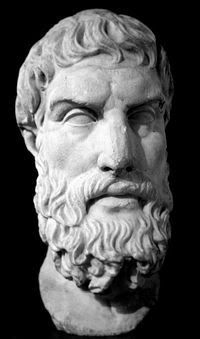
Epicurus:
As with most of these schools I’ll cover, the name of the school has come to have a common modern meaning. Also, as with most, the modern understanding of the term “epicurean” misrepresents the school. I will leave it to the historians of philosophy to gather why misunderstandings stand in common language about these schools, but I will also add that there are also relations in a warped way to the original.
 I will be using the print version of the Oxford “Dictionary of Philosophy” to refresh myself for this series. Links offered below may or may not have been referenced to research this post. I may or may not believe their assertions or have been exposed to them, but they are given to ease further your direct research should you like. I give my own impressions of the topics within, please form your own impressions if you are at all interested in the topics, mine include my own simplifications and interpretations. I try to present them fairly, clearly, but I am a skeptic myself, a relativist with opinions on all these schools, and a tendency to eschew the doctrinaire side of each of these schools, myself, and tend to seek and emphasize the reusable tools each has to offer.
A not particularly common but still well established understanding of “Epicurean” is one who likes fine foods and luxuries of that sort, good hosting, good service, the attendances of wealth, and which is, by that taste, indulgent. But Epicurus advocated the the opposite: personal restraint and intentional simplicity of pleasures. The relation by which the indulgent term comes is that the simple pleasures of life are, indeed, things like a pleasant meal.
Epicurus advocated an idea by which the more extreme the pleasures you sought, the more extreme the displeasure will also be, the greater your misery. Simple pleasures enjoyed well, like an afternoon at the ocean, can give exquisite pleasure, the reasoning goes, to make for an excellent and enjoyable life. But they are also mild enough according to Epicurus to lead to only mild displeasures (eating sand? salt rashes?). The combination, according to Epicurus, is the way to live well and have a good life.
These ancient schools generally take their goal as seeking a well lived life. Perhaps that means a tranquil life, but by whatever criteria, to be “satisfied” or, at least, “proper”, they seek good living. They offer principles and usually also a set of interpretations of life drawn from those principles. Note for example that the Epicurean approach does not strictly require seeking mild pleasures. It is also in accord with Epicurus’ principles to live extremely, if one realized this mean putting up with extreme misery, or at least, risk of that. However, one might, and some do, argue that is worth it in order to obtain extreme pleasure. And in this interpretation of Epicurus we reach a hedonistic philosophy for those willing to accept extreme risks, and therein a philosophical explanation for the extreme sports..
We all know modern Epicureans, I hope, for they make excellent friends. They are great to dine with, they care about subtlety in food, music, art and relaxation with the simple pleasures of life. They are able to enjoy pleasures with modest costs, so not only the best, most rare, wines, but also those of the common, reasonably priced wines. Your Epicurean friend knows which of these modest pleasures is still crafted with care and craft. I think an element of this philosophy is essential to a good life, and I side with the ancients that the purpose of a good philosophy is a good life. Epicurean sentiments, with a taste for high quality in the modest pursuits allows us to live without a lot of materialist anxiety on the one hand, but also without the life denying depravity of eschewing material pleasures on the other. Epicureanism provides a modest avenue for acknowledging and within reason embracing, the carnal pleasures.
Below, I will share some of the interesting points Oxford’s Dictionary of Philosophy shared.
 My partner and I spent an hour on Wednesday with the college’s chaplain, getting a start on the design of our civil union ceremony. We live in New Jersey and have been domestic partners since this state provided that acknowledgment of our relationship and on October 20th will upgrade that designation to civil union. Some day, we hope to have that designation changed to “married.”
  A lot of people say I’m confusing, and at least one reason is easy problems are no fun… once it’s easy, why bother. Well, I do know reasons to bother with them, so here are some easy things: