
Author's posts
Sep 11 2011
Today on The Stars Hollow Gazette

Our regular featured content-
- On This Day In History September 10 by TheMomCat
- Punting the Pundits by TheMomCat
- Evening Edition by ek hornbeck
These weekly featured articles-
- Popular Culture (Music): The Who, Quadrophenia Part II of II by Translator
- This Week In The Dream Antilles by davidseth
- Health and Fitness News by TheMomCat
- Random Japan by mishima
This weekend’s special feature-
- F1: Autodromo Nazionale Monza Qualifying by ek hornbeck
Join us tomorrow morning for more Formula 1 auto racing with live coverage at 8 AM EDT-
- F1: Autodromo Nazionale Monza by ek hornbeck
This is an Open Thread
Sep 10 2011
On This Day In History September 10
Cross posted from The Stars Hollow Gazette
Find the past “On This Day in History” here.
September 10 is the 253rd day of the year (254th in leap years) in the Gregorian calendar. There are 112 days remaining until the end of the year
On this day in 1776, Nathan Hale volunteers to spy behind British lines
On this day in 1776, General George Washington asks for a volunteer for an extremely dangerous mission: to gather intelligence behind enemy lines before the coming Battle of Harlem Heights. Captain Nathan Hale of the 19th Regiment of the Continental Army stepped forward and subsequently become one of the first known American spies of the Revolutionary War.
the Battle of Long Island, which led to British victory and the capture of New York City, via a flanking move from Staten Island across Long Island, Hale volunteered on September 8, 1776, to go behind enemy lines and report on British troop movements. He was ferried across on September 12. It was an act of spying that was immediately punishable by death, and posed a great risk to Hale.
An account of Nathan Hale’s capture was written by Consider Tiffany, a Connecticut shopkeeper and Loyalist, and obtained by the Library of Congress. In Tiffany’s account, Major Robert Rogers of the Queen’s Rangers saw Hale in a tavern and recognized him despite his disguise. After luring Hale into betraying himself by pretending to be a patriot himself, Rogers and his Rangers apprehended Hale near Flushing Bay, in Queens, New York. Another story was that his Loyalist cousin, Samuel Hale, was the one who revealed his true identity.
British General William Howe had established his headquarters in the Beekman House in a rural part of Manhattan, on a rise between 50th and 51st Streets between First and Second Avenues Hale reportedly was questioned by Howe, and physical evidence was found on him. Rogers provided information about the case. According to tradition, Hale spent the night in a greenhouse at the mansion. He requested a Bible; his request was denied. Sometime later, he requested a clergyman. Again, the request was denied.
According to the standards of the time, spies were hanged as illegal combatants. On the morning of September 22, 1776, Hale was marched along Post Road to the Park of Artillery, which was next to a public house called the Dove Tavern (at modern day 66th Street and Third Avenue), and hanged. He was 21 years old. Bill Richmond, a 13-year-old former slave and Loyalist who later became famous as an African American boxer in Europe, was reportedly one of the hangmen, “his responsibility being that of fastening the rope to a strong tree branch and securing the knot and noose.”
By all accounts, Hale comported himself eloquently before the hanging. Over the years, there has been some speculation as to whether he specifically uttered the famous line:
I only regret that I have but one life to give for my country.
But may be a revision of:
I am so satisfied with the cause in which I have engaged that my only regret is that I have not more lives than one to offer in its service.
The story of Hale’s famous speech began with John Montresor, a British soldier who witnessed the hanging. Soon after the execution, Montresor spoke with the American officer William Hull about Hale’s death. Later, it was Hull who widely publicized Hale’s use of the phrase. Because Hull was not an eyewitness to Hale’s speech, some historians have questioned the reliability of the account
Sep 09 2011
Today on The Stars Hollow Gazette
Our regular featured content-
- On This Day In History September 9 by TheMomCat
- Punting the Pundits by TheMomCat
- Evening Edition by ek hornbeck
These featured articles-
- Obama’s Plan: Cut the Safety Net by Michael Kwiatkowski
- Hands Off Medicare & Social Security by TheMomCat
- Civil Liberties, National Security & 9/11 by TheMomCat
This is an Open Thread
Sep 08 2011
Today on The Stars Hollow Gazette
Our regular featured content-
- On This Day In History September 8 by TheMomCat
- Punting the Pundits by TheMomCat
- Evening Edition by ek hornbeck
These featured articles-
- The Gold Bug by ek hornbeck
- Please, Sir, More Cuts by TheMomCat
- The Great Debate: A “Serious” Critique by TheMomCat
This is an Open Thread
Sep 08 2011
Obama Selling His Republican Agenda
Cross posted from The Stars Hollow Gazette
President Obama is going to lay our his jobs plan before Congress on Thursday night and most will not even bother to listen. Why? it seems the President has a credibility gap. He says one thing and does another. His plan to pump $300 billion into the economy with tax cuts, infrastructure spending and direct aid to state and local governments.
WASHINGTON — The economy weak and the public seething, President Barack Obama is expected to propose $300 billion in tax cuts and federal spending Thursday night to get Americans working again. Republicans offered Tuesday to compromise with him on jobs – but also assailed his plans in advance of his prime-time speech.
snip
According to people familiar with the White House deliberations, two of the biggest measures in the president’s proposals for 2012 are expected to be a one-year extension of a payroll tax cut for workers and an extension of expiring jobless benefits. Together those two would total about $170 billion.
The people spoke on the condition of anonymity because the plan was still being finalized and some proposals could still be subject to change.
The White House is also considering a tax credit for businesses that hire the unemployed. That could cost about $30 billion. Obama has also called for public works projects, such as school construction. Advocates of that plan have called for spending of $50 billion, but the White House proposal is expected to be smaller.
Obama also is expected to continue for one year a tax break for businesses that allows them to deduct the full value of new equipment. The president and Congress negotiated that provision into law for 2011 last December.
Though Obama has said he intends to propose long-term deficit reduction measures to cover the up-front costs of his jobs plan, White House spokesman Jay Carney said Obama would not lay out a wholesale deficit reduction plan in his speech.
The majority of the tax cuts are payroll tax cuts that will siphon off more from the social safety net feeding the Republicans rhetoric that the big three are broken and adding to the deficit. The rest of the plan would only put less than $50 billion into jobs.
Does any of this sound familiar? As Atrios puts it:
The problem that arises is that if you start beating the deficit drum, then you haven’t made voters “trust you” on the deficit, you’ve made the case to voters that they should elect the Republicans who will be better on this very important issue … If you make the case that Republican issues are important, you’re making the case for … Republicans.
Much like Matt Taibbi: “I just don’t believe this guy anymore, and it’s become almost painful to listen to him”
There’s a football game you can get ready to watch instead.
Sep 08 2011
Please, Sir, More Cuts
Cross posted from The Stars Hollow Gazette
Despite the clear evidence that austerity budgets will hurt the stagnating economy, that tax cuts and focusing on the debt and deficit do not create jobs, President Barack Obama will present a $300 billion program that will propose more of the same. The Democrats on the bipartisan Congressional Super Committee that was created to solve the problem of the deficit, taxes and job stimulus, has taken a lead from Obama, more cuts, please:
The key dilemma facing President Obama and Congressional Democrats is that Republicans are wholly unwilling to support any new job-creating spending projects — even projects with bipartisan support — unless they’re offset with spending cuts or savings elsewhere in the budget.
Thus, Democrats on the new joint deficit Super Committee will seek more than the $1.5 trillion in deficit reduction they’ve been tasked with finding, in order to help offset some of those costs.
Guess where those cuts will come from? Social Security (which does NOT contribute to the deficit), Medicare and Medicaid with President Obama leading the way:
In the speech Thursday, Obama will challenge the 12-member congressional supercommittee to exceed its $1.5 trillion goal for budget savings – setting a higher target that would allow the additional money to fund tax breaks and other stimulus spending. But the “very specific” deficit recommendations that Obama promised last month won’t come until after the speech, although the exact timing is unclear, White House officials said.
snip
The deficit plan will be more specific than the framework the White House released in April. It is likely to include some unpopular measures that, until now, Obama backed only behind closed doors during the July talks with House Speaker John Boehner (R-Ohio), according to Democratic officials familiar with proposal.
Before the “grand bargain” fell apart over tax revenues, Obama and Boehner agreed on about $250 billion in proposed cuts to Medicare, including gradually raising the eligibility age to 67 and hiking co-pays and premiums for wealthier beneficiaries. They also agreed to change the inflation calculator for Social Security and other federal programs . . . .
Most polls indicate Americans believe the country is on the wrong track and that the president is doing a poor job handling the economy and yet all that is being put forward are the same ideas that put this country into this hole. Contrary to what Obama seems to think, his plan will not attract moderate and independent voters he so desperately needs in next year’s elections.
Sep 08 2011
Polls: Majority Says U.S. On Wrong Track
Cross posted from The Stars Hollow Gazette
It takes three polls to tell us what many of us already knew without being told.
Public pessimism about the direction of the country has jumped to its highest level in nearly three years, erasing the sense of hope that followed President Obama’s inauguration and pushing his approval ratings to a record low, according to a new Washington Post-ABC News poll.
More than 60 percent of those surveyed say they disapprove of the way the president is handling the economy and, what has become issue No. 1, the stagnant jobs situation. Just 43 percent now approve of the job he is doing overall, a new career low; 53 percent disapprove, a new high.
Among political independents – a prime target of Obama’s new outreach – 78 percent see the country as off-kilter. The percentage saying so in January 2009 was 79 percent. Pessimism was even higher among independents – and everyone else – during the depth of the financial crisis in late 2008. But for Obama, things are back to square one.
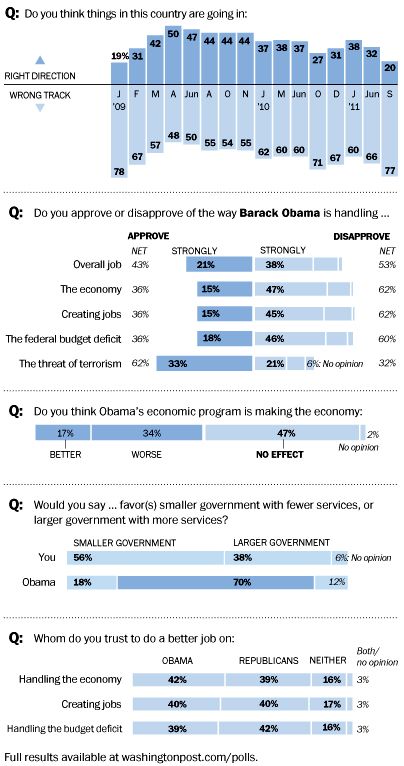
The debt-limit showdown and the stalled economy have tarnished President Barack Obama’s standing with voters and dampened their optimism about America’s future, with nearly three out of four voters now saying the country is headed in the wrong direction, according to a new POLITICO/George Washington University Battleground Poll.
snip
Capturing a rapid erosion of confidence through the summer months, the poll found 72 percent of voters believe the country is either strongly or somewhat headed in the wrong direction, a jump of 12 percentage points since May. Only 20 percent of voters say the country is going in the right direction, a 12-point drop in the same period.
Sep 08 2011
On This Day In History September 8
Cross posted from The Stars Hollow Gazette
Find the past “On This Day in History” here.
September 8 is the 251st day of the year (252nd in leap years) in the Gregorian calendar. There are 114 days remaining until the end of the year.
On this day in 1966, The TV series, “Star Trek“, debuted on NBC-TV, on its mission to “boldly go where no man has gone before” and despite ratings and only a three year run that gave us 79 episodes, the series did exactly that.

When Star Trek premiered on NBC-TV in 1966, it was not an immediate hit. Initially, its Nielsen ratings were rather low, and its advertising revenue was modest. Before the end of the first season of Star Trek, some executives at NBC wanted to cancel the series because of its rather low ratings. The chief of the Desilu Productions company, Lucille Ball, reportedly “single-handedly kept Star Trek from being dumped from the NBC-TV lineup.”
Toward the end of the second season, Star Trek was also in danger of cancellation. The lobbying by its fans gained it a third season, but NBC also moved its broadcast time to the Friday night “death slot”, at 10 p.m. Eastern Standard Time (9:00 p.m. Central Time). Star Trek was cancelled at the end of the third season, after 79 episodes were produced. However, this was enough for the show to be “stripped” in TV syndication, allowing it to become extremely popular and gather a large cult following during the 1970s. The success of the program was followed by five additional television series and eleven theatrical films. The Guinness World Records lists the original Star Trek as having the largest number of spin-offs among all TV series in history.
The series begat five televisions series and 11 movies with more to come. I knew I loved Lucille Ball for a reason.
Sep 08 2011
On This Day In History September 9
Cross posted from The Stars Hollow Gazette
Find the past “On This Day in History” here.
September 9 is the 252nd day of the year (253rd in leap years) in the Gregorian calendar. There are 113 days remaining until the end of the year.
On this day in 1776, Congress renames the nation “United States of America”.
On this day in 1776, the Continental Congress formally declares the name of the new nation to be the “United States” of America. This replaced the term “United Colonies,” which had been in general use.
In the Congressional declaration dated September 9, 1776, the delegates wrote, “That in all continental commissions, and other instruments, where, heretofore, the words ‘United Colonies’ have been used, the stile be altered for the future to the “United States.”
The Lee Resolution, also known as the resolution of independence, was an act of the Second Continental Congress declaring the United Colonies to be independent of the British Empire. First proposed on June 7, 1776, by Richard Henry Lee of Virginia, after receiving instructions from the Virginia Convention and its President, Edmund Pendleton (in fact Lee used, almost verbatim, the language from the instructions in his resolution). Voting on the resolution was delayed for several weeks while support for independence was consolidated. On June 11, a Committee of Five was appointed to prepare a document to explain the reasons for independence. The resolution was finally approved on July 2, 1776, and news of its adoption was published that evening in the Pennsylvania Evening Post and the next day in the Pennsylvania Gazette. The text of the document formally announcing this action, the United States Declaration of Independence, was approved on July 4.
Sep 07 2011
Today on The Stars Hollow Gazette
Our regular featured content-
- On This Day In History September 7 by TheMomCat
- Punting the Pundits by TheMomCat
- Evening Edition by ek hornbeck
These featured articles-
- Credibility Gap by ek hornbeck
- Obama Selling His Republican Agenda by TheMomCat
- The Same Old Water by ek hornbeck
This is an Open Thread