
Author's posts
Apr 09 2012
Today on The Stars Hollow Gazette

Our regular featured content-
- On This Day In History April 9 by TheMomCat
- Punting the Pundits by TheMomCat
These featured articles-
- Pique the Geek 20120408: More on Meat by Translator
- Squat and Spread Your Cheeks by joeshikspack
- Sunday Train: Did Governor Brown Save California’s HSR? by BruceMcF
- Legally Obligated to Prosecute by TheMomCat
This is an Open Thread
Apr 09 2012
George Carlin Classic: Religion is BS
Adapted from The Stars Hollow Gazette
Now for a little irreligious relevance as only George cold do it. I’m here for the chocolate and Peeps.
Between you and me, in any decent universe, this guy would have been out on his all powerful ass a long time ago. By the way, I say “guy” because I firmly believe. looking at these results, that if there is a god it has to be a man, no woman could, or would, ever fuck things up this bad. ~ George Carlin
Apr 09 2012
On This Day In History April 9
Cross posted from The Stars Hollow Gazette
This is your morning Open Thread. Pour your favorite beverage and review the past and comment on the future.
Find the past “On This Day in History” here.
April 9 is the 99th day of the year (100th in leap years) in the Gregorian calendar. There are 266 days remaining until the end of the year.
On this day in 1865, Confederate General Robert E. Lee surrendered his Army of Northern Virginia at the McLean House in the village of Appomattox Court House. In an untraditional gesture and as a sign of Grant’s respect and anticipation of peacefully restoring Confederate states to the Union, Lee was permitted to keep his sword and his horse, Traveller.

At Appomattox, Virginia, Confederate General Robert E. Lee surrenders his 28,000 troops to Union General Ulysses S. Grant, effectively ending the American Civil War. Forced to abandon the Confederate capital of Richmond, blocked from joining the surviving Confederate force in North Carolina, and harassed constantly by Union cavalry, Lee had no other option.
In retreating from the Union army’s Appomattox Campaign, the Army of Northern Virginia had stumbled through the Virginia countryside stripped of food and supplies. At one point, Union cavalry forces under General Philip Sheridan had actually outrun Lee’s army, blocking their retreat and taking 6,000 prisoners at Sayler’s Creek. Desertions were mounting daily, and by April 8 the Confederates were surrounded with no possibility of escape. On April 9, Lee sent a message to Grant announcing his willingness to surrender. The two generals met in the parlor of the Wilmer McLean home at one o’clock in the afternoon.
Lee and Grant, both holding the highest rank in their respective armies, had known each other slightly during the Mexican War and exchanged awkward personal inquiries. Characteristically, Grant arrived in his muddy field uniform while Lee had turned out in full dress attire, complete with sash and sword. Lee asked for the terms, and Grant hurriedly wrote them out. All officers and men were to be pardoned, and they would be sent home with their private property–most important, the horses, which could be used for a late spring planting. Officers would keep their side arms, and Lee’s starving men would be given Union rations.
Shushing a band that had begun to play in celebration, General Grant told his officers, “The war is over. The Rebels are our countrymen again.” Although scattered resistance continued for several weeks, for all practical purposes the Civil War had come to an end
Apr 08 2012
Today on The Stars Hollow Gazette
Our regular featured content-
- On This Day In History April 8 by TheMomCat
These featured articles-
- The Fabulous Non-Edible Egg by Fabergé by TheMomCat
- Open Thread: What We Now Know by TheMomCat
our weekly features-
- My Little Town 20120404: Personal Tribute and Family Secrets by Translator
- Six In The Morning: On Sunday by mishima
- Punting the Pundits: Sunday Preview Edition by TheMomCat
- Rant of the Week: George Carlin by TheMomCat
This is an Open Thread
Apr 08 2012
Health and Fitness News
 Welcome to the Health and Fitness News, a weekly diary which is cross-posted from The Stars Hollow Gazette. It is open for discussion about health related issues including diet, exercise, health and health care issues, as well as, tips on what you can do when there is a medical emergency. Also an opportunity to share and exchange your favorite healthy recipes.
Questions are encouraged and I will answer to the best of my ability. If I can’t, I will try to steer you in the right direction. Naturally, I cannot give individual medical advice for personal health issues. I can give you information about medical conditions and the current treatments available.
You can now find past Health and Fitness News diaries here and on the right hand side of the Front Page.

Throughout the Mediterranean, springtime is the season for spinach and other greens, artichokes and fava beans, and these vegetables make delicious appearances at Passover meals. There’s much in the way of healthy produce to choose from, and olive oil is the only fat you’ll find.
Endive, romaine and chicory are present on many Sephardic ritual platters, but here these pungent greens form the basis for a salad with a garlicky dressing.
Moroccan Fava Bean and Vegetable Soup
The springtime bounty of the Mediterranean – greens, artichokes, fava beans – plays a starring role in these tradition-rich dishes.
No schmaltz is needed for this comforting Greek-style soup – the matzos are crumbled right into the broth.
Turkish Spinach With Tomatoes and Rice
Not every tradition allows rice during Passover; in this fragrant dish there’s just enough of it to add substance to the vegetables.
Braised Greek Artichoke Bottoms With Lemon and Olive Oil
These brightly flavored artichokes, served cold or at room temperature, can be made a day ahead of time.
Apr 08 2012
The Fabulous Non-Edible Egg by Fabergé
Cross Posted from The Stars Hollow Gazette
 Decorating eggs has long been a tradition of Easter. They can be dyed or painted, glittered and stickered with symbols of the season. But the most fabulously decorated eggs of all are those of the House of Fabergé that were created for the Tsars of Russia in the late 1800’s. The very first egg was created for the Empress Maria Fedorovna in 1885 to commemorate the 20th anniversary of her marriage to Tsar Alexander III. Alexander gave the commission to create the special Easter Egg to Peter Carl Fabergé after Maria had admired his beautiful creations. The very first egg was presented to the Empress on Easter morning. It appeared on the outside to be a simple enameled egg, called “The Hen” but inside is a golden yolk; within the yolk is a golden hen; and concealed within the hen is a diamond miniature of the royal crown and a tiny ruby egg. The crown and the ruby egg have long been lost. The Empress was so delighted with the egg that the Tsar rewarded Fabergé with a commission for an Easter egg every year. The requirements are straightforward: each egg must be unique, and each must contain a suitable surprise for the Empress.
 Alexander died unexpectedly in 1894 and his eldest son became Tsar Nicholas II. Nicholas, feeling unprepared to assume the reign, decided his best course as ruler was to continue to do everything his father did, including the creation of the Fabergé Egg each Easter for his mother and a second order to be delivered to his new wife, Czarina Alexandra Fedorovna. One of the most elegant eggs was the Fifteenth Anniversary egg (1911), a family album just over five-inches-tall. Exquisitely detailed paintings depict the most notable events of the reign of Nicholas II and each of the family members. “Not only is it a staggering tour-de-force of the jeweler’s art,” says Forbes, “but probably more than any other egg, it is the one most intimately associated with the whole tragedy of Nicholas and Alexandra and that incredibly beautiful family. There are these five children – all these sort of glamorous events surrounding their lives – and there they are looking out at us happily unknowing what was going to happen to them just a few years later.”
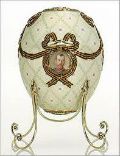 The Eggs were so opulent and each one so unique, that they created a demand from other aristocrats, kings and queens and captains if industry. A series of seven eggs was made for the industrialist Alexander Kelch and others were made for the Duchess of Marlborough, the Nobels and the Rothschilds.
After the 1917 Russian Revolution and the assassination of Nicholas and his family, the Tsars treasures including the Fabergé Eggs were moved to the Kremlin Armoury on the orders of Vladimir Lenin. Of the immediate family, only Nicholas’ mother, the Dowager Empress Maria Fedorovna, escapes the assassin’s bullet. As she makes a hasty departure from her homeland, she brings with her the Order of St. George egg, the last Fabergé Imperial Easter egg she would ever receive from her son Nicholas.
 In a bid to acquire more foreign currency, Joseph Stalin had many of the eggs sold in 1927. Many of the eggs were sold to Armand Hammer, president of Occidental Petroleum and a personal friend of Lenin, whose father was founder of the United States Communist party. After the collection in the Kremlin Armoury, the largest gathering of Fabergé eggs was assembled by Malcolm Forbes. Totalling nine eggs, and approximately 180 other Fabergé objects, the collection was put up for auction at Sotheby’s in February 2004 by Forbes’ heirs. Before the auction even began the collection was purchased in its entirety by the oligarch Victor Vekselberg for a sum estimated between $90 and $120 million. The Winter Egg, studded with 1,660 diamonds, and made from quartz, platinum, and orthoclase, garnered the highest bid for any single egg. It was sold by Christies in 2002 for $9.6 million to a private collector on Qatar.
(Click on images to enlarge)
Apr 08 2012
On This Day In History April 8
Cross posted from The Stars Hollow Gazette
This is your morning Open Thread. Pour your favorite beverage and review the past and comment on the future.
Find the past “On This Day in History” here.
April 8 is the 98th day of the year (99th in leap years) in the Gregorian calendar. There are 267 days remaining until the end of the year.
On this day in 1974, Hank Aaron of the Atlanta Braves hits his 715th career home run, breaking Babe Ruth’s legendary record of 714 homers. A crowd of 53,775 people, the largest in the history of Atlanta-Fulton County Stadium, was with Aaron that night to cheer when he hit a 4th inning pitch off the Los Angeles Dodgers’ Al Downing. However, as Aaron was an African American who had received death threats and racist hate mail during his pursuit of one of baseball’s most distinguished records, the achievement was bittersweet.
Although Aaron himself downplayed the “chase” to surpass Babe Ruth, baseball enthusiasts and the national media grew increasingly excited as he closed in on the home run record. During the summer of 1973 Aaron received thousands of letters every week; the Braves ended up hiring a secretary to help him sort through it.
At the age of 39, Aaron hit 40 home runs in 392 at-bats, ending the season one home run short of the record. He hit home run number 713 on September 29, 1973, and with one day remaining in the season, many expected him to tie the record. But in his final game that year, playing against the Houston Astros (led by manager Leo Durocher, who had once roomed with Babe Ruth), he was unable to achieve this. After the game, Aaron stated that his only fear was that he might not live to see the 1974 season.
Over the winter, Aaron was the recipient of death threats and a large assortment of hate mail from people who did not want to see a black man break Ruth’s nearly sacrosanct home run record. The threats extended to those providing positive press coverage of Aaron. Lewis Grizzard, then editor of the Atlanta Journal, reported receiving numerous phone calls calling them “nigger lovers” for covering Aaron’s chase. While preparing the massive coverage of the home run record, he quietly had an obituary written, scared that Aaron might be murdered.
Sports Illustrated pointedly summarized the racist vitriol that Aaron was forced to endure:
“Is this to be the year in which Aaron, at the age of thirty-nine, takes a moon walk above one of the most hallowed individual records in American sport…? Or will it be remembered as the season in which Aaron, the most dignified of athletes, was besieged with hate mail and trapped by the cobwebs and goblins that lurk in baseball’s attic?”
Aaron received an outpouring of public support in response to the bigotry. Newspaper cartoonist Charles Schulz satirized the anti-Aaron camp in a series of Peanuts strips printed in August 1973, in which Snoopy attempts to break the Ruth record, only to be besieged with hate mail. (As Lucy puts it in the August 11 strip, “Hank Aaron is a great player…but you! If you break Babe Ruth’s record, it’ll be a disgrace!”) Babe Ruth’s widow, Claire Hodgson, even denounced the racism and declared that her husband would have enthusiastically cheered Aaron’s attempt at the record. Ruth, who was unprejudiced, had himself been subjected to racial taunts during his youth, by those who fancied that he had Negroid features.
As the 1974 season began, Aaron’s pursuit of the record caused a small controversy. The Braves opened the season on the road in Cincinnati with a three-game series against the Cincinnati Reds. Braves management wanted him to break the record in Atlanta, and were therefore going to have Aaron sit out the first three games of the season. But Baseball Commissioner Bowie Kuhn ruled that he had to play two games in the first series. He played two out of three, tying Babe Ruth’s record in his very first at bat off Reds pitcher Jack Billingham, but did not hit another home run in the series.
The team returned to Atlanta, and on April 8, 1974, a crowd of 53,775 people showed up for the game-a Braves attendance record. In the fourth inning, Aaron hit career home run number 715 off Los Angeles Dodgers pitcher Al Downing. Although Dodgers outfielder Bill Buckner nearly went over the outfield wall trying to catch it, the ball landed in the Braves’ bullpen, where relief pitcher Tom House caught it. While cannons were fired in celebration, two white college students, Cliff Courtney and Britt Gaston, sprinted onto the field and jogged alongside Aaron for part of his circuit around the bases, temporarily startling him. As the fans cheered wildly, Aaron’s parents ran onto the field as well.
Dodgers broadcaster Vin Scully addressed the racial tension – or apparent lack thereof – in his call of the home run:
“What a marvelous moment for baseball; what a marvelous moment for Atlanta and the state of Georgia; what a marvelous moment for the country and the world. A black man is getting a standing ovation in the Deep South for breaking a record of an all-time baseball idol. And it is a great moment for all of us, and particularly for Henry Aaron. … And for the first time in a long time, that poker face in Aaron shows the tremendous strain and relief of what it must have been like to live with for the past several months.”
A few months later, on October 5, 1974, Aaron hit his 733rd and final home run as a Brave, which stood as the National League’s home run record until it was broken in 2007. Thirty days later, the Braves traded Aaron to the Milwaukee Brewers for Roger Alexander and Dave May. On May 1, 1975, Aaron broke baseball’s all-time RBI record, previously held by Ruth with 2,217. That year, he also made the last of his 21 record-tying (with Musial and Mays) All-Star appearances; he lined out to Dave Concepcion as a pinch-hitter in the second inning. This All-Star game, like his first in 1955, was before a home crowd at Milwaukee County Stadium.
On July 20, 1976, Hank Aaron hit his 755th and final home run at Milwaukee County Stadium off Dick Drago of the California Angels.
Apr 08 2012
Today on The Stars Hollow Gazette
Regular Features-
- On This Day In History April 7 by TheMomCat
- Punting the Pundits by TheMomCat
These Weekly Features-
- Popular Culture (Music) 20120406: Love Songs by Translator
- Health and Fitness News by: TheMomCat
- Random Japan by mishima
These Featured Articles-
- Atheists Don’t Have No Songs by ek hornbeck
- How To Make Friends And Influence People by ek hornbeck
This is an Open Thread
Apr 08 2012
Open Thread: What We Now Know
Cross Posted from The Stars Hollow Gazette
MSNBC’s Chris Hayes and his guests on Saturday morning’s Up with Chris discuss what they now know about the events of the past week. At the table are Van Jones (@vanjones68), author of Rebuild the Dream and former green-jobs advisor for the Obama administration; Joan Walsh (@joanwalsh), MSNBC Political Analyst and Salon Editor-at-Large; Ann Friedman (@annfriedman), executive editor of GOOD magazine; Josh Barro (@jbarro), Forbes.com and National Review Online contributor; Mark Bittman (@bittman), food writer for the New York Times and author of Food Matters and How to Cook Everything; and Patrick Shea, attorney for climate change activist Tim DeChristopher and former director of the Bureau of Land Management.
This morning we covered President Obama’s media criticism and Mitt Romney’s reaction to his statements. Plus, we discussed civil disobedience with climate change activist Tim DeChristopher’s attorney Patrick Shea, Chris’s Story of the Week, and the Occupy movement’s 99% Spring Training. And we took a closer look at food politics and the controversy over lean finely textured beef, aka “pink slime”, with New York Times food writer Mark Bittman.
What do you now know?
Apr 07 2012
On This Day In History April 7
Cross posted from The Stars Hollow Gazette
This is your morning Open Thread. Pour your favorite beverage and review the past and comment on the future.
Find the past “On This Day in History” here.
April 7 is the 97th day of the year (98th in leap years) in the Gregorian calendar. There are 268 days remaining until the end of the year.
On this day in 1948, The World Health Organization is founded. WHO is a specialized agency of the United Nations (UN) that acts as a coordinating authority on international public health. Established on April 7, 1948, with headquarters in Geneva, Switzerland, the agency inherited the mandate and resources of its predecessor, the Health Organization, which was an agency of the League of Nations.
The World Health Organization (WHO) is one of the original agencies of the United Nations, its constitution formally coming into force on the first World Health Day, (April 7, 1948), when it was ratified by the 26th member state. Jawaharlal Nehru, a major freedom fighter of India had given an opinion to start WHO. Prior to this its operations, as well as the remaining activities of the League of Nations Health Organization, were under the control of an Interim Commission following an International Health Conference in the summer of 1946. The transfer was authorized by a Resolution of the General Assembly. The epidemiological service of the French Office International d’Hygiène Publique was incorporated into the Interim Commission of the World Health Organization on January 1, 1947.
Apart from coordinating international efforts to control outbreaks of infectious disease, such as SARS, malaria, tuberculosis, influenza, and HIV/AIDS, the WHO also sponsors programmes to prevent and treat such diseases. The WHO supports the development and distribution of safe and effective vaccines, pharmaceutical diagnostics, and drugs. After over two decades of fighting smallpox, the WHO declared in 1980, that the disease had been eradicated – the first disease in history to be eliminated by human effort. The WHO aims to eradicate polio within the next few years.
The organization develops and promotes the use of evidence-based tools, norms and standards to support Member States to inform health policy options. It regularly publishes a World Health Report including an expert assessment of a specific global health topic. The organization has published tools for monitoring the capacity of national health systems and health workforces to meet population health needs, and endorsed the world’s first official HIV/AIDS Toolkit for Zimbabwe (from 3 October 2006), making it an international standard.
In addition, the WHO carries out various health-related campaigns – for example, to boost the consumption of fruits and vegetables worldwide and to discourage tobacco use. The organization relies on the expertise and experience of many world-renowned scientists and professionals to inform its work. Experts met at the WHO headquarters in Geneva in February, 2007, and reported that their work on pandemic influenza vaccine development had achieved encouraging progress. More than 40 clinical trials have been completed or are ongoing. Most have focused on healthy adults. Some companies, after completing safety analysis in adults, have initiated clinical trials in the elderly and in children. All vacciness so far appear to be safe and well-tolerated in all age groups tested.
The WHO also promotes the development of capacities in Member States to use and produce research that addresses national needs, by bolstering national health research systems and promoting knowledge translation platforms such as the Evidence Informed Policy Network (EVIPNet). WHO and its regional offices are working to develop regional policies on research for health – the first one being the Pan American Health Organization/Regional Office for the Americas (PAHO/AMRO) that had its Policy on Research for Health approved in September 2009 by its 49th Directing Council Document CD 49.10.
WHO also conducts health research in communicable diseases, non-communicable conditions and injuries; for example, longitudinal studies on ageing to determine if the additional years we live are in good or poor health, and, whether the electromagnetic field surrounding cell phones has an impact on health. Some of this work can be controversial, as illustrated by the April, 2003, joint WHO/FAO report, which recommended that sugar should form no more than 10% of a healthy diet. This report led to lobbying by the sugar industry against the recommendation, to which the WHO/FAO responded by including in the report the statement “The Consultation recognized that a population goal for free sugars of less than 10% of total energy is controversial”, but also stood by its recommendation based upon its own analysis of scientific studies.
The World Health Organization’s suite of health studies is working to provide the needed health and well-being evidence through a variety of data collection platforms, including the World Health Survey covering 308,000 respondents aged 18+ years and 81,000 aged 50+ years from 70 countries and the Study on Global Aging and Adult Health (SAGE) covering over 50,000 persons aged 50+ across almost 23 countries. The World Mental Health Surveys, WHO Quality of Life Instrument, WHO Disability Assessment Scales provide guidance for data collection in other health and health-related areas. Collaborative efforts between WHO and other agencies, such as the Health Metrics Network and the International Household Surveys Network, serve the normative functions of setting high research standards.
WHO has also worked on global initiatives in surgery such as the Global Initiative for Emergency and Essential Surgical Care and the Guidelines for Essential Trauma Care focussed on access and quality. Safe Surgery Saves Lives addresses the safety of surgical care. The WHO Surgical Safety Checklist is in current use worldwide in the effort to improve safety in surgical patients.
Apr 06 2012
Today on The Stars Hollow Gazette
Our regular featured content-
- On This Day In History April 6 by TheMomCat
- Punting the Pundits by TheMomCat
These featured articles-
- The Haunting Housing Crisis by TheMomCat
- What’s Cooking: French Onion Soup by TheMomCat
- Super Fun PACk Sold Out! by ek hornbeck
This is an Open Thread
Apr 06 2012
What’s Cooking: French Onion Soup
Cross posted from The Stars Hollow Gazette
 So now that you’ve finished dying eggs naturally using onion skins, what do you do with all those onions? Make French Onion Soup, bien sûr!
French onion soup in France is served as the traditional French farmer’s breakfast or the end of the day repast for the late night café and theater crowd. It was made famous in the great open market of Les Halles in Paris where hungry truckers converged from all over France with their fresh produce. On my first visit to Paris in 1966, I made a late night visit to Les Halles with some friends to savor the tradition and practice my very rusty college French. The truckers and waiters in the little café we “invaded” were quite friendly and chuckled as they good heartedly corrected my pronunciation. Needless to say, je parle français bien mieux maintenant. Les Halles was torn down in 1971 and replaced with a modern shopping area, the Forum des Halles. But I digress, we are here for the food.
My favorite recipe is from Bernard Clayton, Jr.’s The Complete Book of Soups and Stews with some variations. It is from a restaurant near the Halles Metro station. M. Calyton’s version uses a hearty homemade beef stock which is time consuming to make. I found that either Swanson’s or College Inn Beef Broth produces a good result, just reduce the salt. The low sodium broth didn’t produce the hearty broth that’s needed to compliment the flavor of the caramelized onions and the cheese.
You will need some “special” equipment for this soup: individual oven-proof bowls, enough to hold 1 1/2 to 2 cups. I have the bowls with a handle and a lid that serve double duty for baked beans, and other soups and stews. You will also need cheesecloth for le sachet d’épices, that’s a spice bag for you Americans ;-), and butcher’s twine or some other cotton twine. Those items can be found in the gadget aisles of most large grocery stores.
Soupe à l’oignon des Halles