June 2012 archive

NN12: Schneiderman Keynote A Snoozer

Cross posted from The Stars Hollow Gazette

The much anticipated keynote address on the opening night at Netroots Nation 12 in Providence, RI was, I dare say, over two hours of my life I will never get back. While I understand the need for levity, thus the comedic interludes by emcee Baratunde Thurston, the number of speakers was just too many and they were unfortunately long winded, even for politicians. I wasn’t alone in that assessment. After nearly two hours Schneiderman had not reach the stage, so I decided to “stretch my legs” before I embarrassed my self by dozing off and falling out of my seat, although, it might have more entertaining for some than Mr. Thurston. I wasn’t alone. In the lobby outside the ballroom, I ran into an Obama supporter who found that she and I had something in common, this was booooooooring. I missed the New York Attorney General’s address and opted for the hotel restaurant for some food and libation. So here is the entire opening keynote with Schneiderman coming in at the last fifteen minutes.

Here is more agreement about the anesthesia effects of the evening from FDL blogger masachio

Schneiderman chose the pander speech. He started by explaining that real change comes from the grassroots, leaders emerge from struggles over real problems. That’s us, the Netroots! We are the leaders of the future!

He continues: We are in a transitional era now, just like the early 30s. We democrats stand for the rule of law applicable to everyone equally just like President Obama. Someone from the audience suggests loudly that locking up banksters would be a good start, and Schneiderman says he’ll get to that. Which he does a few minutes later saying that he can’t comment on the investigation he is doing. Everyone is really nice about this bit of foolery, and it was at this point I realized I would prefer to be drinking. I mutter at my tablemates that banksters and pot smokers do not face the same application of the rule of law, but no one hears me because they are stunned into dopiness.

The somnolence continues. [..]

After the speech, Schneiderman told a Talking Points Memo reporter that “nothing was off the table.” So if that’s true, when do the prosecutions start? Oh, wait, the “special unit” still has no office or telephone number after six months.

SCOTUS Blesses Indefinite Detention

Cross posted from The Stars Hollow Gazette

Another right further diminished by the Supreme Court.

Supreme Court Denies 7 Detainee Cases, Leaving Crippling Limits On Detainee Rights In Place

One day before the fourth anniversary of Boumediene v. Bush, which held that detainees being held indefinitely at Guantanamo Bay have the right to challenge their confinement in federal court, the Supreme Court denied review (pdf) of seven detainee cases that were pending before the court. The decision not to review any of the cases essentially makes the U.S. Court of Appeals for the D.C. Circuit the last stop for detainees seeking habeas corpus. While many detainees won their habeas corpus cases at the trial court level, no detainees have been released from Guantanamo due to these decisions because the DC Circuit has a perfect record of reversing these decisions.

Although today’s action does not have any precedential force, it undercuts the extent to which detainees can seriously challenge their detention by leaving the D.C. Circuit’s pro-detention decisions in place [..]

Marcy Wheeler @ emptywheel explains what the Supreme Court has just blessed:


  • Holding a person indefinitely for being in the wrong place at the wrong time-including a school, a road, and a guest house-where suspect people are.
  •    

  • Holding a person indefinitely based on an admittedly error-ridden report the government wrote up itself.
  •    

  • Holding a person indefinitely based on pattern analysis.
  •    

  • Completely upending the role of District Court judges in the fact-finding process.
  • The Justices have abdicated their responsibility  to an ever more powerful Executive branch:

    Especially deserving of review was a petition by Adnan Latif, a Yemeni who was captured near the border between Afghanistan and Pakistan in December 2001. Latif said he had traveled to Pakistan to seek medical treatment; the U.S. government insisted that he was a fleeing Taliban fighter.

    A federal district judge ruled in Latif’s favor, concluding that, because of possible transcription and other errors, a government report of an interview with him was “not sufficiently reliable to support a finding by a preponderance of the evidence that Latif was recruited by an Al Qaeda member or trained and fought with the Taliban.” Overturning that finding, the D.C. Circuit ruled that the government’s evidence was entitled to “a presumption of regularity” and that lower court judges should require that a detainee’s “self-serving account must be credible – not just plausible.” In her opinion, Circuit Judge Janice Rogers Brown (a former California Supreme Court justice) approvingly cited dissents in the Boumediene case and referred snidely to its impracticality and “airy suppositions.” [..]

    Dissenting in the Latif case, Judge David Tatel described the decision as an “assault on Boumediene.” At the very least, the ruling called for a full-fledged review by the Supreme Court. Instead, the justices have abdicated their authority and devalued their own achievement.

    Today on The Stars Hollow Gazette

    Our regular featured content-

    These featured articles-

    Follow us on Twitter @StarsHollowGzt

    This is an Open Thread

    The Stars Hollow Gazette

    The Bank Jog

    It’s where the money is.

    Europe Fears Bailout of Spain Would Strain Its Resources

    By LANDON THOMAS Jr., The New York Times

    Published: May 30, 2012

    At the root of Spain’s financing crisis has been a drastic outflow of foreign capital from the country – one that, paradoxically, has been accentuated by the European Central Bank’s much-vaunted program of providing low-cost three-year loans to European banks so that they might buy their governments’ bonds.


    But in the case of Spain, the program evidently bought time by making the country’s underlying problems all the worse. Spanish banks have by far been the most aggressive participants in the cheap-loan program, having borrowed more than €300 billion from the E.C.B. And much of that money was spent on Spanish government bonds.


    It’s not just Spain, either.

    Italian banks have also been enthusiastic buyers of their government’s bonds, and they own 57 percent of bonds outstanding. As in the case of Spain, foreigners have been obliging sellers and have sold €242 billion worth of bonds to local banks, bringing their share in Italian bond holdings down to 35 percent as of this March compared with 51 percent late last year.

    It is worth noting that just before the restructuring of private-sector Greek debt in March, foreign investors owned 32 percent of the bonds outstanding, a higher proportion than what foreigners now own in Spain.

    The fact is this notional overestimation of wealth is going to have to come of the pockets of the rich because that’s where the money is.  If you seized everything from the bottom 50% it simply wouldn’t be enough.

    Trevor Potter via Alternet

    Not that it’s a reliable source.

    How I Became Stephen Colbert’s Lawyer — And Joined the Fight to Rescue Our Democracy from Citizens United

    Trevor Potter, Alternet

    May 25, 2012

    The Colbert Report coverage is so successful because it accurately describes a campaign finance world that seems too surreal to be true.  A system that claims to require disclosure of money spent to elect or defeat candidates, but in fact provides so many ways around that requirement as to make disclosure optional; a system that says that “independent expenditures” cannot be limited as a matter of Constitutional law because they cannot corrupt because they are “totally independent” of candidates and parties-when the daily news reports about these supposedly “independent” groups show that candidates raise money for them, candidates’ former employees run them, and candidates’ polling and advertising vendors advise them.  And the major donors to these “independent” groups are often also official fundraisers for the candidate.  Other major donors have private meetings with the candidates, or travel with them on campaign trips!


    How did we get here? It is often forgotten, but for long periods of the previous Century, we had a pretty well functioning campaign finance system.  In 1904 President Roosevelt called for public funding of the political parties, and a ban on corporate contributions.  In 1907 he got one of those with the passage of the Tillman Act, which banned corporate contributions in federal elections, Congress extended contribution and expenditure restrictions to unions in 1947, and rewrote the laws following Watergate to ensure disclosure, set new individual contribution limits to candidates and parties, and create for the first time a public funding system for presidential elections and establish the FEC as an enforcement and disclosure agency.


    In the last two years, the Supreme Court has allowed unlimited corporate and labor spending in all elections in the U.S., overturning 60 year old federal laws and some older laws in 26 states.  It has declared unconstitutional as a restriction on speech the Arizona public financing system, because it provided additional public funds for more speech to candidates participating in the public funding system, triggered if their opponents spent that amount. The DC Circuit has declared unconstitutional the longstanding $5,000 contribution limit to independent-expenditure only political action committees, which decision has resulted in the creation of what we know as SuperPACs-like Stephen Colbert’s Americans for a Better Tomorrow, Tomorrow.

    Cartnoon

    On Topic – Technology – Video Games 3:27

    If science gives you a result that you don’t like…

    pass a Law sying that the result is illegal.  Problem solved.

    On This Day In History June 12

    Cross posted from The Stars Hollow Gazette

    This is your morning Open Thread. Pour your favorite beverage and review the past and comment on the future.

    Find the past “On This Day in History” here.

    Click on image to enlarge

    June 12 is the 163rd day of the year (164th in leap years) in the Gregorian calendar. There are 202 days remaining until the end of the year.

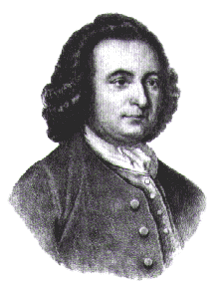
    On this day in 1776, Virginia adopts George Mason’s Declaration of Rights

    The assembled slaveholders of Virginia promised to “the good people of VIRGINIA and their posterity” the equal right to life, liberty and property, with the critical condition that the “people” were white men. These same white men were guaranteed that “all power” would be “vested in, and consequently derived from” them. Should a government fail to represent their common interest, a majority of the same held the right to “reform, alter or abolish” the government.

    Drafting and adoption

    The Declaration was adopted unanimously by the Fifth Virginia Convention at Williamsburg, Virginia on June 12, 1776 as a separate document from the Constitution of Virginia which was later adopted on June 29, 1776. In 1830, the Declaration of Rights was incorporated within the Virginia State Constitution as Article I, but even before that Virginia’s Declaration of Rights stated that it was ‘”the basis and foundation of government” in Virginia.  A slightly updated version may still be seen in Virginia’s Constitution, making it legally in effect to this day.

    It was initially drafted by George Mason circa May 20, 1776; James Madison assisted him with the section on religious freedom. It was later amended by Thomas Ludwell Lee and the Convention to add a section on the right to uniform government (Section 14). Patrick Henry persuaded the Convention to delete a section that would have prohibited bills of attander, arguing that ordinary laws could be ineffective against some terrifying offenders.

    Mason based his initial draft on the rights of citizens described in earlier works such as the English Bill of Rights (1689), and the Declaration can be considered the first modern Constitutional protection of individual rights for citizens of North America. It rejected the notion of privileged political classes or hereditary offices such as the members of Parliament and House of Lords described in the English Bill of Rights.

    The Declaration consists of sixteen articles on the subject of which rights “pertain to [the people of Virginia]…as the basis and foundation of Government.” In addition to affirming the inherent nature of natural rights to life, liberty, and property, the Declaration both describes a view of Government as the servant of the people, and enumerates various restrictions on governmental power. Thus, the document is unusual in that it not only prescribes legal rights, but it also describes moral principles upon which a government should be run.

    Influence

    The Virginia Declaration of Rights heavily influenced later documents. Thomas Jefferson is thought to have drawn on it when he drafted the United States Declaration of Independence one month later (July 1776). James Madison was also influenced by the Declaration while drafting the Bill of Rights (completed September 1787, approved 1789), as was the Marquis de Lafayette in voting the French Revolution’s Declaration of the Rights of Man and of the Citizen (1789).

    The importance of the Virginia Declaration of Rights is that it was the first constitutional protection of individual rights, rather than protecting just members of Parliament or consisting of simple laws that can be changed as easily as passed.

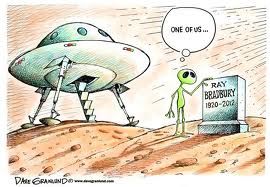
    In Memoriam: Ray Bradbury

    “I don’t try to predict the future, I try to prevent it.”

    ~Ray Bradbury~

    Ray Douglas Bradbury, August 22, 1920 – June 5, 2012

    Bradbury died in Los Angeles, California, on June 5, 2012, at the age of 91, after a “lengthy illness”, coincidentally during a rare transit of Venus

    My earliest memory of Ray Bradbury was my father reading to me from The Martian Chronicles. I was three. Later he would read aloud from Fahrenheit 451 and his short stories while I looked on at the words on the page. I read from those same books that were left to me by “Pop” to my daughter and gave her my first edition copy of “Something Wicked This Way Comes” which “Pop”  gave me for my 15th birthday.

    Ray Bradbury, Who Brought Mars to Earth With a Lyrical Mastery, Dies at 91

    By many estimations Mr. Bradbury was the writer most responsible for bringing modern science fiction into the literary mainstream. His name would appear near the top of any list of major science fiction writers of the 20th century, beside those of Isaac Asimov, Arthur C. Clarke, Robert A. Heinlein and the Polish author Stanislaw Lem. His books are still being taught in schools, where many a reader has been introduced to them half a century after they first appeared. Many readers have said Mr. Bradbury’s stories fired their own imaginations.

    More than eight million copies of his books have been sold in 36 languages. They include the short-story collections “The Martian Chronicles,” “The Illustrated Man” and “The Golden Apples of the Sun,” and the novels “Fahrenheit 451” and “Something Wicked This Way Comes.”

    Though none of his works won a Pulitzer Prize, Mr. Bradbury received a Pulitzer citation in 2007 “for his distinguished, prolific and deeply influential career as an unmatched author of science fiction and fantasy.”

    Scarecrow gave this tribute to Bradbury’s memory by reminding us of what could happen in a totalitarian society like the one in Fahrenheit 451:

    In Fahrenheit 451, Bradbury describes the horrors of a totalitarian society so repressive and fearful of ideas that it banned books and burned them.  But clever humans figured out they could preserve the literature if each person committed to memorizing a book, reciting and teaching it to others, and passing it on to the next generations.

    So I thought we might honor Bradbury’s life and work by passing on a few ideas that are worth preserving as we ponder the meaning of Wisconsin and mourn America’s descent into union bashing and income inequality, enforced by secrecy, propaganda and protected financial looting. [..]

    First, as this analysis from the Economic Policy Institute illustrates – and see the video at top – income equality tends to be much higher in America when there are strong unions, while inequality explodes when unions are weak.  It seems like an obvious connection – if lower classes have clout, they can demand more of the benefits of their labor – but it’s not emphasized enough in all the media’s right wing excitement about destroying the power of unions. [..]

    Second, as James Kwak has written, the Republican policy of lower taxes does not apply across the board; it applies to the top, mostly.  But they don’t seem to care if taxes are directly or indirectly raised on the poor.  In the Atlantic, Kwak writes about the “GOP’s bizarre, disturbing passion for raising taxes on the poor.” [..]

    [One] way to look at Wisconsin is to see it as part of a long term, calculated strategy of weakening unions and destroying their bargaining power.  With that power gone, there is nothing to prevent the top percentages from grabbing almost all the gains from labor productivity increases, thus increasing income and wealth inequality.  The winners then use the political power from that to perpetuate the inequality in their favor.  From there, it is a simple enough leap to use the protected positions of wealth to loot the rest of society and use the power of the state to protect the looting and cover for the looters.

    It’s a great strategy if you’re one of the looters, but it’s profoundly criminal.    Remember that.

    Ray Bradbury will live forever with his words, hopefully, the future generations will listen, so far we aren’t

    May the Goddess guide him on his journey to the Summerlands. May his family, friends and all those who ahve read and will read his works, find Peace.

    Blessed Be. The Wheel Turns.

    Muse in the Morning

    Photo Sharing and Video Hosting at Photobucket
    Muse in the Morning


    Zinda, his face black, his eyes red

    Late Night Karaoke

    Today on The Stars Hollow Gazette

    Our regular featured content-

    These featured articles-

    Follow us on Twitter @StarsHollowGzt

    This is an Open Thread

    The Stars Hollow Gazette

    Load more